
Zirconia Dental Crowns
Durable and natural-looking restoration for both front and back teeth. Long-lasting aesthetic solution for teeth that have undergone root canal treatment, are worn down, broken, or need crowns on dental implants.
Medically reviewed. Last updated: May 18, 2026.What Is a Zirconia Dental Crown?
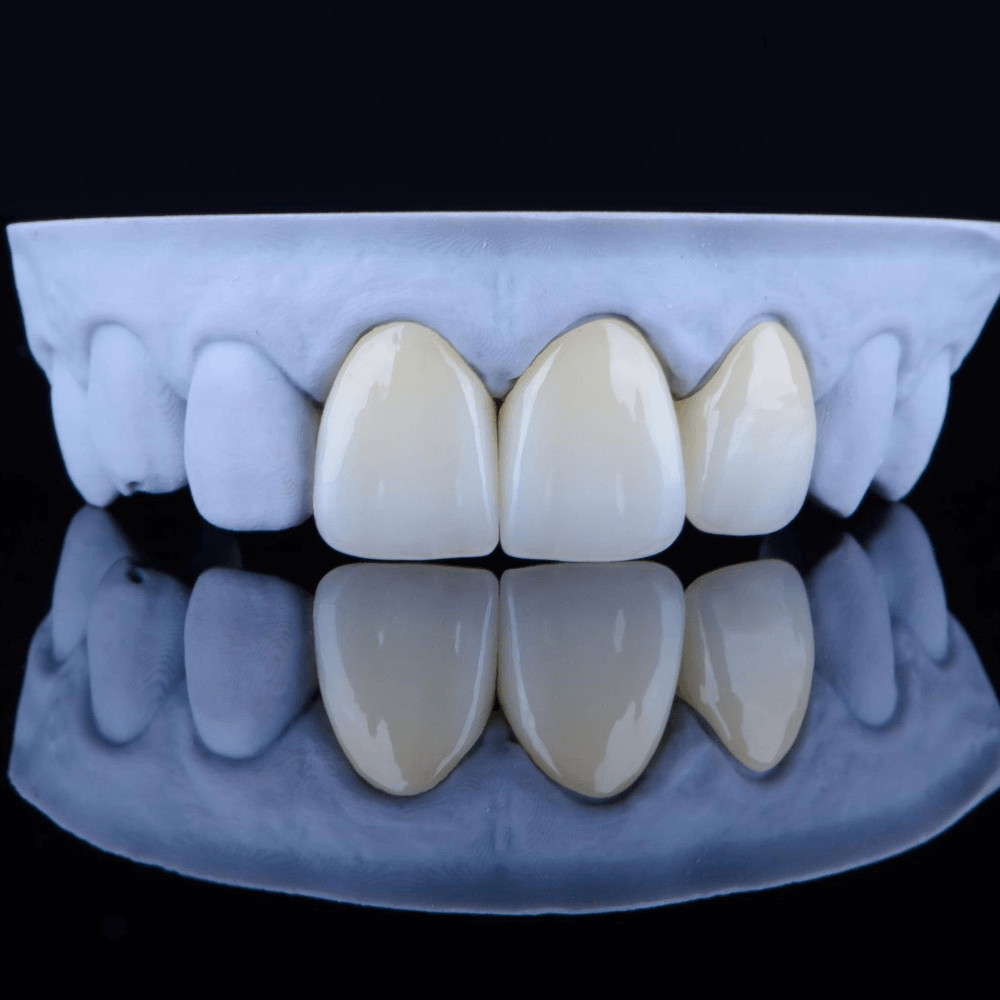
A zirconia dental crown is a white, metal-free restoration that fully covers a tooth. It has a base made of zirconia oxide, topped with aesthetic porcelain. This combination gives you both a natural tooth appearance and high durability. Unlike traditional metal-backed crowns, zirconia does not create a gray shadow at the gum line and transmits light like a natural tooth.
Zirconia crowns are chosen for both aesthetic and functional reasons. They are used to correct the appearance of discolored, misshapen, or undersized teeth. They provide long-lasting restoration for teeth with large fillings, root canal treatment, or fractures. They are also a popular choice for implant crowns. In cases of multiple missing teeth, zirconia can be used as the framework material for dental bridges.
During the initial exam, your dentist evaluates the tooth condition, surrounding tissues, and bite. If the tooth is vital and does not need a root canal, the crown process begins directly. Otherwise, root canal treatment is completed first. At the first appointment, the tooth is reduced to make room for the crown. This is done under local anesthesia. An impression is taken and a temporary crown is placed. The impression is sent to the lab, where the crown's color and shape are customized to your preferences. The final crown is ready in about a week for a fitting. Once the fit is confirmed, it is bonded to your tooth with a special adhesive.
With proper care, a zirconia crown can last 10 to 15 years or more. However, the tooth underneath can still develop decay, so regular brushing, flossing, and professional cleanings are essential. If decay under a crown is caught early, the crown may be saved. If you grind your teeth, your dentist may recommend a night guard to protect your crown. For front teeth, laminate veneers may require less tooth reduction. For pricing details, visit our zirconia crown cost calculator.
Types of Zirconia Crowns
Zirconia is a category of material used in dentistry that includes different subtypes with varying production techniques and aesthetic-durability balances. Each type has its own advantages and suitable case types. The zirconia crowns used at Doredent are manufactured to high quality standards by our trusted dental laboratory partner.- It is the most durable type of zirconia, strong against chewing forces.
- Its one-piece structure eliminates problems like layer separation.
- Modern generation monolithic zirconia offers translucency close to natural teeth.
- Provides strong chewing performance in back teeth.
- Offers the most natural tooth-like aesthetic result.
- Has high translucency and color depth.
- Can be preferred for anterior aesthetic cases.
- Requires careful use as the outer porcelain layer may chip over time.
Which Type of Zirconia Is Right for You?
Zirconia type selection is not based solely on aesthetic preference. The tooth's position in the mouth, chewing force, your habits, and aesthetic expectations are all evaluated together. Modern monolithic zirconia has made significant progress in translucency in recent years and has become widely used in both anterior and posterior regions. For this reason, monolithic zirconia is preferred in the vast majority of cases at Doredent. Layered zirconia may be considered only for anterior cases where aesthetic expectations are very high. Which type is suitable for you is determined during your initial examination by evaluating your tooth structure, bite relationship, and aesthetic expectations.Zirconia Bridges and Implant-Supported Crowns
In addition to single-tooth crowns, zirconia is one of the most preferred materials in multi-unit bridge prostheses and implant-supported restorations. In full-arch implant treatments such as All-on-4 and All-on-6, zirconia-based prostheses are considered the gold standard in terms of both durability and aesthetics. In these applications, monolithic zirconia is also the primary material preferred at Doredent.Treatment Process
Alternative Treatments
Zirconia crowns offer an effective solution for many cases where teeth need structural reinforcement. However, zirconia is not always the right approach for every dental problem. When patients request zirconia crowns for aesthetic reasons, a critical question is whether the tooth truly needs this intervention. Below you will find real alternatives to zirconia crowns and which approach is more suitable for each situation.Orthodontic Treatment (An Important Warning)
Composite Fillings and Bonding
If the tooth has minimal material loss or only shows a slight shape irregularity or color issue, a much less invasive solution than zirconia crowns may be sufficient: composite work. Composite fillings are used for damage in back teeth, while front-tooth bonding is used for minor aesthetic corrections on front teeth. Both use composite resin material, remove minimal tooth structure, and are completed in a single session. Advantages:- Requires minimal intervention to tooth structure.
- Completed in a single session.
- Most cost-effective option.
- If needed later, transition to permanent solutions like zirconia or veneers is possible.
- Composite material is not harder than tooth enamel. It can break when biting hard foods.
- Longevity depends heavily on your usage habits.
- May discolor over time, especially in tea-coffee-tobacco users.
- Not sufficient for large material losses or teeth with high fracture risk.
Laminate Veneers
Laminate veneers are very thin porcelain layers bonded only to the front surface of teeth. Compared to zirconia crowns, much less tooth material is removed; in some cases they can be applied without any grinding. They are especially preferred for front-tooth cases with high aesthetic expectations. Advantages:- Requires minimal tooth preparation, preserving most tooth structure.
- One of the most aesthetic crown types available.
- Provides an appearance very close to natural tooth translucency.
- Applied only to front teeth, not used on back teeth.
- Not sufficient for cases where teeth need structural reinforcement.
- If tooth color is very dark, may not fully mask it; zirconia is more suitable in this case.
- Higher risk of fracture in patients with bruxism (nighttime teeth grinding).
Porcelain (Metal-Backed) Crowns
Porcelain crowns are produced using the traditional method of applying porcelain over a metal substructure. Used for decades, this crown type is durable and cost-effective. However, due to the metal substructure, light translucency is lower than zirconia. This can cause teeth to appear more opaque than natural teeth, especially in front-tooth cases. Porcelain crowns are still a viable option for back-tooth cases where aesthetic expectations are not very high. However, for front teeth where natural appearance is the priority, zirconia crowns have gradually become the standard.Inlays and Onlays
If tooth material loss is moderate, meaning larger than what requires a filling but not extensive enough to need a crown, an inlay or onlay application may be considered. In this solution, the tooth is measured, a custom restoration is fabricated in the laboratory from porcelain or composite blocks, and bonded to the tooth. Unlike zirconia crowns, which cover the entire tooth, inlays and onlays restore only the damaged portion. This preserves healthy tooth structure. Inlays and onlays are especially preferred for back teeth in cases with chewing stress where crowns are not necessary.Which Treatment Is Right for You?
The right treatment choice is made based on the current condition of your teeth, the amount of material loss, your bite relationship, and aesthetic expectations. Different patients may receive different treatment plans for the same dental problem. At Doredent, your dental condition is evaluated in detail during the initial examination, and the most suitable approach for you is determined together. It is important to emphasize here: At Doredent, the least invasive, most conservative treatment option is offered as the priority. We do not recommend crowns for teeth that can be solved with fillings, or zirconia for problems that can be corrected with orthodontic treatment. The fundamental reason for this approach is to preserve the long-term health of your teeth.Risks and Complications
Zirconia crowns are among the most durable and biocompatible restoration materials used in dentistry. With proper indications, appropriate preparation, and quality laboratory work, the vast majority remain trouble-free for many years. However, like any restorative treatment, zirconia crowns have limitations and potential complications you should know about. Most of these complications are directly related to usage habits.Usage Habits: Most Risks Are Under Your Control
- Biting hard foods: Cracking seeds, chewing ice, breaking hard-shell nuts, biting bones are the most common causes of crown fracture.
- Nighttime teeth grinding (bruxism): Bruxism without a night guard threatens both your crown and opposing teeth.
- Inadequate oral hygiene: Risk of decay and gum inflammation at crown margins.
- Irregular check-ups: Small problems that could be caught early grow when neglected.
- Pen chewing, nail biting: Can directly damage front crowns.
Who Is It Suitable For?
Zirconia crowns are a treatment option used in many clinical situations where teeth require structural reinforcement and protection. However, suitability is determined not only by the patient's expectations, but by evaluating the current condition of the tooth, the bite relationship, and the overall oral health status together. The following patient profiles represent the groups most commonly treated with zirconia crowns.- Wraps around the tooth 360 degrees, significantly reducing the risk of fracture.
- Especially preferred for back teeth that bear chewing loads.
- Supports the long-term retention of the tooth in the mouth.
- Provides an aesthetic close to the natural tooth appearance.
- Zirconia crowns wrap around and support the remaining portion of the tooth.
- Fully restore chewing function.
- Suitable for advanced damage cases where filling is inadequate.
- Provide a long-lasting restoration.
- The natural length and form of the tooth are restored.
- Chewing function is returned to the correct height.
- The underlying cause of wear is evaluated together.
- If bruxism is present, use of a night guard is mandatory.
- The structure and form of the fractured tooth are restored.
- Whether the tooth nerve is vital is evaluated beforehand.
- Combined with root canal treatment if necessary.
- For front teeth, aesthetic outcome is important; layered zirconia may be preferred.
- Intense staining such as tetracycline stains is completely covered.
- Used for teeth that have darkened after root canal treatment.
- Provides a long-term and stable aesthetic result.
- Resolves the patient's smile concerns.
Who Requires Additional Evaluation?
In some situations, additional evaluation, preparation, or different planning is required before zirconia crown treatment. This does not mean the treatment cannot be done. In most cases, it means an additional step needs to be added to the treatment or certain conditions must be met first.- Patients with problems that can be solved with orthodontic treatment: Doredent does not place zirconia crowns on patients considering crowns for crowded, gapped, or crooked teeth. These patients are first recommended Invisalign or braces treatment.
- Those with active gum disease: Before crowns, dental scaling, and if necessary curettage or periodontal treatments must be completed. Crowns placed without gum health have a shorter lifespan.
- Patients with bite disorders: If bite problems such as deep bite or crossbite exist, the bite is first corrected with orthodontic treatment. Crowns placed without correcting bite disorders wear out or fracture quickly.
- Those with severe bruxism (nighttime teeth grinding): In patients with teeth grinding habits, use of a night guard becomes mandatory before or immediately after crown placement. Without a night guard, crowns may fracture sooner than expected.
- Teeth with damaged nerve tissue: If the tooth's nerve tissue has been damaged due to extensive loss of structure or trauma, root canal treatment may be necessary before crown placement. This is determined by examination and X-ray evaluation.
- Those with untreated cavities: If there are active cavities in the mouth, even on teeth not receiving crowns, these cavities must be treated first. Otherwise, decay can spread to the teeth adjacent to the crowns.
After Treatment
Once your zirconia crown treatment is complete, your teeth will have a new form both aesthetically and functionally. However, the longevity of the treatment depends on certain points you need to pay attention to in the following days and your long-term oral care habits. Below, you can find step-by-step instructions for what you need to do immediately after the crowns are placed, the normal experience during the first days, and long-term care.The First Hours: Anesthesia and Temporary Crown Period
Zirconia crown treatment typically spans several sessions. In the first session, the teeth are prepared appropriately, impressions are taken, and the patient is fitted with a temporary crown. While the permanent zirconia crown is being fabricated in the laboratory, the patient wears this temporary crown. Temporary crowns are structures made from acrylic or composite blocks with short-term durability. Points to consider after the first session:- Do not eat until the anesthesia wears off. Since there is no sensation in the lips, inner cheeks, and tongue, there is a high risk of accidentally biting these tissues. Anesthesia typically loses its effect within two to three hours. During this time, drinking water only is safe.
- Be careful with the temporary crown. Temporary crowns are not as durable as permanent zirconia. Avoid hard, sticky, or difficult-to-chew foods (gum, caramel, hard nuts).
- Use dental floss carefully. During the temporary crown period, it is safer to slide the floss horizontally rather than pulling it out vertically, preventing the crown from dislodging.
- Do not panic if the crown comes off. Temporary crowns may rarely come off. In such a case, do not discard the crown, contact the clinic, and have it reattached. If the tooth is left exposed, sensitivity may occur.
The First Days: Sensitivity and Adjustment
When zirconia crowns are newly placed, some patients may experience short-term sensitivity or an adjustment period:- Hot-cold sensitivity: The natural tooth tissue beneath the crown may show short-term sensitivity after preparation. This usually passes within a few days. In teeth where the preparation was very close to the nerve tissue, it may last slightly longer.
- Biting sensation: In the first few days after the permanent crown is placed, the tooth may feel different in your mouth. This adjustment period passes quickly. However, if you feel a clear high point or discomfort when biting, contact the clinic for a check-up—a fine adjustment of the tooth may be needed.
- Gum sensitivity: You may experience slight sensitivity in your gums around the crown margins during the first days. This is the gum adapting to the new surface. Gentle brushing with a soft toothbrush is recommended.
About the Lifespan of Zirconia Crowns
Zirconia crowns are among the most durable restorations in modern dentistry. When properly planned, appropriately applied, and supported by the patient's oral care and usage habits, they function without problems for many years. However, we need to share a clear truth here: no crown lasts forever, and how long the crown will last largely depends on the patient's usage habits. Zirconia material is quite strong, but not unlimited. Habits such as shell cracking, ice chewing, cracking hard-shelled nuts, opening bottle caps can cause cracking or fracture even in zirconia crowns. In clinical practice, we frequently see patients being more careless than expected in this regard. Fracture risk also exists in patients who accidentally encounter very hard objects like stones. For this reason, at Doredent, no guarantee is given regarding the durability of zirconia crowns. The lifespan of the crown depends on the patient's oral care, chewing habits, nighttime teeth grinding status, and regular clinical check-ups. A properly maintained zirconia crown can be used without problems for many years; an improperly used crown may cause problems much earlier than expected.Long-Term Care
After getting zirconia crowns, you do not need to adopt a special care routine. However, the best way to protect your teeth is to pay slightly more attention to your oral hygiene than usual. No matter how high-quality the crown is, the natural tooth tissue beneath it can still decay and the gums can still become diseased.- Brush twice daily: Brush for at least two minutes with a soft-bristled toothbrush and fluoride toothpaste, covering the crown margins as well.
- Use dental floss daily: Plaque accumulation at the line where the tooth under the crown meets the gum is critically important. Dental floss is the most effective way to clean this area.
- Be careful with hard foods: Avoid cracking seeds, ice, hard candy, unopened shelled nuts with your teeth. Zirconia is durable but not unlimited.
- Limit sugary and acidic beverages: The crown itself does not decay, but the natural tooth tissue underneath can. Sugary beverages, acid attacks, and inadequate hygiene increase this risk.
- Use a night guard if you grind your teeth: In patients with bruxism, a night guard is the most effective method to protect both zirconia crowns and natural teeth. In bruxism patients who do not use a night guard, the fracture risk of crowns increases significantly.
- Do not use your teeth as tools: Habits such as opening bottles, tearing packages, cutting labels are harmful to both natural teeth and crowns.
Routine Check-ups Every 6 Months
After getting zirconia crowns, you do not need to enter a special check-up schedule. A standard routine dental examination every 6 months is sufficient to monitor the condition of the crowns and surrounding tissues. During these examinations, the crown fit, margin adaptation, gum health, and occlusion relationship with teeth in the opposing jaw are evaluated. Routine check-ups are also an appropriate time for professional dental scaling. In patients who attend regular follow-ups, potential problems are detected early and resolved with minor interventions. In neglected zirconia crowns, problems can grow and may require complete replacement of the crown. Another important advantage of regular check-ups is monitoring the health of the natural tooth tissue under the crown and surrounding teeth. This way, a new cavity, gum recession, or different problem is detected and resolved at an early stage.Frequently Asked Questions
Do zirconia crowns look natural?
Are zirconia crowns durable?
Do zirconia crowns turn yellow?
Is getting a zirconia crown painful?
How long does zirconia crown treatment take?
Treatment Pricing
Zirconia Dental Crowns Pricing
At Doredent, we offer transparent pricing for our international patients. As every case is different, the final treatment cost depends on your individual evaluation.
The cost of Zirconia Dental Crowns varies based on factors such as the number of teeth to be crowned, the production laboratory, the zirconia quality used, and aesthetic expectations. For an accurate quote, a personalized assessment is recommended.
For pricing details, reach out via WhatsApp or book your initial consultation.
Our Dentists
Meet our specialist team.


Content Information
This page was prepared by the Dore Medical Editorial Board and medically reviewed by Dr. Merve Özkan Akagündüz.
