
All-on-4 Dental Implants
A fixed denture supported by 4 implants for patients who have lost all their teeth or have teeth beyond saving. Say goodbye to removable dentures and leave our clinic the same day with fixed temporary teeth.
Medically reviewed. Last updated: July 29, 2026.What Is All-on-Four?
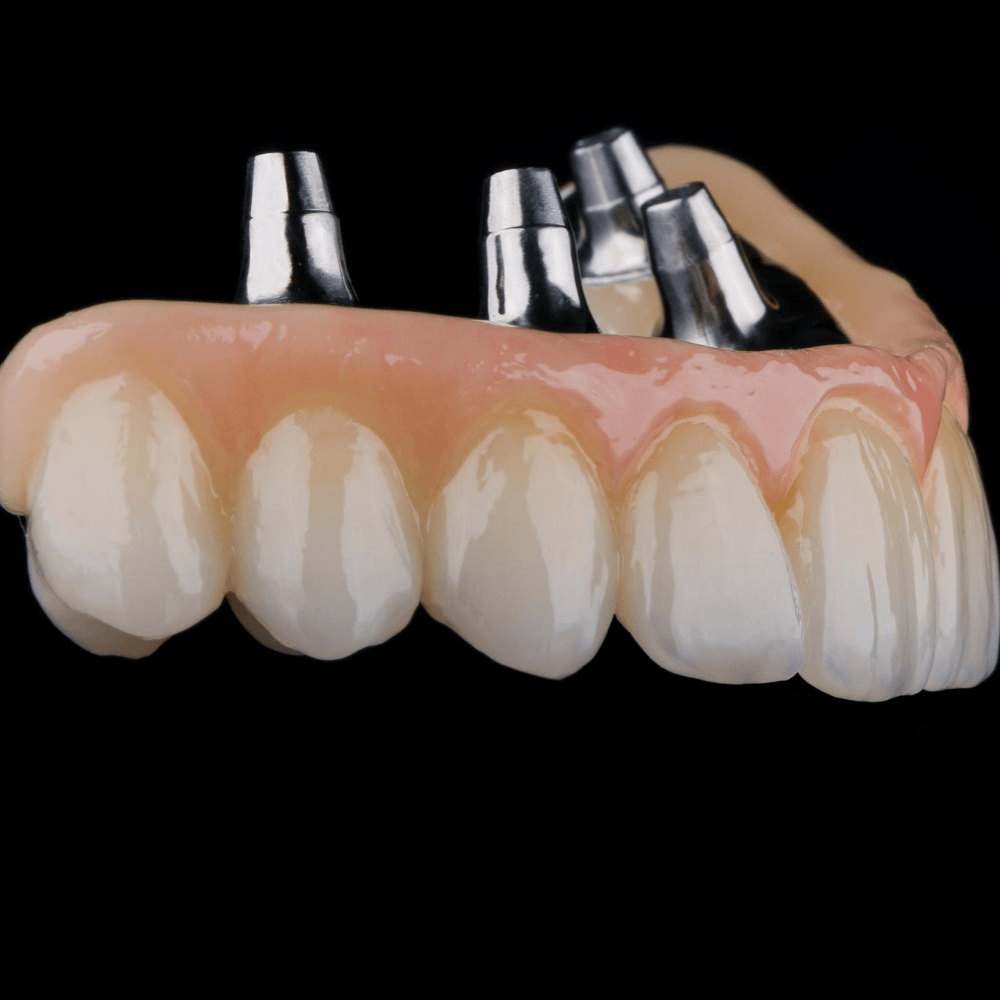
All-on-4 is a method that places a full arch of fixed teeth on just 4 implants for patients who have lost all their teeth or whose remaining teeth need to be extracted. As the name suggests, it means "all on four." While traditional implant treatment plans a separate implant for each missing tooth, All-on-4 supports a complete 12 or 14-tooth bridge with only 4 implants.
The core concept relies on the stronger bone in the front of the jaw. In the back regions, bone loss is common, especially in patients who have had missing teeth for a long time. In the All-on-4 technique, two implants are placed vertically in the front, while two are angled at approximately 30-45 degrees toward the back. This angled placement makes the most efficient use of available bone, and most patients avoid the need for additional bone grafting.
Treatment is completed in a single appointment. If teeth need to be removed, tooth extraction and implant placement can happen the same day. You leave the clinic with teeth. This feature is the most important advantage that sets All-on-4 apart from other implant methods. The first 3-6 months are the osseointegration period, during which the implants fuse with the bone. Once fusion is complete, the temporary prosthesis is removed and you receive a permanent fixed prosthesis made of zirconia or hybrid material.
For patients with stronger jawbone who want additional long-term support, All-on-6 dental implant treatment can be considered as an alternative. Which method is right for you is determined after a detailed examination and 3D tomography. For cost information, visit our dental implant cost calculator page.
Treatment Process
Alternative Treatments
All-on-4 is considered one of today's gold standard treatment options for complete or near-complete tooth loss. It is a preferred method due to its fixed structure, shorter overall treatment time, and significant improvement in quality of life. However, All-on-4 is not the only option for every patient. In some cases, a different approach may be more suitable, and in some situations, the patient's expectations and clinical conditions may require a different treatment. Below you can find the real alternatives to All-on-4 and which situations each one is best suited for.All-on-6 Dental Implants
All-on-6 implant treatment works on the same principle as All-on-4, but involves placing 6 implants in the jaw instead of 4. The additional support provided by more implants can be preferred especially in cases with high chewing loads and when bone conditions permit. Advantages:- Provides additional mechanical support from more implants.
- Chewing forces are distributed over a wider area along the jaw.
- Lower risk of system compromise if one implant is lost.
- Advantageous for long-term stability in cases where bone conditions are suitable.
- Higher cost compared to All-on-4 since more implants are required.
- Surgical time is slightly longer.
- Requires sufficient bone height and width; may not be applicable in some cases with advanced bone loss.
Classic Single Implant Treatment
If the patient has not lost all their teeth and existing healthy teeth can still be used in the mouth, classic single implant treatment may be a more suitable option. In this approach, a separate implant is placed for each missing tooth and a single crown is mounted on it. Advantages:- Healthy natural teeth are preserved and not extracted.
- If the number of missing teeth is limited, it is a less invasive solution.
- Each implant is independent; if one has a problem, the others are not affected.
- Allows the combined use of natural teeth with fixed implants.
- If there are many missing teeth, the total cost may be higher.
- In completely edentulous patients, a separate implant is not needed for each gap; All-on-4 may be a more practical solution.
- In cases with a high number of missing teeth, total treatment time increases.
Implant-Supported Removable Denture (Overdenture)
Implant-supported removable denture is a method in which a removable denture with special attachments is mounted on 2-4 implants placed in the jaw. It solves the movement problem of classic removable dentures, but the patient can still remove the denture for cleaning. It is a more economical intermediate solution compared to the fixed structure of All-on-4. Advantages:- More economical than All-on-4.
- Requires fewer implants; the surgical process is shorter.
- Much more comfortable than classic removable dentures; the movement problem is largely resolved.
- Easy to clean since the denture is removable.
- Not fixed; the patient can remove and replace it.
- Chewing force is lower compared to All-on-4.
- In designs requiring palatal coverage, the taste experience may be partially reduced.
- Attachment mechanisms may need to be replaced over time.
Classic Removable Denture (False Teeth)
These are classic acrylic or metal-framework removable dentures applied without placing any implants in the jaw. It is a method that has been used for decades and is still preferred in certain cases. Advantages:- The lowest cost treatment option.
- Does not require surgical intervention.
- An alternative for patients with advanced systemic diseases not suitable for implant surgery.
- Can also be used as a temporary solution for patients who have recently lost their teeth.
- Can shift during speaking and eating; retention problems are common especially in the lower jaw.
- Chewing force remains well below that of natural teeth.
- Long-term resorption develops in the underlying gum tissue and bone.
- Adaptation period can be long; the foreign body sensation in the mouth is uncomfortable.
- Needs to be removed daily and a separate care routine must be followed.
Which Treatment Is Right for You?
In cases of complete or near-complete tooth loss, the right treatment choice is made by evaluating together the structure of the jaw bone, the condition of remaining teeth, the patient's general health, expectations, and lifestyle. Although All-on-4 offers an ideal solution for many patients, it may not be the most suitable approach for every case. At Doredent, your jaw structure is examined in detail during the initial examination with a panoramic X-ray, clinical evaluation, and if necessary, a three-dimensional CT scan. All suitable options are clearly explained with their advantages and limitations, and the most appropriate plan is determined together with you. Our goal is to provide the most suitable solution that will ensure the patient's long-term oral health, chewing comfort, and quality of life together.Risks and Complications
All-on-4 dental implant treatment is one of the most reliable treatments in modern dentistry for complete tooth loss, with some of the highest success rates. Current systematic reviews show long-term success rates of All-on-4 treatments, when properly planned, ranging from 94% to 98%. However, as with any surgical procedure, there are some potential risks and side effects you should know about with All-on-4 treatment. Because All-on-4 is a more comprehensive surgery than a standard single implant, these risks warrant special attention. Below you will find the main risks and side effects that may be encountered with All-on-4 dental implant treatment.Risk-Increasing Factors
Certain conditions can increase the risk of complications with All-on-4 treatment. These factors do not mean treatment cannot be performed, but they may require additional evaluation and sometimes additional precautions.- Smoking: Smoking both reduces osseointegration success and significantly increases the long-term risk of peri-implantitis. This risk is more critical in major surgeries like All-on-4. Quitting smoking before and after treatment, or at least reducing it significantly, is strongly recommended.
- Uncontrolled diabetes: In patients whose blood sugar is not well controlled, the healing process is prolonged and infection risk increases. All-on-4 can be successfully performed in patients with controlled diabetes.
- Poor oral hygiene: Failure to follow postoperative care guidelines increases the risk of infection and peri-implantitis. For All-on-4 patients, a daily hygiene routine remains important for life.
- Bisphosphonate therapy: Bisphosphonate medications used for osteoporosis can negatively affect healing processes in the jawbone. Patients taking these medications require additional evaluation.
- History of head and neck radiotherapy: Bone healing can be more difficult in areas that have received radiotherapy. These patients require special planning and additional precautions.
- Bruxism (nighttime teeth grinding): Excessive chewing forces can stress the All-on-4 prosthesis. For these patients, using a night guard may become part of the treatment plan.
- Advanced bone loss: In cases with very advanced bone loss, standard All-on-4 may be insufficient; alternative approaches such as sinus lifting, bone grafting, or zygomatic implants may be considered.
How Are These Risks Managed at Doredent?
The vast majority of potential risks with All-on-4 treatment can be minimized through proper planning, appropriate patient selection, and regular follow-up. The key elements of the approach applied at Doredent are:- Detailed clinical and radiological evaluation: Before treatment, the structure of your jawbone, the location of critical anatomical structures, and bone quality are examined in detail with panoramic X-rays and three-dimensional tomography. Determining the correct implant angles in All-on-4 is critical for treatment success.
- Internationally certified implant brands: All implant brands used at Doredent (Nucleoss, NTA Korea, NTA Switzerland) hold CE, FDA, and ISO certifications. The same quality standards apply in All-on-4 cases.
- Planning tailored to patient profile: A personalized treatment plan is created by evaluating your general health status, systemic diseases, medications used, and lifestyle habits. When necessary, treatment is postponed or additional preparatory procedures are planned.
- Phased treatment follow-up: Healing and function are monitored through regular checkup appointments after surgery, during the temporary prosthesis period, and at the permanent prosthesis stage. Long-term annual checkups enable early detection of conditions such as peri-implantitis.
- Patient education and compliance: Before and after treatment, you receive detailed information about surgical care, oral hygiene, smoking, and nutrition. Patient compliance plays a role in the long-term success of All-on-4 treatment that is just as important as the dentist's technical skill.
Who Is All-on-4 Right For?
All-on-4 dental implant treatment offers a fixed, long-lasting solution for patients who have lost most or all of their teeth. It allows patients who have worn removable dentures for years or whose remaining teeth are beyond saving to regain fixed teeth. However, All-on-4 is not suitable for every patient. Proper patient selection is one of the most important factors determining the long-term success of the treatment. The patient profiles below represent the groups for whom All-on-4 treatment is most commonly recommended.- Its fixed structure provides the closest chewing comfort to natural teeth.
- Eliminates the loss of quality of life caused by years of being without teeth.
- Does not cover the palate, so your sense of taste is not affected.
- Transition to fixed teeth across the entire jaw is possible in a single treatment process.
- Extraction and implant surgery are often planned in the same appointment.
- Transition directly to a fixed solution without going through a removable denture phase.
- Time spent without teeth is minimized.
- Treatment is completed before bone resorption in the jaw has even started.
- Eliminates the fear of dentures moving or falling out.
- Most foods, including hard foods, can be comfortably eaten.
- Prosthesis does not slip during speech, increasing self-confidence.
- The restrictions dentures impose on social life come to an end.
- Can be applied in cases with insufficient bone for standard single implants.
- The need for additional surgical procedures such as sinus lifting is often reduced.
- Placing implants at different angles allows the best use of available bone.
- Can often provide a solution even in cases of advanced bone loss.
- Can be applied even in patients in their 70s and 80s.
- Improved nutrition quality at an older age supports overall health.
- Contributes to the continuation of social life and smile confidence.
- When the patient's general health is suitable for surgery, treatment can be planned comfortably.
About Immediate Loading (Same-Day Temporary Teeth)
The "same-day teeth" promise often heard in All-on-4 treatment promotions is real, but not possible for every patient. In this approach, known as immediate loading, a temporary fixed prosthesis is placed on the same day immediately after implant placement, and the patient does not leave the clinic without teeth.- Implants must demonstrate sufficient primary stability in the bone (firmly anchored to the bone)
- Jawbone density must be adequate
- Patient's general health condition must be favorable
- Excessive chewing forces such as bruxism must be absent or under control
- Clinical and radiological evaluation must support immediate loading
Who Requires Additional Evaluation?
In some cases, additional evaluation, preparation, or different planning is needed before All-on-4 treatment. This does not mean the treatment cannot be performed. It often means an additional step needs to be added to the treatment or certain conditions must first be met.- Uncontrolled diabetic patients: In patients whose blood sugar is poorly controlled, the healing process is prolonged and complication risk increases. Treatment is planned after diabetes is brought under control.
- Those with active gum disease: If periodontal infection is present, dental scaling, curettage, and, if necessary, advanced periodontal treatments are completed first.
- Heavy smokers: Smoking negatively affects osseointegration and increases the long-term risk of peri-implantitis. Cessation of smoking before and after major surgery such as All-on-4 is strongly recommended.
- Patients with very advanced bone loss: While the standard All-on-4 approach works in most bone loss cases, very advanced losses may require different approaches such as additional bone grafting, sinus lifting, or zygomatic implants.
- Patients taking bisphosphonates: In patients using this group of medications for osteoporosis, healing in the jawbone may be impaired. Additional evaluation is required based on the type, dose, and duration of medication use.
- Patients who have received radiotherapy to the head and neck: Bone healing in areas with a history of radiotherapy may follow a different course. Special planning and additional precautions are taken in these patients.
- Uncontrolled bruxism: In patients with excessive nighttime teeth grinding habits, All-on-4 prostheses may be damaged sooner than expected. Night guard use and bruxism management are planned before treatment.
- Serious systemic diseases: In patients with uncontrolled heart disease, advanced kidney failure, or those receiving immunosuppressive therapy, coordinated evaluation with a physician is required before surgery.
After Treatment
Once All-on-4 implant treatment is complete, you begin a long journey. Even if the surgery is successful, the long-term outcome depends directly on the guidelines you follow in the weeks, months, and years ahead. Because All-on-4 is a more extensive surgery than a standard single implant procedure, the healing process requires correspondingly closer attention. Below you'll find the post-surgical period explained step by step.First 24 Hours: The Most Critical Period After Surgery
The first 24 hours after surgery are critical for bleeding control, clot formation, and managing swelling. Key points during this period:- Do not eat until the anesthesia wears off. Because your lips, inner cheeks, and tongue are numb, there is a high risk of accidentally biting these tissues. The anesthetic effect wears off in 2–3 hours. During this time, drinking water is safe.
- Bite down on the gauze pads provided. Gauze placed at the surgical sites should be firmly bitten for 30–45 minutes to support clot formation. Do not use cotton, tissue, or napkins instead of gauze.
- Do not spit or rinse vigorously for the first 24 hours. The pressure from spitting and vigorous rinsing can dislodge the clots at the implant sites.
- Do not drink through a straw. The suction created when using a straw can disrupt clot formation.
- Do not smoke. Smoking significantly reduces osseointegration success and increases infection risk. You should stay completely away from smoking for at least the first week after All-on-4; ideally you should not smoke at all during the healing period. The same rule applies to e-cigarettes and hookah.
- Do not consume alcohol. Alcohol interferes with clot formation, may interact with medications, and slows healing.
- Apply cold compresses to reduce swelling. Applying a cold compress to your cheek in 15-minute intervals during the first 24 hours noticeably reduces swelling.
- Keep your head elevated. Sleeping with two pillows stacked to keep your head elevated reduces swelling.
- Take the medications your dentist prescribed regularly. If you were prescribed antibiotics and pain relievers, take them in the recommended dose and duration. Antibiotics play a critical role in preventing infection.
- Do not touch the extraction or surgical sites with your fingers or tongue. These actions can disrupt the clot and increase the risk of infection.
First Week: Living and Eating With the Temporary Prosthesis
During the first week, post-surgical healing progresses rapidly. Swelling and sensitivity decrease noticeably within 5–7 days. What to watch for during this period:- Soft-food diet: Throughout the first week, choose soft and lukewarm foods. Soups (not too hot), mashed foods, yogurt, eggs, soft pasta, bananas, and similar no-chew options are ideal. Avoid hard, hot, spicy, and acidic foods.
- Be careful with the temporary prosthesis: If immediate loading was applied, a temporary fixed prosthesis may have been placed on the first day. Temporary prostheses are much more delicate than permanent ones. Absolutely avoid hard foods, nuts, and sticky foods. With the temporary prosthesis you essentially have "fixed teeth that can only eat soft foods"—full chewing capacity comes with the permanent prosthesis.
- Light saltwater rinses: Starting the second day, you can do gentle rinses with lukewarm salt water. This should not be vigorous—just gently swish the water around your mouth. This helps keep the area clean.
- Maintain oral hygiene: Clean areas near the surgical site very gently with a soft brush. Follow the special oral-hygiene protocols your dentist recommends.
- Avoid strenuous exercise: Staying away from heavy sports and exhausting activities that raise blood pressure for the first 1–2 weeks reduces the risk of bleeding and swelling.
- Suture check: Sutures are usually removed within 7–14 days. In some cases, self-dissolving sutures are used.
- Watch for abnormal signs: If you experience progressively worsening pain, uncontrollable bleeding, high fever, pronounced and growing swelling, or purulent discharge, contact the clinic without delay.
First 3–6 Months: The Osseointegration Process
Osseointegration—the process by which implants fuse with the jawbone—is the most critical phase determining the long-term success of All-on-4 treatment. This process typically takes 3–6 months and occurs slightly faster in the lower jaw than the upper. During this period you will use a temporary prosthesis and will have largely returned to your daily life, but some rules still apply:- Careful use of the temporary prosthesis: The temporary prosthesis provides a comfortable transition but is not as durable as the permanent one. Stay away from hard foods, bones, and hard-shelled nuts. Because this period is called "temporary," these restrictions are temporary—they will be relaxed with the permanent prosthesis.
- Chewing habits: Chewing should be balanced on both sides. Putting load on only one area can affect implant stability.
- Smoking: It is strongly recommended not to smoke during the osseointegration process. Smoking is one of the most important factors that negatively affect this process.
- Regular oral hygiene: Meticulous cleaning around the temporary prosthesis reduces infection risk. Use the special hygiene tools (interdental brushes, water flossers, etc.) your dentist recommends regularly.
- Follow-up appointments: Several follow-up appointments are usually scheduled during this period. The condition of the implants, the fit of the temporary prosthesis, and soft-tissue healing are regularly evaluated.
- General health monitoring: In patients with systemic conditions such as diabetes, controlling these conditions is important for osseointegration success.
Placement of the Permanent Prosthesis
Once osseointegration is successfully complete, the temporary prosthesis is removed and the permanent prosthesis is mounted. The permanent prosthesis is designed for long-term use with much more durable materials and a design customized specifically for you.- Impression and fitting phase: Detailed impressions are taken before fabrication of the permanent prosthesis, and color and form are determined with you. This process may span several appointments.
- Material selection: Permanent All-on-4 prostheses typically feature a metal framework covered with zirconia or high-quality acrylic. Which material is right for you is determined based on clinical conditions and your preferences.
- Initial adjustment period: After the permanent prosthesis is placed, you begin a few days of adjustment. Chewing, speech, and the feel in your mouth normalize within a few days.
- Full chewing capacity: With the permanent prosthesis you now have chewing capacity close to that of natural teeth. Most foods, including hard ones, can be eaten comfortably—but you should still avoid habits that require excessive force, such as cracking bones or chewing ice.
Long-Term Maintenance and Follow-Up
The long-term success of All-on-4 treatment does not end when treatment is complete. A lifelong care routine ensures that your implants and prosthesis serve you trouble-free for many years. Key points to be careful about:- Daily hygiene: Brushing twice daily with a soft toothbrush, interdental brushes, and preferably a water flosser (irrigator) are critical for cleaning around All-on-4 prostheses. Using classic dental floss can be difficult—special super-floss products have been designed for this.
- Special hygiene tools: Use the special cleaning tools your dentist recommends regularly. A standard dental-care routine may not be sufficient for All-on-4.
- Smoking and alcohol: Smoking is the most important risk factor for peri-implantitis. If possible, quit completely; at the very least, reduce significantly.
- Bruxism management: If you have a nighttime teeth-grinding habit, use the night guard your dentist recommends regularly. Bruxism is one of the most important mechanical risk factors for All-on-4 prostheses.
- General health: Keeping diabetes, heart disease, and other systemic conditions under control directly contributes to the longevity of implants.
- Nutrition: A balanced diet and adequate calcium and vitamin D intake support bone health.
Follow-Up Schedule
Regular clinical follow-ups for All-on-4 patients are a bit more frequent than standard patient follow-up. Small problems detected early can be resolved with small interventions, while neglected problems can even lead to implant loss.- During the first year: In the first year after surgery, 3–4 follow-up appointments are scheduled. During this period, the condition of the implants, the fit of the prosthesis, and gum health are closely monitored.
- In subsequent years: Standard follow-up every 6 months is applied. At these appointments, the peri-implant area, prosthesis condition, occlusion, and overall oral health are evaluated.
- Professional cleaning: Professional cleaning in All-on-4 patients requires a special technique. Standard scaling instruments can scratch implant surfaces, so special ultrasonic tips or plastic instruments are used.
- Annual radiographic follow-up: Once a year, a panoramic X-ray is used to evaluate the condition of the implants within the bone. This allows early detection of peri-implantitis or bone loss.
Frequently Asked Questions
Are All-on-4 dental implants permanent?
Is the All-on-4 procedure painful?
Can teeth be placed the same day?
Can All-on-4 be applied to everyone?
How long does the healing process take?
Is All-on-4 more advantageous than removable dentures?
What is the difference between All-on-4 and All-on-6?
How do you clean after All-on-4?
How do you clean after All-on-4?
Can a smoker have All-on-4?
Treatment Pricing
All-on-Four Implant Treatment Pricing
At Doredent, we offer transparent pricing for our international patients. As every case is different, the final treatment cost depends on your individual evaluation.
The cost of All-on-Four Implant Treatment varies based on factors such as the implant brand used, superstructure choice (acrylic or zirconia), and the need for additional surgical procedures. For an accurate quote, a personalized assessment is recommended.
For pricing details, reach out via WhatsApp or book your initial consultation.
Our Dentists
Meet our specialist team.


Content Information
This page was prepared by the Dore Medical Editorial Board and medically reviewed by Dr. Merve Özkan Akagündüz.
