
Invisalign Clear Aligners
Clear aligner treatment provided by an Invisalign Diamond Provider orthodontist. See your treatment results before you start with iTero digital scanning.
Medically reviewed. Last updated: May 20, 2026.What Is Clear Aligner Treatment?
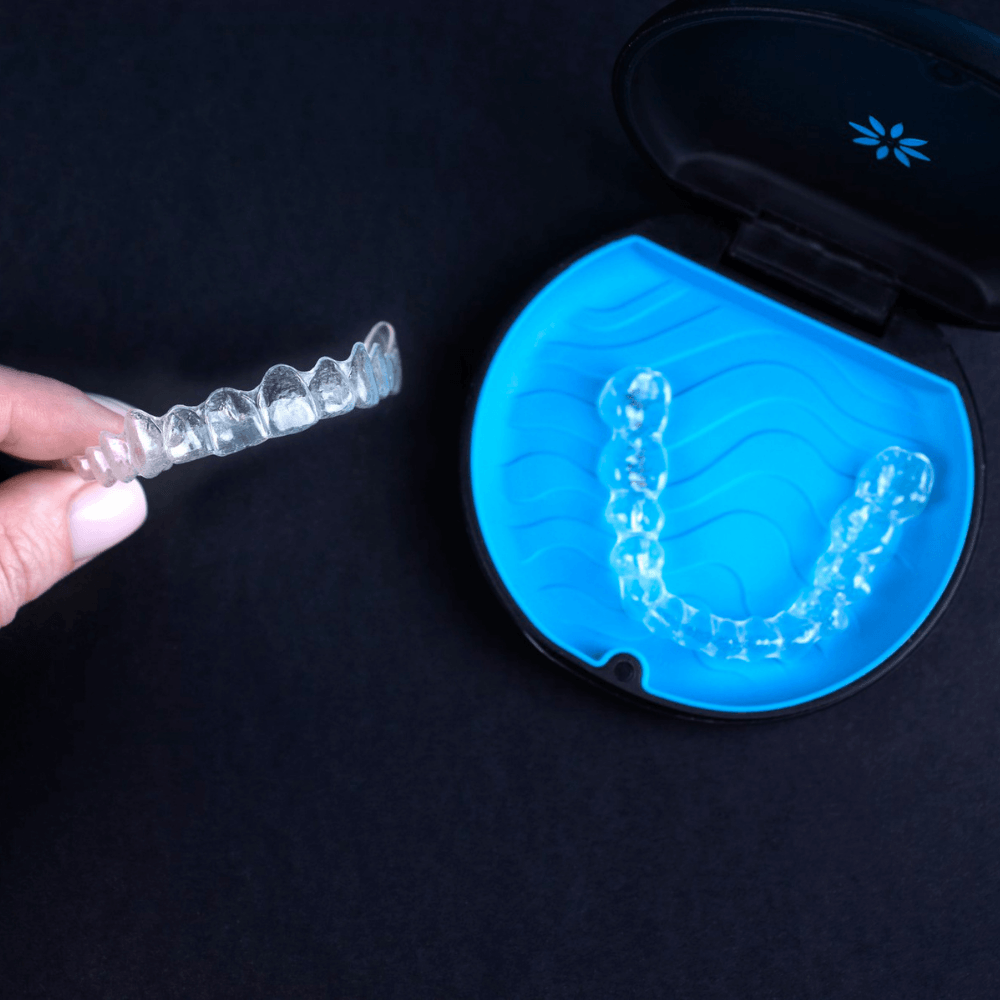
Clear aligner treatment is a modern orthodontic method that straightens teeth using a series of transparent aligners, without brackets or wires. The global leader and best-known brand in this field is Invisalign. The aligners are custom-made for each patient using 3D scanning technology and are typically changed every two weeks. Each aligner moves your teeth a specific amount, completing one step of your treatment plan.
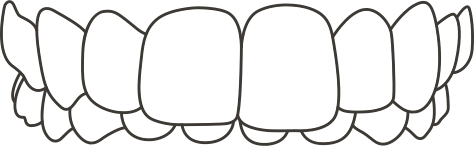
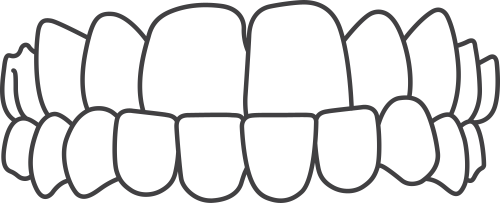
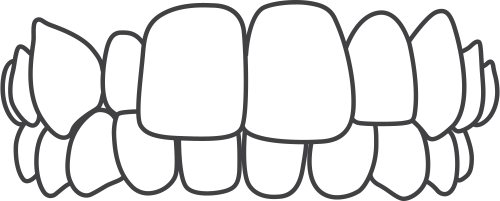
Clear aligner treatment can address many orthodontic problems, including crowding, gap teeth, deep bite, open bite, crossbite, and mild to moderate lower jaw retrusion. While this method was once limited to simple cases, advances in technology now allow it to treat the vast majority of cases that traditional braces treatment can address.
Before treatment begins, a digital scan of your teeth is taken using the iTero intraoral scanner. Your post-treatment smile is simulated in advance using ClinCheck software. Once the plan is approved, all aligners needed for the entire treatment are manufactured and delivered to you. You need to wear the aligners 20 to 22 hours per day, removing them only for eating and brushing your teeth. This means your eating habits are not restricted during treatment, and you can maintain oral hygiene easily. Check-ups are typically scheduled every 6 to 8 weeks.
Treatment duration varies from 6 to 24 months depending on the complexity of your case. After treatment is complete, you move into the retention phase using either Vivera retainers or a retainer wire to maintain your teeth in their new positions. Without retention, orthodontic relapse can occur. A specialized system called Invisalign First is also available for children. For cost information, you can review the clear aligner cost calculator page.
Invisalign Package Options
Invisalign treatment is offered in different packages based on the complexity of your case and the number of aligners needed. At Doredent, your orthodontist evaluates the condition of your teeth after a digital scan and recommends the most suitable package for you. The packages below cover a wide range of cases, from minor cosmetic corrections to moderate-to-advanced orthodontic issues.| Package | Number of Aligners | Suitable Case Type | Estimated Duration |
|---|---|---|---|
| Invisalign Express | Max. 7 aligners | Very minor corrections, cosmetic adjustments requiring minimal intervention | 3–4 months |
| Invisalign Lite | Max. 14 aligners | Mild crowding, small diastemas, single-arch treatments | 5–7 months |
| Invisalign Moderate | Max. 20 aligners | Moderate crowding and mild bite issues | 8–10 months |
| Invisalign Comprehensive | 21+ aligners · Unlimited | All moderate-to-advanced cases, comprehensive bite corrections | 12–18 months |
Which package is right for you?
Choosing the right package requires a detailed examination of your case. Invisalign Express is an ideal starting option for patients who have had orthodontic treatment before and whose teeth have shifted slightly. A significant portion of orthodontic relapse cases can be resolved with this package. Invisalign Lite is preferred for mild crowding and small diastema cases, or when only one arch requires correction. Treatment time is shorter and results are noticeable. Invisalign Moderate is used for cases with moderate crowding combined with mild bite issues. Because it requires more tooth movement, both the number of aligners and treatment duration increase accordingly. Invisalign Comprehensive is the most comprehensive package. It is used to treat complex orthodontic problems such as deep bite, open bite, crossbite, and underbite. There is no upper limit on the number of aligners, and additional refinement plans are included in the package when needed.How is the package selection made?
Package selection is not based on patient preference or budget, but on the number of aligners required to resolve the orthodontic problem. The main factor determining this number is the amount of movement needed between your teeth's current position and the final target position. A two-millimeter correction and the correction of a complex bite disorder require very different numbers of aligners. The person making this decision is your orthodontist. Reading the case correctly, planning which tooth movements will occur in which sequence, and accurately estimating the required number of aligners all depend entirely on the clinician's experience. For the same case, inexperienced planning may predict too many or too few aligners; both scenarios negatively affect treatment outcomes. At Doredent, package selection is made by Uzm. Dt. Merve Özkan Akagündüz based on iTero digital scan data. Invisalign Diamond Provider status is earned through high annual case volume, and accurate package prediction is a natural result of this experience.Conditions Treated
Which orthodontic problems can clear aligners solve?
Doredent's Invisalign Diamond Provider orthodontists effectively treat a wide range of orthodontic problems with clear aligners. Click on the condition you're interested in to see a brief simulation of how it works.
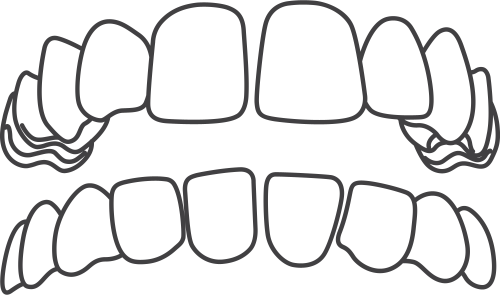
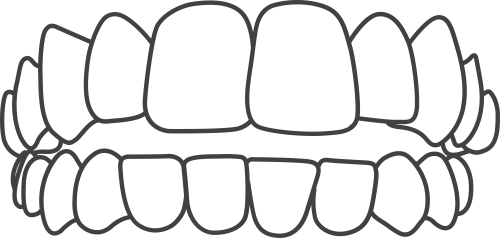
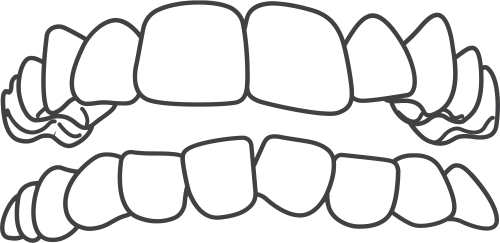

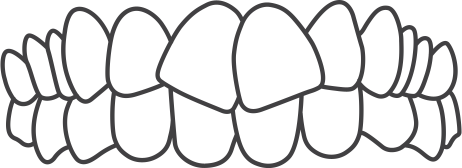
Treatment Process
Alternative Treatments
Clear aligner treatment is an orthodontic method that delivers effective results across a wide range of cases. However, it's not the only option for every patient or every situation. In some cases, braces may be more suitable; in advanced skeletal discrepancies, orthodontics alone may not be enough; and for very minor aesthetic concerns, restorative approaches may be considered instead of orthodontic treatment. Below you'll find the real alternatives to Invisalign and when each approach may be more appropriate.Traditional Braces (Fixed Orthodontic Treatment)
Braces treatment is the most well-known and most common alternative to Invisalign. It works with brackets bonded to the tooth surfaces and wires that connect them. Because it's a fixed system, it applies force to your teeth 24/7 and doesn't depend on patient compliance. This feature is a significant advantage for patients who may struggle with wearing removable aligners consistently. Braces are often preferred for complex tooth movements, advanced rotations, and certain bite corrections. At Doredent, braces treatment is offered with two different options:- Metal brackets: These are classic stainless steel brackets. They're durable, effective, and the most cost-effective option. If appearance isn't a primary concern or for child and adolescent patients, metal brackets are usually the first choice.
- Ceramic brackets: Made from tooth-colored ceramic material, they're much less noticeable when you smile. They're suitable for adult patients with aesthetic concerns who still need a fixed system. Functionally, they deliver the same results as metal brackets.
- Self-ligating brackets: Instead of securing the wire with a separate elastic or tie, the wire is held by a clip mechanism on the bracket itself. Reduced friction provides a more comfortable treatment experience; adjustment appointments may be shorter.
Orthognathic Surgery-Assisted Orthodontics
In some adult patients with advanced skeletal discrepancies, the root cause isn't the position of the teeth but the position of the jaw bones. In these cases, orthodontic treatment alone (Invisalign or braces) is not sufficient. Surgical intervention is needed to bring the jaws into proper relationship. This is called orthognathic surgery. Surgery-assisted treatment is a three-phase process. In the first phase, the orthodontist carries out pre-surgical preparation treatment; teeth are aligned in preparation for their post-surgical positions. In the second phase, the oral and maxillofacial surgeon performs the surgery and repositions the jaw bones. In the final phase, the orthodontist completes post-surgical fine-tuning and the retention period. At Doredent, the orthodontic preparation and post-surgical treatment of cases requiring orthognathic surgery is planned by Uzm. Dt. Merve Özkan Akagündüz. The surgical procedure is performed by specialist oral and maxillofacial surgeons. In these cases, proper patient guidance and multidisciplinary coordination throughout the process is critical. This approach is considered for conditions like severe underbite, severe open bite, and significant jaw asymmetry. The vast majority of mild to moderate cases can still be successfully treated with Invisalign or braces.Restorative Aesthetic Approaches (Bonding, Veneers, Crowns)
Clear aligner treatment is a true orthodontic treatment; it moves teeth through bone and provides both aesthetic and functional correction. However, some patients with very minor aesthetic concerns may want to consider restorative methods instead of undergoing orthodontic treatment. Composite bonding is a method that can be used for limited situations like minor shape irregularities, mild diastemas (gaps between teeth), or chipped tooth corners. It's completed in a single session, is reversible, and requires minimal intervention to the tooth. Laminate veneers and zirconia crowns are more permanent aesthetic solutions, but they require removing some tooth structure. Here's the critical point: restorative methods are not orthodontic treatment. They don't resolve crowding, bite discrepancies, or skeletal imbalances; they only modify the visible surface of the tooth. For this reason, restorative approaches are not considered alternatives to Invisalign for patients with real orthodontic problems. They only come into consideration as an option for very limited aesthetic corrections. In many cases, the best outcome is achieved through coordinated planning of orthodontic and restorative treatment; first the teeth are moved to the correct positions, then small aesthetic touches are made if needed.Which method is right for you?
Choosing the right treatment requires evaluating your tooth condition, bite, and expectations together. Two cases that look similar may require completely different treatment plans upon clinical examination. For this reason, instead of comparing alternative options on your own, it's best to start the process with an evaluation by an orthodontist. At your first exam at Doredent, a three-dimensional model of your teeth is taken with iTero digital scanning. Both Invisalign and braces options are evaluated specifically for your case, and a multidisciplinary plan is created if needed.Risks and Complications
Clear aligner treatment is an orthodontic method that has been used for years and has an extensive scientific literature on its safety profile. The common finding of peer-reviewed publications is this: serious side effects are rare, and the vast majority of problems encountered are mild, temporary, and manageable with proper clinical follow-up. However, as with any medical treatment, knowing the possible risks before starting the process is important for the patient to make an informed decision. Below you will find the main risks and side effects that may occur during Invisalign treatment.How Are These Risks Managed at Doredent?
The vast majority of side effects in clear aligner treatment can be minimized with proper planning, proper patient selection, and regular clinical follow-up. The key components of the approach applied at Doredent are as follows:- Detailed planning with iTero digital scanning: All stages of the case are modeled three-dimensionally, allowing us to predict which tooth movements are possible and where additional intervention may be needed.
- Proper patient selection: Not every case is suitable for clear aligners. In unsuitable cases, braces or combined treatment options are clearly recommended.
- Regular check-up appointments: During check-ups every 6–8 weeks, tooth movements, gum health, and aligner hygiene are evaluated. Early intervention is made if an unexpected situation arises.
- Hygiene and usage training: At the start of treatment, aligner cleaning, brushing technique, aligner change schedule, and daily usage rules are explained in detail. Most cavity and sensitivity risks depend on this education.
- Retainers are included in the treatment package: To prevent the risk of relapse at the end of treatment, retainers are offered as part of the treatment package at Doredent. Patients complete the process without leaving it halfway, and the permanence of the treatment is secured.
Who Is Clear Aligner Treatment Suitable For?
Clear aligner treatment is an orthodontic method that can be applied across a wide age range and variety of cases. From childhood to adulthood, it delivers successful results with different planning approaches at different stages. The three age groups below represent the most common patient profiles for Invisalign treatment. However, age alone is not sufficient criteria; suitability is determined by the clinical evaluation your orthodontist performs following a digital scan.- Jaw development can be guided, and the upper jaw can be expanded.
- Baby and permanent teeth are tracked within the same aligner.
- Early intervention can reduce the need for more complex treatment later.
- More comfortable and hygienic for children than metal braces.
- Virtually invisible at school and in social settings.
- No issues with sports or musical instruments that metal braces can cause.
- Special "eruption compensator" areas accommodate teeth still coming in.
- Brushing and hygiene are much easier than with fixed appliances.
- Treatment is virtually unnoticeable in professional and social life.
- Frequently chosen by patients who had orthodontic treatment previously and experienced relapse.
- Adult bite issues and mild to moderate crowding are successfully corrected.
- Can be coordinated with other treatments such as crowns or implants.
Which Conditions Is Clear Aligner Treatment Suitable For?
Regardless of age group, Invisalign is an effective treatment option for a significant portion of the following orthodontic conditions:- Mild to moderate tooth crowding.
- Aesthetically bothersome gaps between teeth (diastema).
- Mild to moderate bite disorders (deep bite, open bite, crossbite).
- Patients who had orthodontic treatment previously and experienced relapse (orthodontic relapse).
- Single-arch treatments or limited regional corrections.
- Preparation of tooth positions before restorative or implant treatment.
Who Requires Additional Evaluation?
In some situations, clear aligner treatment alone may not be sufficient or may require different planning. This does not mean treatment "cannot be done"; it often means an additional treatment method needs to accompany Invisalign or a different approach may be preferred.- Adults with severe skeletal discrepancies: If the problem originates from jaw bone position, orthodontic treatment alone is not sufficient. These cases require treatment supported by orthognathic surgery.
- Patients with untreated gum disease: Patients with active gum disease or advanced bone loss must complete periodontal treatment first, then orthodontic treatment is planned.
- Patients with untreated decay or infection: Existing cavities and infections are resolved with filling or root canal treatment before starting Invisalign.
- Cases requiring very complex tooth movements: Some advanced rotations or vertical movements may deliver more predictable results with fixed orthodontic treatment (braces).
- Patients who cannot maintain aligner wear discipline: Clear aligners are ineffective when not worn 20–22 hours per day. Fixed treatment may be more suitable for patients who feel they cannot maintain this discipline.
After Treatment
When clear aligner treatment is complete, your teeth have reached their target position, but the process does not end there. One of the most critical phases of orthodontic treatment is the post-treatment period. Your teeth stabilize over time in their new position, and this stabilization process cannot fully occur without proper retention appliances. Without retention, the tendency for teeth to shift back toward their original position (relapse) is a biological reality for all orthodontic treatments. At Doredent, the post-treatment period is handled as an integral part of orthodontic treatment. Maintaining results is not left solely to the patient. Retention appliances are planned within the treatment package and delivered to you.Fixed Lingual Retainer
The fixed lingual retainer is a thin, flexible wire bonded to the back surface of your teeth when treatment is complete. It is the most reliable method for maintaining your teeth in their new positions. Because it sits on the tongue side, it is invisible when you smile, and over time you may not even notice its presence. It has no meaningful impact on speech, eating, or your tooth brushing routine. At Doredent, the fixed lingual retainer is included in your treatment package, and lifelong use is recommended. This is not a debatable preference but the most reliable way to preserve your teeth's position in the long term. Orthodontic literature and clinical experience show that patients who use fixed retainers do not experience significant shifting even years later. We must be clear here: in some orthodontic practices, fixed retainers are not routinely placed. Among patients who come to Doredent, there are many who had orthodontic treatment elsewhere but whose teeth shifted again because no retainer was placed. These patients usually have to undergo a second treatment from scratch. The retention phase is as important as the success of orthodontic treatment, if not the defining factor for permanence. At Doredent, the fixed retainer is not neglected or offered as an extra treatment. It is directly applied as part of the treatment process.Night Guard (Retention Plate)
In addition to the fixed retainer, you will receive a retention plate (night guard) produced in our own laboratory at Doredent. This appliance supports the fixed retainer and helps your teeth internalize their new positions, especially in the first year after treatment. The recommended protocol is: wear it every night for the first year after treatment, then continue wearing it regularly a few nights per week. This appliance is also provided as part of your treatment package.Vivera Retainers (Optional)
Some patients may want to continue the comfort of the invisible appliances they became accustomed to during clear aligner treatment into the retention period. For these patients, Vivera, Invisalign's retention product, may be recommended. Vivera is a set of clear aligners made from a more durable polymer and custom-manufactured based on your final measurements. At Doredent, final measurements are taken for all patients at the end of treatment and stored digitally. This allows you to order Vivera at any time in the future and obtain a new set. Vivera is an additional option to the fixed retainer and night guard. It is not included in the treatment package but is offered as a separately provided treatment. This is due to Doredent's approach to keeping core treatment prices at the most accessible level possible.Post-Treatment Dental Health Follow-Up
The retention period is not limited to maintaining tooth position alone. Regular clinical check-ups after treatment are important for both retainer condition and general oral and dental health. Minor adjustments may be needed to the fixed retainer over time. Your night guard may wear out or reach a point where replacement is needed. Additionally, dental scaling and monitoring gum health are recommended after treatment. Patients with aesthetic expectations may choose to have teeth whitening or minor bonding applied after treatment to visually enhance their teeth now in their new positions. These treatments are not part of the orthodontic process, but when planned in the proper sequence, they are finishing touches that complete the result.The Importance of the Retention Process
The success of clear aligner treatment is felt not only during treatment but in the years that follow. The position your teeth have reached can be maintained for years with proper retention appliances and consistent use. The approach at Doredent is built on not "leaving the patient on their own" when treatment ends. The fixed retainer and night guard are part of the treatment package, the Vivera option is available for patients who want it, and the clinic door is always open for long-term follow-ups. For more detailed information about the retention process, you can review our retainer wire page and Vivera retention page. You can direct your questions to Uzm. Dt. Merve Özkan Akagündüz at your initial examination.Frequently Asked Questions
Do Clear Aligners Affect My Speech?
How Long Does Clear Aligner Treatment Take?
How Often Are Clear Aligners Changed?
How Do I Clean Clear Aligners?
Do Clear Aligners Cause Pain?
Can I Eat With Clear Aligners?
Treatment Pricing
Clear Aligner Treatment Pricing
At Doredent, we offer transparent pricing for our international patients. As every case is different, the final treatment cost depends on your individual evaluation.
The cost of Clear Aligner Treatment varies based on factors such as the complexity of the case, number of aligners, treatment duration, and the Invisalign package selected. For an accurate quote, a personalized assessment is recommended.
For pricing details, reach out via WhatsApp or book your initial consultation.
Our Dentists
Meet our specialist team.


Content Information
This page was prepared by the Dore Medical Editorial Board and medically reviewed by Dr. Merve Özkan Akagündüz.
