
Porcelain Dental Crowns
A strong, aesthetic restoration for broken, worn, or weakened teeth due to large fillings. Custom solutions with metal-ceramic or all-ceramic crown options.
Medically reviewed. Last updated: May 18, 2026.What Is a Porcelain Dental Crown?
A porcelain dental crown is an aesthetic restoration made of porcelain that fits over and completely covers a tooth. It is one of the classic methods used in dentistry for many years. Today, when people say porcelain crown, two types are generally understood: metal-supported porcelain and all-ceramic (metal-free) porcelain. While metal-supported crowns can be preferred for back teeth because they are economical, metal-free crowns stand out in the front region and in cases where aesthetic expectations are high.
Porcelain crowns are used for both aesthetic and structural purposes. They offer aesthetic solutions for teeth that are misshapen, undersized, discolored, or have bite incompatibilities. They are also commonly used to protect teeth with large fillings, broken teeth, or teeth that have undergone root canal treatment. Porcelain is also the preferred material for traditional bridges that replace missing teeth.
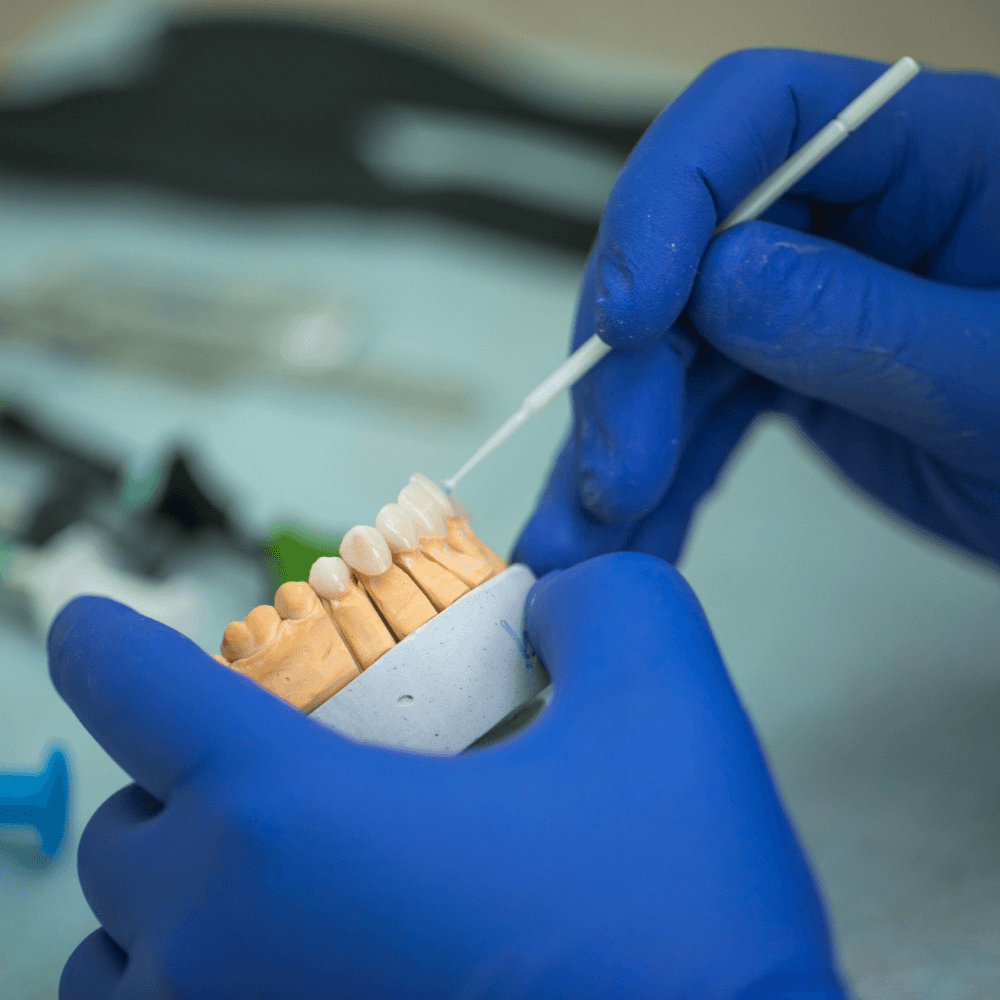
During the pre-treatment examination, the vitality of the tooth, surrounding tissues, and bite are evaluated. If necessary, root canal treatment is completed first. In the first session, the tooth is trimmed down under local anesthesia to the thickness needed for the crown to fit. The amount of reduction at this stage varies depending on the type of material. Metal-supported porcelain requires more tooth reduction, while all-ceramic systems are more conservative. An impression is taken, a temporary crown is placed, and the tooth shade is determined together with the patient. The laboratory phase takes about a week. In the second session, the crown is tried on, and once the fit is confirmed, it is bonded with a special adhesive.
Porcelain surfaces resist staining and have a shine close to natural enamel. With proper care, they have a lifespan of 10-15 years. However, with metal-supported systems, a gray line may become visible at the gum line over time, which is why metal-free zirconia crowns are a more aesthetic choice for the front region. For patients who want minimal intervention only on the front surface, laminate veneers may be an alternative. Regular brushing, flossing, and dental scaling extend the life of the crown. Patients with bruxism are advised to use a night guard.
Treatment Process
Alternative Treatments
Porcelain dental crowns are an effective solution for many cases that require structural reinforcement and aesthetic improvement of teeth. However, porcelain crowns are not the right approach for every dental problem. In some cases, a less invasive option may be preferred, and in others, a different type of crown may provide better results. Below, you can find the real alternatives to porcelain crowns and which method stands out in which situation.Orthodontic Treatment (An Important Warning)
Zirconia Dental Crowns
Zirconia crowns are a newer technology compared to porcelain crowns and have become standard in many cases today. They contain no metal substructure, which gives them higher light transmission and prevents gray reflection at the gum line. Zirconia is often preferred for cases in the front area where natural appearance is a priority. Advantages:- Contains no metal substructure, high biocompatibility.
- Better light transmission compared to porcelain.
- No gray line forms at the margin if gum recession occurs.
- Can be applied to both front and back teeth.
- Strong in terms of long-term durability.
- May be higher in cost compared to porcelain crowns.
- In some multi-unit bridge cases, metal-supported porcelain may still be technically preferred.
Laminate Veneers
Laminate veneers are very thin porcelain shells bonded only to the front surface of the tooth. Unlike full porcelain crowns, the entire tooth is not ground down; only a very small amount of material is removed from the front surface. In some cases, they can be applied without any grinding at all. They are especially preferred in the front area where aesthetic expectations are high. Advantages:- Requires minimal tooth reduction, preserves most of the tooth structure.
- One of the crown types that provides the most aesthetic result.
- Provides an appearance very close to natural tooth translucency.
- Much less invasive than porcelain crowns in terms of reversibility.
- Applied only to front teeth, not used on back teeth.
- Not sufficient in cases of major damage where the tooth needs structural reinforcement.
- May not fully cover very dark-colored teeth; in such cases, porcelain or zirconia crowns are more suitable.
- Higher risk of fracture in patients with bruxism (nighttime teeth grinding).
Composite Fillings and Bonding
If the material loss in the tooth is small to moderate, a much less invasive option than crowns may be sufficient: composite work. Composite fillings are used for damage in back teeth, while front area bonding is used for small aesthetic corrections in front teeth. Both are done with composite resin material, remove minimal tooth structure, and are completed in a single session. Advantages:- Requires minimal intervention to tooth structure.
- Completed in a single session.
- Most cost-effective option.
- Transition to porcelain, zirconia, or laminate veneers is possible later if needed.
- Composite material is not harder than tooth enamel. It can fracture when biting hard foods.
- Discoloration may occur over time, especially in tea-coffee-cigarette users.
- Not sufficient for large material losses or teeth with high fracture risk.
- Long-term durability depends greatly on your usage habits.
Inlays and Onlays
If the material loss in the tooth is moderate, meaning in a range larger than a filling but not requiring a crown, an inlay or onlay application may be considered. In this solution, an impression of the tooth is taken, custom-made from porcelain or composite block in the laboratory, and bonded to the tooth. The difference from a porcelain crown is that instead of covering the entire tooth, it only restores the damaged portion. This preserves healthy tooth structure. Inlays and onlays are especially preferred for back teeth in cases where there is chewing load and a full crown is not necessary. They are an intermediate solution that is less invasive compared to crowns and more durable compared to fillings.Which Treatment Is Right for You?
The right treatment choice is made according to the current condition of the tooth, the amount of material loss, the bite relationship, and aesthetic expectations. Different treatment plans may be applied for the same dental problem in different patients. At Doredent, during the initial examination, the condition of your teeth is evaluated in detail and the most suitable approach for you is determined together. It is important to emphasize here: At Doredent, the least invasive, most conservative treatment option is offered as a priority. We do not recommend crowns for a tooth that can be solved with a filling, or porcelain for a problem that can be corrected with orthodontics. The fundamental reason for this approach is to protect the long-term health of your teeth.Risks and Complications
Porcelain dental crowns are a well-understood type of restoration that modern dentistry has used for decades. With proper indications and appropriate planning, this treatment shows high success rates and serves most patients without issues for many years. However, as with any medical procedure, there are some potential risks and complications you should be aware of with porcelain crowns. The vast majority of these are mild, temporary, and manageable with proper follow-up. Below you will find the main risks and complications that may occur with porcelain crown treatment.Risk-Increasing Factors
Certain conditions may increase the risk of complications and early failure with porcelain crown treatment. These factors do not mean treatment cannot be performed, but they require additional evaluation and sometimes extra precautions.- Uncontrolled bruxism (nighttime teeth grinding): Excessive chewing forces significantly increase the risk of chipping and fracture in porcelain crowns. Use of a night guard is essential for these patients before crown placement.
- Bite problems: Crowns placed when bite issues like deep bite or crossbite are present experience unbalanced forces and may fail earlier than expected. Orthodontic treatment is recommended first.
- Inadequate oral hygiene: Plaque buildup at crown margins increases the risk of secondary decay and gum disease.
- Active gum disease: When periodontal treatment is not completed before crown placement, the crown's lifespan is shortened.
- Smoking: Smoking negatively affects gum health and causes discoloration around crowns.
- High-sugar diet: Increases the risk of decay in the natural tooth structure under the crown.
- Excessive force with hard foods: Habits like cracking ice, hard-shelled nuts, or seeds with your teeth significantly shorten crown lifespan.
How Are These Risks Managed at Doredent?
The vast majority of potential risks in porcelain crown treatment can be minimized with proper indications, appropriate planning, and patient follow-up. The key elements of the approach applied at Doredent are:- Proper indications: Porcelain crowns are only recommended when clinically truly necessary. For cases that can be solved with a less invasive option, that alternative is honestly presented to the patient. We do not recommend porcelain crowns for teeth that can be treated with a filling, inlay/onlay, or veneer.
- Detailed clinical and radiological evaluation: Before treatment, the tooth structure, nerve tissue status, gum health, and bite relationship are examined in detail. X-ray evaluation of the tooth root is performed when necessary.
- Preparatory treatments: If active decay, gum disease, or bite problems exist, these issues are resolved before crown placement. This is critical for the crown's longevity.
- Patient education: Before treatment, the advantages, limitations, alternatives, and risks of porcelain crowns are clearly explained to the patient. Realistic expectation management is the foundation of satisfaction.
- Bruxism management: For patients with nighttime teeth grinding habits, a night guard becomes part of the treatment plan before or immediately after crown placement.
- Regular follow-up: Routine check-ups every 6 months evaluate the crowns' fit, margin integrity, gum health, and bite relationship. Small problems detected early are resolved with minor interventions.
Who Is It Suitable For?
Porcelain dental crowns are a treatment option used in many clinical situations where teeth need structural reinforcement, functional restoration, or aesthetic improvement. Porcelain crowns remain a proven method with decades of clinical use, and they still offer significant advantages in certain cases. The following patient profiles represent the most common groups for porcelain crown treatment.- Metal-supported porcelain provides strong support against chewing forces.
- Porcelain is advantageous for back teeth where aesthetics are secondary.
- It wraps around the remaining tooth structure, reducing fracture risk.
- A proven solution with decades of clinical use.
- The strength of the metal framework stands out in multi-unit bridges.
- A reliable choice for long-span bridges.
- Aesthetic concerns are secondary in posterior bridge cases.
- A method supported by decades of clinical data.
- Wraps 360 degrees around the tooth, significantly reducing fracture risk.
- Especially preferred for back teeth that bear heavy chewing loads.
- Supports the long-term retention of the tooth in the mouth.
- One of the standard restoration options after root canal treatment.
- The tooth's natural length and form are restored.
- Chewing function is brought back to the correct height.
- The underlying cause of wear is evaluated together.
- If bruxism is present, night guard use is mandatory.
- The fractured tooth's structure and form are restored.
- The vitality of the tooth nerve is evaluated beforehand.
- Combined with root canal treatment if necessary.
- Supports the tooth's retention in the mouth for many years.
- Generally more cost-effective compared to zirconia crowns.
- A reliable solution with decades of use.
- Aesthetic differences are minimal in posterior cases.
- Can provide long-lasting results with proper care.
An Important Consideration for Front Teeth Cases
Who Needs Additional Evaluation?
In some situations, additional evaluation, preparation, or a different treatment plan is needed before porcelain crown treatment. This does not mean treatment cannot be done—it often means an additional step must be included or certain conditions must be met first.- Patients with problems that can be resolved with orthodontic treatment: At Doredent, porcelain crowns are not placed on patients considering crowns for crooked, spaced, or misaligned teeth. These patients are first recommended Invisalign or braces treatment.
- Patients with active gum disease: Before crowns, dental scaling and, if necessary, curettage or periodontal treatment must be completed. Crowns placed without healthy gums have a shortened lifespan.
- Patients with bite problems: If bite problems such as deep bite or crossbite exist, the bite must first be corrected with orthodontic treatment. Crowns placed without correcting the bite will wear down or fracture quickly.
- Patients with severe bruxism (nighttime teeth grinding): For patients with teeth grinding habits, night guard use becomes mandatory before or immediately after crown placement. Without a night guard, crowns may fracture sooner than expected.
- Patients with metal allergies: Metal-supported porcelain crowns can cause metal allergies in rare cases. For these patients, all-ceramic or zirconia crowns are preferred.
- Teeth with damaged nerve tissue: If the tooth's nerve tissue has been damaged due to significant structure loss or trauma, root canal treatment may be needed before crown placement. This is determined through examination and X-ray evaluation.
- Patients with untreated cavities: If there are active cavities in the mouth, even on teeth not receiving crowns, these cavities must be treated first. Otherwise, decay can spread to the teeth adjacent to the crowned teeth.
After Treatment
Once your porcelain crown treatment is complete, your teeth will have a new form both aesthetically and functionally. However, the longevity of the treatment depends on certain points you need to pay attention to in the following days and your long-term oral care habits. Below you can find step-by-step what you need to do immediately after the crowns are placed, the normal experience of the first days, and long-term care.First Hours: Anesthesia and Temporary Crown Period
Porcelain crown treatment typically spans several sessions. In the first session, the teeth are prepared appropriately, impressions are taken, and the patient is fitted with a temporary crown. While the permanent porcelain crown is being fabricated in the laboratory, the patient uses this temporary crown. Temporary crowns are structures made from acrylic or composite blocks with short-term durability. Points to pay attention to after the first session:- Do not eat until the anesthesia wears off. Because there is no sensation in your lips, inside of your cheeks, and tongue, the risk of unintentionally biting these tissues is high. Anesthesia typically loses its effect within two to three hours. During this time, it is safe to drink only water.
- Be careful with the temporary crown. Temporary crowns are not as durable as permanent porcelain. Avoid hard, sticky, or difficult-to-chew foods (gum, caramel, hard nuts).
- Use dental floss carefully. During the temporary crown period, it is safer to slide the floss horizontally rather than pulling it out vertically, which prevents the crown from becoming dislodged.
- Do not panic if the crown comes off. Temporary crowns may rarely become dislodged. In such a case, do not discard the crown, contact the clinic and have it reattached. If the tooth is left exposed, sensitivity may occur.
First Days: Sensitivity and Adjustment
When permanent porcelain crowns are placed, some patients may experience brief sensitivity or an adjustment period:- Hot-cold sensitivity: The natural tooth tissue under the crown may show brief sensitivity after preparation. This usually passes within a few days. It may last slightly longer in teeth where the preparation was very close to the nerve tissue.
- Biting sensation: For the first few days after the permanent crown is placed, the tooth may feel different in your mouth. This adjustment period passes quickly. However, if you notice a clear high spot or discomfort when biting, contact the clinic for a check-up, as a minor adjustment to the tooth may be needed.
- Gum sensitivity: There may be slight sensitivity in your gums at the crown margins during the first days. This is the process of the gum adapting to the new surface. Gentle brushing with a soft-bristled toothbrush is recommended.
About the Lifespan of Porcelain Crowns
When applied correctly in appropriate cases and supported by the patient's oral care and usage habits, porcelain crowns function without problems for many years. This method, which has been used for decades, is a clinically well-understood type of restoration. However, a clear fact needs to be shared here: no crown lasts forever, and how long the crown lasts depends largely on the patient's usage habits. Porcelain material is durable, but not unlimited. Habits such as cracking seeds, chewing ice, breaking hard-shelled nuts, or opening bottle caps can cause porcelain crowns to crack or break. In porcelain-fused-to-metal crowns, the outer porcelain layer may crack over time; all-porcelain crowns can also break under excessive forces. We frequently see in clinical practice that patients are more careless than expected in this regard. For this reason, Doredent does not provide any guarantee regarding the durability of porcelain crowns. The crown's lifespan depends on the patient's oral care, chewing habits, nighttime teeth grinding, and regular clinical check-ups. A properly maintained porcelain crown can be used without problems for many years; an improperly used crown may cause problems much earlier than expected.Long-Term Care
After getting porcelain crowns, you do not need to switch to a special care routine. However, the best way to protect your teeth is to pay a bit more attention to your oral hygiene than usual. No matter how high-quality the crown is, the natural tooth tissue underneath can still decay and the gums can still become diseased.- Brush twice daily: Brush for at least two minutes with a soft-bristled toothbrush and fluoride toothpaste, covering the crown margins as well.
- Use dental floss every day: Plaque buildup at the line where the gum meets the tooth under the crown is critically important. Dental floss is the most effective way to clean this area. When neglected, both new decay can develop at the crown margin and the gums can recede, causing aesthetic problems.
- Be careful with hard foods: Avoid breaking foods such as seeds, ice, hard candy, or unshelled nuts with your teeth. Porcelain is durable but not unlimited.
- Limit sugary and acidic beverages: The crown itself does not decay, but the natural tooth tissue underneath can. Sugary drinks, acid attacks, and inadequate hygiene increase this risk.
- Use a night guard if you grind your teeth: In patients with bruxism, a night guard is the most effective method to protect both porcelain crowns and natural teeth. In bruxism patients who do not use a night guard, the risk of crown fracture increases significantly.
- Do not use your teeth as tools: Habits such as opening bottles, tearing packages, or cutting labels are harmful to both natural teeth and crowns.
Special Monitoring of Gum Health
For patients with porcelain crowns, gum health is slightly more important than usual. Because when the gums recede slightly over the years, especially in porcelain-fused-to-metal crowns, a thin gray line may appear at the crown margin at the gum line. While this may not be noticeable on back teeth, it can be visible in front tooth aesthetic cases. The way to prevent this aesthetic change is to maintain gum health. Regular brushing, dental floss use, professional dental scaling, and routine check-ups every 6 months minimize this risk. When gum recession is detected early, it can be stopped or slowed with smaller interventions.Routine Check-up Every 6 Months
After getting porcelain crowns, you do not need to enter a special check-up schedule. A standard routine dental examination every 6 months is sufficient to monitor the condition of the crowns and surrounding tissues. During these examinations, the crown's fit, margin adaptation, gum health, and occlusion relationship with the opposing teeth are evaluated. Routine check-ups are also an appropriate time for professional dental scaling. In patients who maintain regular follow-ups, potential problems are detected early and resolved with minor interventions. In neglected porcelain crowns, problems can grow and may require complete crown replacement. Another important advantage of regular check-ups is that the health of the natural tooth tissue under the crown and surrounding teeth is also monitored. This way, a new cavity, gum recession, or a different problem is detected and resolved at an early stage.Frequently Asked Questions
Do porcelain dental crowns look natural?
Are porcelain crowns durable?
Do porcelain dental crowns turn yellow?
Is getting a porcelain crown a painful procedure?
Can porcelain crowns be placed on front teeth?
How long does porcelain dental crown treatment take to complete?
Treatment Pricing
Porcelain Dental Crowns Pricing
At Doredent, we offer transparent pricing for our international patients. As every case is different, the final treatment cost depends on your individual evaluation.
The cost of Porcelain Dental Crowns varies based on factors such as the number of teeth to be crowned, the type of porcelain used, and the production laboratory. For an accurate quote, a personalized assessment is recommended.
For pricing details, reach out via WhatsApp or book your initial consultation.
Our Dentists
Meet our specialist team.


Content Information
This page was prepared by the Dore Medical Editorial Board and medically reviewed by Dr. Merve Özkan Akagündüz.
