
All-on-6 Dental Implants
A stronger foundation with 6 implants and more balanced load distribution. A stable and long-lasting prosthetic solution for complete edentulism cases, especially in the upper jaw where bone support is critical.
Medically reviewed. Last updated: July 29, 2026.What Is All-on-6?
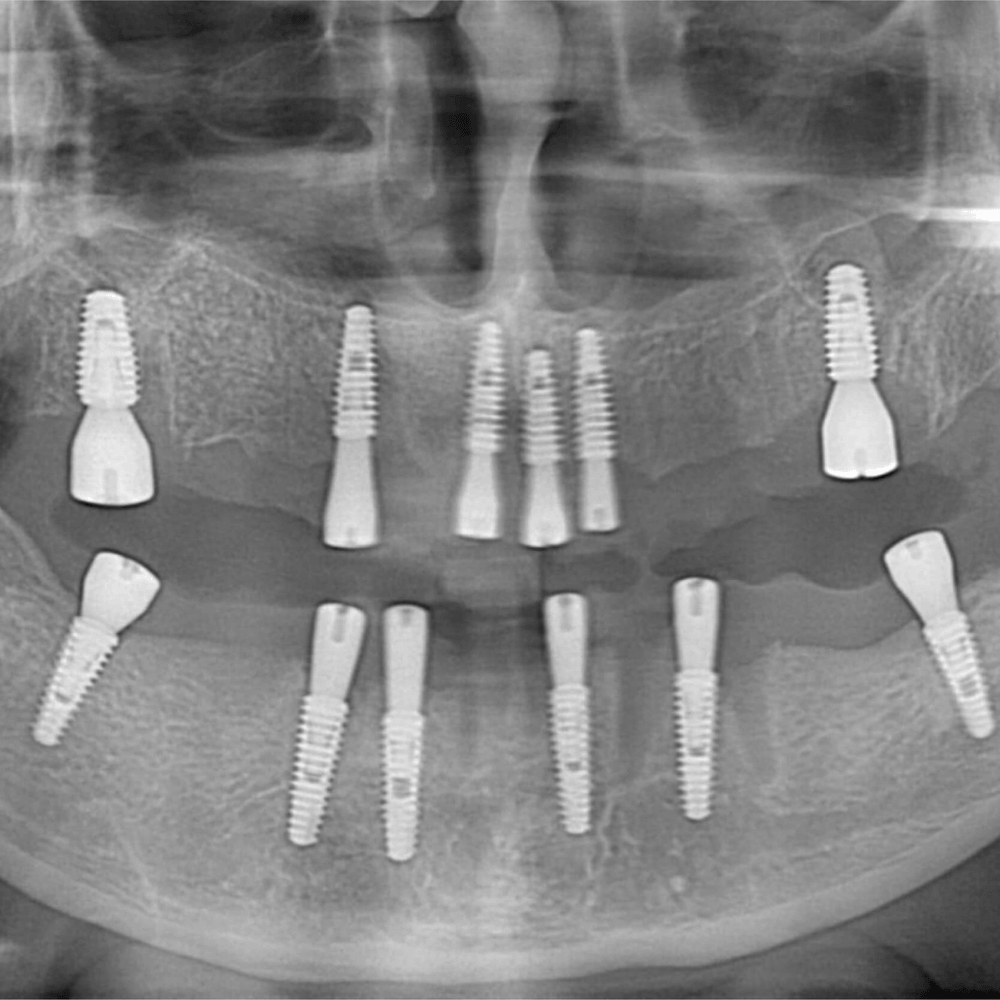
All-on-6 is a full-arch implant treatment in which fixed teeth for one jaw are supported by six dental implants. It can be thought of as a reinforced version of the All-on-4 technique. It works on the same principle: patients who have lost all their teeth receive fixed teeth in a single session. The key difference is that the number of load-bearing implants is increased from four to six.
When two additional implants are added, chewing forces are distributed over a wider area along the jawbone. The load on each individual implant is reduced, support at the back ends of the bridge is increased, and a more stable structure is achieved in the long term. For patients with sufficient jawbone, this difference provides a clear advantage in terms of treatment longevity. Additionally, if one implant encounters a problem in the future, the remaining five implants can continue to support the bridge.
All-on-6 is particularly preferred for patients with good jawbone density, strong chewing forces, and bruxism (teeth grinding) habits. Before treatment, the jawbone is examined in detail with 3D tomography, and sinus cavities and the inferior alveolar nerve are mapped. If there are teeth that need to be removed, tooth extraction and implant placement can be performed in the same session.
After surgery, a temporary fixed prosthesis is fitted the same day or within a few days. The osseointegration period lasts 3 to 6 months. Once integration is complete, the temporary prosthesis is removed and a permanent prosthesis made of zirconia or hybrid material is placed. Patients with teeth grinding habits are recommended to use a night guard to protect their prosthesis. Annual checkups and regular dental scaling extend the life of the implants. For pricing, you can visit our dental implant cost calculator page.
Treatment Process
Alternative Treatments
All On Six dental implants are one of the approaches considered for fixed prosthetic planning in patients with complete edentulism or advanced tooth loss. However, there is no single correct method for every patient. When jaw bone structure, anatomical limitations, overall health status, and patient expectations are evaluated together, different treatment options may be more suitable. At Doredent, all appropriate alternatives are shared with the patient before creating a treatment plan, and the least invasive and most suitable approach is determined together.Risks and Complications
All-On-6 dental implant treatment has a high success rate, but like any surgical procedure, it carries certain risks and possible side effects. Most of these risks can be controlled through proper patient selection, careful surgical planning, and following post-treatment instructions. At Doredent, we discuss all possible risks openly with you before treatment.Who Is a Good Candidate?
All-on-6 dental implant treatment provides a fixed, long-lasting solution for patients who have lost most or all of their teeth. The wider support base created by 6 implants offers an advantage in cases requiring greater mechanical strength. However, All-on-6 is not suitable for every patient. Proper patient selection is one of the most important factors determining the long-term success of the treatment. The following patient profiles represent the groups most commonly evaluated for All-on-6 treatment.- Six implants help distribute chewing forces more evenly.
- Eliminates the loss of quality of life caused by years of tooth loss.
- No palatal coverage means your sense of taste remains unaffected.
- Transition to fixed teeth across the entire jaw is planned in a single treatment process.
- Extraction and implant surgery are often planned in the same session.
- Six implants provide stronger support in the wide gaps created after extractions.
- Time without teeth is minimized.
- Treatment is completed before jawbone resorption begins.
- Eliminates the movement and fear of your denture falling out.
- Most foods, including hard foods, can be eaten comfortably.
- Your prosthesis does not shift during speech, increasing your confidence.
- The limitations dentures place on your social life come to an end.
- Ensures the prosthesis is equally supported across all areas in a wide jaw structure.
- Helps distribute strong chewing forces across more implants.
- Reduces mechanical load on the prosthesis and implants over the long term.
- Creates a more secure foundation in cases where 4 implants would be borderline.
- Can be applied even in patients in their 70s and 80s.
- Improved nutrition quality in older age supports overall health.
- Contributes to continued social life and smile confidence.
- When the patient's general health is suitable for surgery, treatment can be easily planned.
About Immediate Loading (Same-Day Temporary Teeth)
The "same-day teeth" promise often heard in All-on-6 treatment promotions is real, but it is not possible for every patient. In this approach, known as immediate loading, a temporary fixed prosthesis is placed the same day the implants are inserted, and the patient does not leave the clinic without teeth. However, this is only applied in suitable cases.- The implants must demonstrate sufficient primary stability in the bone (securely anchored to the bone)
- Adequate jawbone density
- Favorable general health condition of the patient
- Absence or control of excessive chewing forces such as bruxism
- Clinical and radiological evaluation that supports immediate loading
Who Requires Additional Evaluation?
In some situations, additional evaluation, preparation, or different planning is required before All-on-6 treatment. This does not mean the treatment cannot be performed; in most cases, it means an additional step must be added to the treatment or certain conditions must first be met.- Patients with uncontrolled diabetes: In patients whose blood sugar is not well controlled, the healing process is prolonged and complication risk increases. Treatment is planned after diabetes is brought under control.
- Patients with active gum disease: If periodontal infection is present, dental scaling, curettage, and if necessary, advanced periodontal treatments are completed first.
- Heavy smokers: Smoking negatively affects osseointegration and increases the risk of peri-implantitis in the long term. Quitting smoking before and after major surgery such as All-on-6 is strongly recommended.
- Patients with very advanced bone loss: Although the standard All-on-6 approach provides a solution in most bone loss cases, very severe losses may require different approaches such as additional bone grafting, sinus lifting, or zygomatic implants.
- Patients taking bisphosphonates: In patients using this group of medications for osteoporosis, jawbone healing can be compromised. Additional evaluation is required based on the type, dose, and duration of medication use.
- Patients who have received head and neck radiotherapy: Bone healing may proceed differently in areas with a history of radiotherapy. Special planning and additional precautions are taken in these patients.
- Uncontrolled bruxism: In patients with severe nighttime teeth grinding habits, prostheses may be damaged sooner than expected. Night guard use and bruxism management are planned before treatment.
- Serious systemic diseases: Patients with uncontrolled heart disease, advanced kidney failure, or those receiving immunosuppressive therapy require coordinated evaluation with a physician before surgery.
After Treatment
The success of All On Six implant treatment depends not only on the surgery itself but also on proper management of the post-treatment process. Adherence to the healing period, oral hygiene habits, and regular check-ups directly affect long-term success. Below are all the stages from post-surgery to the transition to permanent prosthesis.- Apply ice to the surgical area from the outside at regular intervals (20 minutes on, 20 minutes off).
- Take prescribed pain relievers and antibiotics regularly.
- Consume only warm, soft, and liquid foods.
- Do not smoke (strictly forbidden for at least 72 hours).
- Avoid spitting and using straws, as these can disrupt clot formation.
- Continue with a soft food diet (soup, yogurt, purees, pudding).
- Do not brush the surgical area; clean other areas with a soft toothbrush.
- Rinse gently with prescribed mouthwash; do not rinse vigorously.
- Stitches are usually removed on days 7-10.
- Avoid physical exertion and heavy lifting.
- Avoid hard, crunchy, and sticky foods.
- If you have a temporary prosthesis, consume only soft to medium-textured foods.
- Maintain oral hygiene regularly and carefully.
- Smoking directly and negatively affects osseointegration success.
- Attend dental check-ups at the specified intervals.
- Impressions are taken for the permanent prosthesis using digital or conventional methods.
- The color, form, and bite alignment of the prosthesis are determined over several sessions.
- After the permanent prosthesis is placed, a final functional and aesthetic check is performed.
- The transition is typically completed within 3-6 months.
- Attend regular clinical check-ups and professional cleanings every 6 months.
- Using a water flosser is recommended for cleaning areas beneath the prosthesis.
- Clean around the implants regularly with interdental brushes.
- For patients with a history of bruxism, using a night guard is considered.
- Annual X-ray checks monitor bone levels around the implants.
Frequently Asked Questions
Are All-on-6 dental implants permanent?
Is the All-on-6 procedure painful?
What is the difference between All-on-6 and All-on-4?
Can teeth be placed the same day?
Can All-on-6 be applied to everyone?
How long does the healing process take?
What materials are used in All-on-6 prostheses?
Is All-on-6 better than removable dentures?
Does the implant brand matter in All-on-6 treatment?
Is the same method applied to the upper and lower jaw?
Treatment Pricing
All-on-Six Implant Treatment Pricing
At Doredent, we offer transparent pricing for our international patients. As every case is different, the final treatment cost depends on your individual evaluation.
The cost of All-on-Six Implant Treatment varies based on factors such as the implant brand used, superstructure choice (acrylic or zirconia), and the need for additional surgical procedures. For an accurate quote, a personalized assessment is recommended.
For pricing details, reach out via WhatsApp or book your initial consultation.
Our Dentists
Meet our specialist team.


Content Information
This page was prepared by the Dore Medical Editorial Board and medically reviewed by Dr. Merve Özkan Akagündüz.
