
Stainless Steel Crown
A prefabricated metal crown that protects primary teeth from fracture after extensive decay, pulpotomy, or root canal treatment. It helps keep the tooth healthy until the permanent tooth erupts.
Medically reviewed. Last updated: May 13, 2026.What Is a Stainless Steel Crown?
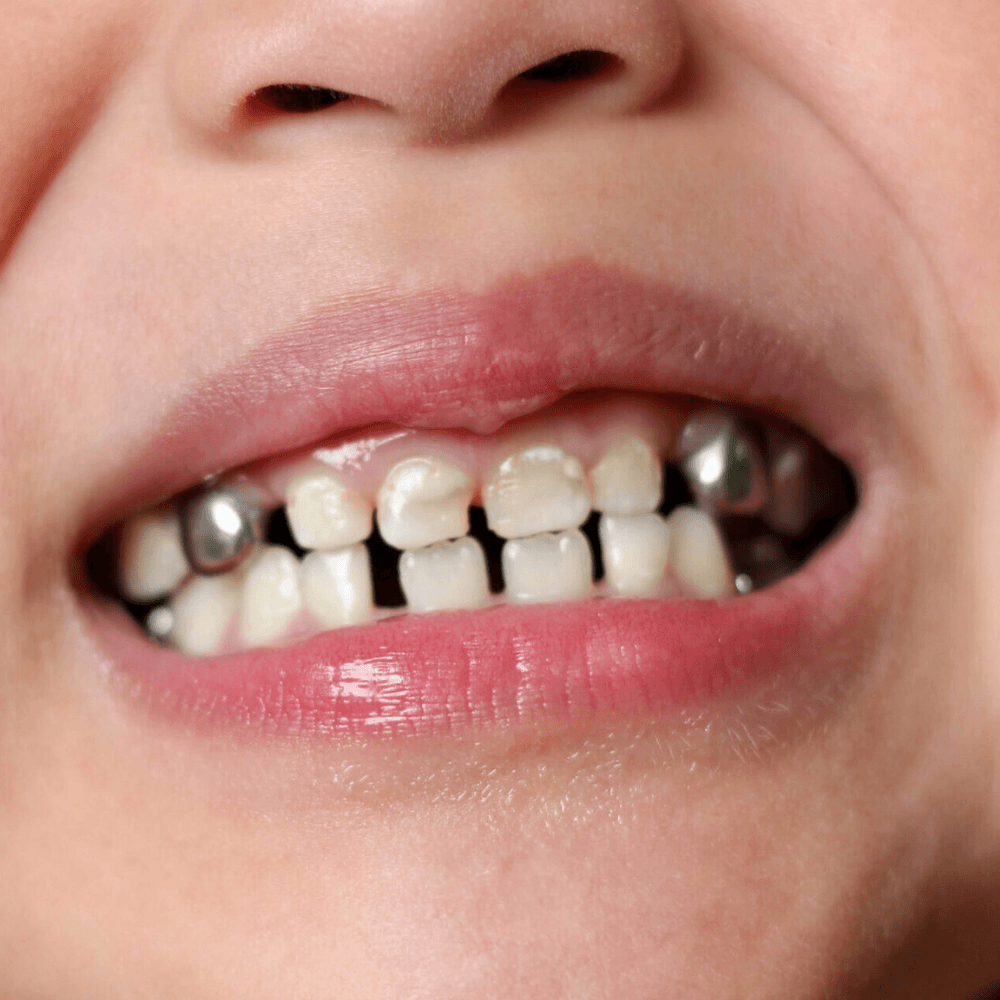
A stainless steel crown is a metal cap that covers the entire tooth, used to protect severely damaged baby teeth. It is also known as a "pediatric crown" or "metal crown." It is abbreviated as SSC. These crowns are prefabricated in different sizes specifically for baby teeth. This allows the appropriate size to be selected for each tooth and placed quickly. Unlike adult crowns, stainless steel crowns come in ready-made sizes, can be applied quickly, and are more cost-effective. They are rarely used on front teeth where aesthetic expectations are higher, and are mostly applied to back molars.
Stainless steel crowns are most commonly placed on baby teeth after pulpotomy or baby tooth root canal treatment. After these procedures, the tooth becomes much more prone to fracture. Without crown protection, it cannot withstand chewing forces and will break in a short time. Stainless steel crowns are also used for teeth with extensive cavities, teeth with tissue loss too large for a filling to hold, teeth with developmental enamel defects, and baby teeth fractured after trauma.
Before the procedure, the pediatric dentist reassures the child and explains the treatment. Local anesthesia is applied. The tooth is minimally reduced to allow the crown to fit—there is no extensive tooth preparation as with adult crowns. The appropriately sized crown is selected from the prefabricated set and fitted onto the tooth. If necessary, the edges are crimped to adapt to the gum line. After checking the bite, the crown is cemented in place with special adhesive. The entire procedure takes 30 to 45 minutes and is usually completed in a single visit.
The stainless steel crown protects the baby tooth until its natural shedding time. When the time comes, the permanent tooth erupting from below resorbs the roots of the baby tooth, and the crown falls out along with the baby tooth. This eliminates the need for a separate removal procedure. The crown allows the tooth to function normally and maintain space for the underlying permanent tooth. Early loss creates the need for a space maintainer. For newly erupted permanent molars, dental sealants and fluoride treatment are recommended for cavity protection. For all pediatric dental procedures, you can visit our pediatric dentistry page. For pricing information, see our stainless steel crown cost calculator page.
Treatment Process
Alternative Treatments
Risks and Complications
Stainless steel crown (SSC) placement is a standard procedure used in pediatric dentistry for decades, with proven safety and effectiveness. When applied with proper indication and appropriate technique, the vast majority of cases proceed without complications. However, as with any medical procedure, there are certain risks and possible outcomes that should be understood.Risk-Reducing Factors
- Proper crown size selection: Choosing a crown of the right size for the tooth is critical for fit, stability, and gum health.
- Appropriate preparation: Properly preparing the tooth supports the crown's proper seating and long-term success.
- Hygiene around the gums: Parents supervising careful brushing around the crown helps maintain gum health.
- Sticky food control: Gum, caramel candy, and sticky gummy candies increase the risk of dislodgement and should be avoided.
- Regular checkups: At 6-month checkups, the crown's condition, gum health, and the underlying tooth are evaluated.
- Child-friendly approach: Topical anesthesia and the tell-show-do technique help gain the child's trust.
When Is It Used?
Stainless steel crowns are not used for every decayed baby tooth. In cases that can be treated with a standard filling, the filling is preferred. Stainless steel crowns are considered when a filling cannot provide adequate protection or when the tooth needs additional structural support.- Baby molars with decay on two or more surfaces.
- When a large portion of the tooth crown is damaged by decay.
- When insufficient tooth structure remains for a filling.
- When structural support is needed to withstand chewing forces.
- Stainless steel crowns are standard practice after pulpotomy.
- Strongly recommended after root canal treatment.
- Pulp treatments without a crown have higher failure rates.
- Isolates the tooth's internal structure from the oral environment.
- When fillings repeatedly fall out.
- When secondary decay develops around the filling.
- When the remaining tooth structure cannot support a new filling.
- The crown covers the entire tooth, resolving the recurring problem.
- Teeth with thin or missing enamel.
- When sensitivity is a significant complaint.
- Can also be used on permanent molars in MIH cases.
- When filling protection is inadequate.
- Cases with extensive tooth fractures.
- Fractures that cannot be restored with a filling.
- As an alternative to tooth extraction.
- Early intervention after trauma is important.
- Young children whose oral hygiene habits are not yet established.
- Cases where frequent filling loss is expected.
- To avoid repeated clinic visits.
- Much longer-lasting protection compared to fillings.
After the Procedure
Stainless steel crown placement is typically completed in a single session. The goal is for your child to return to daily activities immediately after the procedure. Below you'll find important details parents should know about care after stainless steel crown placement.First 2 Hours: Anesthesia Period
- Do not eat: If local anesthesia was used, it's very important that your child not eat until the anesthesia wears off (usually 1-2 hours). Unintentionally biting the numb lip or cheek is the most common complication.
- Warn about biting: Explain to your child in age-appropriate terms not to bite their lip, cheek, or tongue.
- Fluid intake: Until the anesthesia wears off, your child can drink only room-temperature or cold water.
First Few Days: Adjustment
- High bite sensation: After crown placement, your child may feel the tooth is slightly high when biting down. This usually resolves within a few days through natural wear. If the high sensation persists, a follow-up visit is recommended.
- Foreign body sensation: For the first few days, your child will feel the metal crown in their mouth. The tongue may constantly touch the crown. This is normal, and most children adjust completely within 3-5 days.
- Gums: There may be slight gum redness or sensitivity around the crown during the first few days. This usually resolves within a few days. Gentle brushing around the crown supports gum health.
- Diet: Once the anesthesia wears off, your child can eat normally. Avoid sticky foods (gum, caramel candy).
Stainless Steel Crown Care and Hygiene
- Brushing: Careful brushing around the crown and especially at the gum line is important. Plaque buildup around the metal crown can lead to gum inflammation. Parents should supervise brushing until age 7-8.
- Flossing: Using dental floss between the crown and adjacent tooth supports hygiene.
- Avoid sticky foods: Gum, caramel candy, and sticky gummy candies increase the risk of crown dislodgement.
- Watch for hard foods: Avoid habits like chewing ice, hard nuts, or pencil biting.
Follow-Up and Monitoring
- Regular checkups: At pediatric dentistry checkups every 6 months, the crown's condition, gum health, crown integrity, and the underlying tooth are evaluated.
- If the crown comes off: Contact the clinic as soon as possible. The crown can usually be re-cemented. Make sure there's no risk of swallowing the dislodged crown.
- Monitoring the underlying tooth: For teeth that have undergone pulp treatment (pulpotomy or root canal treatment), the underlying tooth is monitored radiologically.
When Does the Crown Come Out?
- Natural exfoliation: When the baby tooth under the crown reaches its natural shedding time, it will fall out on its own along with the crown. This is completely normal and requires no additional intervention.
- As the permanent tooth erupts: In some cases, as the permanent tooth erupts, the baby tooth and crown begin to loosen together. If the baby tooth doesn't fall out naturally and is blocking the permanent tooth's eruption, it may be extracted after your dentist's evaluation.
- Swallowing the fallen crown: When the crown falls out, there's a risk your child could swallow or aspirate it. Parents should be alert when the crown begins to loosen and contact the clinic if needed.
An Important Message for Parents
Frequently Asked Questions
What is a stainless steel crown (SSC)?
Why is an SSC preferred over a filling?
Is SSC placement painful?
How long does an SSC stay in the mouth?
Does an SSC cause aesthetic concerns?
What should be done if an SSC comes off?
Treatment Pricing
Stainless Steel Crown Pricing
At Doredent, we offer transparent pricing for our international patients. As every case is different, the final treatment cost depends on your individual evaluation.
The cost of Stainless Steel Crown varies based on factors such as the number of teeth requiring crowns and the scope of case preparation. For an accurate quote, a personalized assessment is recommended.
For pricing details, reach out via WhatsApp or book your initial consultation.
Our Dentists
Meet our specialist team.


Content Information
This page was prepared by the Dore Medical Editorial Board and medically reviewed by Dr. Merve Özkan Akagündüz.
