
Retainer Wire
A thin fixed wire bonded to the back surface of your teeth after orthodontic treatment. It's invisible from the outside, works 24/7, and quietly protects your treatment results.
Medically reviewed. Last updated: May 20, 2026.What Is a Retainer Wire?
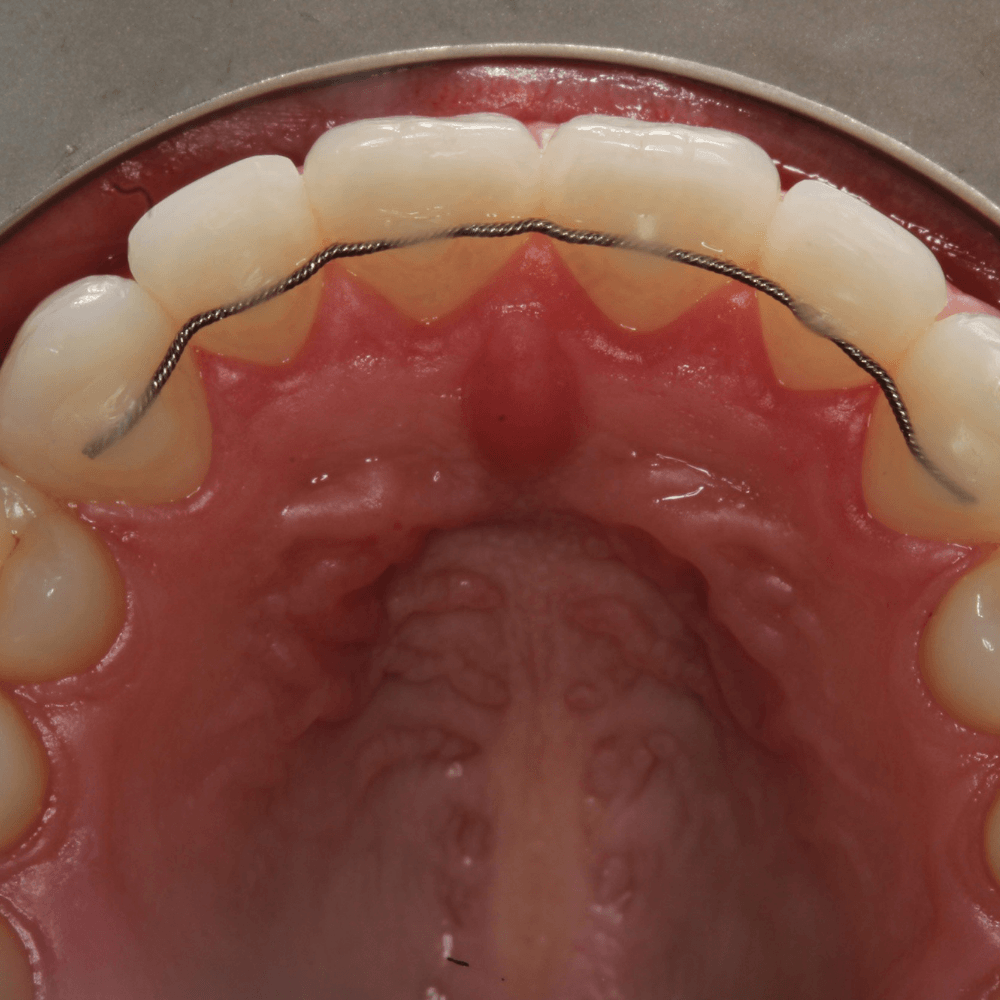
A retainer wire is a thin, fixed retention appliance bonded to the back surfaces of your teeth to maintain their new position after orthodontic treatment is complete. It's also known as a "lingual retainer" or "fixed retainer." It's typically bonded with composite to the inner surface of the front six teeth in both the upper and lower jaws. You cannot remove it yourself. It works day and night. This feature is especially advantageous for patients who struggle with retention discipline.
After orthodontic treatment, your teeth's new position is not immediately permanent. Surrounding tissues, chewing forces, and tongue pressure tend to push your teeth back toward their original positions. This is called orthodontic relapse. Without retention, the results achieved with braces or clear aligner treatment can deteriorate within months. A retainer wire prevents this movement and helps keep your teeth in their proper position for many years.
Placing a retainer wire is a simple, painless procedure. It can be done immediately after your braces removal appointment. The inner surfaces of your teeth are cleaned, and a special orthodontic wire is bonded to each tooth individually using composite bonding material. The procedure takes 30 to 45 minutes. After the wire is placed, you can return to your normal activities. Because the wire is thin and close to where your tongue rests, you may experience an adjustment period for the first few days. After that, you won't notice it.
A retainer wire can stay in place indefinitely. Orthodontists generally recommend keeping it for life. You'll need to clean the teeth under the wire carefully. Because threading regular floss becomes difficult, you should use super floss or interdental brushes. Don't neglect regular dental scaling appointments. Otherwise, plaque and tartar can build up around the wire. In some cases, a Vivera retainer may be used alongside or instead of a retainer wire. For cost information, you can visit the retainer cost calculator page.
Treatment Process
Alternative Retention Methods
Retention treatment after orthodontic treatment is not limited to a single method. Different retention options can be applied depending on the patient's orthodontic condition, treatment history, and lifestyle. At Doredent, retention treatment is planned as an integral part of orthodontic treatment; the most suitable combination for each patient is determined by Uzm. Dt. Merve Özkan Akagündüz. Below you can find the main retention methods applied at Doredent and the advantages and limitations of each.Fixed Lingual Retainer (Retainer Wire)
This is a thin, multi-stranded wire bonded to the back surface (lingual surface) of the front teeth. It is completely invisible from the outside; patients become unaware of its presence in daily life. It is typically applied from canine to canine (front six teeth) on the lower and upper jaws; coverage can be extended in some cases. Advantages:- Completely invisible from the outside because it is on the back surface of the teeth.
- Does not depend on patient compliance; works 24/7.
- Recommended for lifetime use; provides long-term stability.
- Does not affect daily life; patients quickly adapt to speaking, eating, and hygiene routines.
- Included in Invisalign and braces treatment packages at Doredent.
- May break or loosen over time; requires regular monitoring.
- Tartar can accumulate around the wire; paying attention to hygiene is important.
- Does not eliminate all relapse risk on its own; using it together with a night guard is recommended.
- Needs to be re-bonded if it breaks.
Essix Night Guard (Clear Retention Retainer)
This is a clear, thin, removable retainer that fits over the teeth, used to maintain the new position of the teeth after orthodontic treatment. Patients wear the retainer only at night while sleeping and remove it during the day. It provides a second layer of protection in addition to the fixed retainer. Advantages:- Clear and aesthetic; does not affect social life because it is worn at night.
- Also supports the position of back teeth that the fixed retainer cannot protect.
- Protects teeth from mechanical stress in patients with nighttime teeth grinding (bruxism).
- Included in orthodontic treatment packages at Doredent.
- Depends on patient compliance; its protective effect decreases if not worn regularly.
- Wears out over time; needs to be replaced at certain intervals.
- Can become discolored when in contact with staining beverages like tea and coffee.
- Risk of loss or breakage.
Invisalign Vivera Retainer
Vivera, Invisalign's special retainer system, is a more durable and longer-lasting retention option compared to standard Essix retainers. It is provided as a three-set package; each set is used for a certain period before moving to the next. This ensures long-term and uninterrupted retention. Advantages:- Significantly more durable than standard Essix retainers.
- The three-set package eliminates the need for replacement for an extended period.
- Specially manufactured using Invisalign's precise production technology; provides excellent fit to teeth.
- Produced based on iTero digital scan data, minimizing impression errors.
- Higher cost compared to standard Essix retainers.
- Not included in orthodontic treatment packages at Doredent; offered as an optional service.
- Depends on patient compliance; its protective effect decreases if not worn regularly.
Which Combination Is Applied?
Retention treatment at Doredent is typically applied not as a single method but as a combination. The standard approach is as follows:- Fixed lingual retainer + Essix night guard: This combination is included in orthodontic treatment packages at Doredent. The fixed retainer provides 24/7 protection while the night guard creates an additional safety layer.
- Fixed lingual retainer + Vivera: This is the premium combination applied for patients who prefer Vivera instead of Essix retainers. Vivera's durability and three-set structure enhance long-term retention quality.
- Removable retainer only (rare): In very rare cases where a fixed retainer cannot be applied (such as allergic reaction or anatomical unsuitability), retention can be done with a removable retainer only. This approach is entirely dependent on patient compliance.
Patients from Other Clinics
At Doredent, retainer services are provided not only to patients who received treatment at Doredent, but also to patients who underwent orthodontic treatment at other clinics and need retention. Patients whose retainer has broken, worn out, been lost, or was never applied can visit Doredent to have a fixed retainer and night guard made. For patients from other clinics, the current position of the teeth is first evaluated; if the teeth have started shifting, whether a brief orthodontic correction is needed is honestly explained. Timely application or replacement of the retainer is critically important for long-term preservation of treatment results.Important Considerations
Retainer wires and night guards do not create significant discomfort in daily life; however, certain considerations are necessary for long-term success. Below you will find the main points to pay attention to during and after retention treatment.Important Considerations for Retainer Wires
- Watch out for hard and sticky foods: Hard or sticky foods such as raw carrots, nuts, caramel candy, and chewing gum can cause the retainer wire to break. Biting with your front teeth is particularly risky. Being careful when consuming these foods extends the life of your retainer.
- Hygiene around the retainer: Tartar buildup around the fixed retainer can occur faster than normal. Thorough cleaning of this area is important. Since using regular dental floss can be difficult, superfloss or a water flosser (waterpik) is recommended.
- Quick response if the wire breaks: When the retainer breaks or becomes loose, your teeth can quickly begin to shift. When breakage is noticed, contact the clinic as soon as possible. Delay increases the risk of tooth movement.
- Regular checkups: The strength of the retainer, its bonding status, and wire integrity should be evaluated during regular dental checkups.
- Breakage fee: Retainer breakage is a situation resulting from user error; re-bonding or new retainer application is subject to an additional fee.
Important Considerations for Night Guards (Essix)
- Regular use: Use every night for the first year, then a few nights per week in subsequent years is recommended. Reduction in frequency of use is planned by Uzm. Dt. Merve; patients should not discontinue use on their own.
- Do not eat while wearing the appliance: Never eat or consume sugary beverages while wearing the night guard. Only water is allowed. Hot beverages can deform the appliance.
- Cleaning: The appliance should be rinsed with cold or lukewarm water each time it is removed. Hot water deforms the appliance. It can be gently brushed once a week with a soft toothbrush. Brushing with toothpaste can scratch the appliance surface; plain soap or retainer cleaning tablets are preferred.
- Storage: When not in your mouth, the appliance must be stored in its case. Wrapping it in a tissue or leaving it on a table is the most common cause of loss.
- Wear monitoring: Essix appliances wear down over time. They should be replaced when holes, cracks, or significant wear are observed.
- Loss or breakage: If the appliance is lost or broken, the retainer wire alone provides protection until a new one is made; however, a new appliance should be obtained as soon as possible.
Important Considerations for Vivera
- Usage protocol is the same as Essix: Nighttime use, cleaning, and storage rules are applied in the same way.
- Manage the three-set package properly: After each set is used for a specific period, move on to the next one. Follow the usage schedule determined by Uzm. Dt. Merve.
- Despite higher durability, care is still required: Vivera is more durable than standard Essix appliances; however, risks such as hard foods and hot water still apply.
General Oral Hygiene and Retention
- Brush twice daily: Regular brushing should be performed around the retainer wire and on all tooth surfaces. A soft-bristled toothbrush is preferred.
- Use dental floss or superfloss: Superfloss or retainer-compatible dental floss should be used to pass under the fixed retainer. Keeping the area around the retainer clean prevents tartar buildup.
- Professional dental scaling: Professional cleaning is applied when deemed necessary during regular checkups. Tartar accumulated around the retainer should be professionally cleaned.
- Follow-up appointments: Having an orthodontic checkup at least once a year during the retention period is important for the condition of the retainer, tooth position, and overall orthodontic status.
Who Is It For?
Retention treatment is necessary for almost every patient who has undergone orthodontic treatment. The type of treatment does not matter; after Invisalign clear aligner treatment, traditional braces treatment, or any orthodontic intervention, teeth tend to return to their original positions (relapse). Retention treatment is an essential phase that controls this tendency. Below you can find the patient profiles for whom retention treatment is most commonly applied.- Fixed lingual retainer is applied to the lower and upper jaw.
- Essix night retainer is included in the treatment package.
- Vivera retainer is optionally recommended.
- Nightly retainer wear is required for the first year.
- The retainer is applied during the braces removal session.
- Fixed retainer plus night retainer is the standard combination.
- Included in the treatment package.
- The transition is made in the same session with no gap.
- For most children, a night retainer is the standard retention method.
- If permanent front teeth have erupted, a fixed retainer may also be applied.
- Evaluated in conjunction with growth monitoring.
- Whether Phase 2 treatment is needed is assessed at a later stage.
- Fixed retainer plus night retainer is the standard combination.
- Vivera is strongly recommended in these cases.
- Retention is planned long-term and comprehensively.
- Regular orthodontic checkups are required.
- The current position of the teeth is assessed.
- If teeth have started to shift, brief orthodontic correction may be needed.
- New retainer and night retainer are applied.
- External patients can receive retainer services at Doredent.
- Fixed retainer plus night retainer is the standard combination.
- Additional palatal retention may be planned to prevent width relapse.
- Vivera is strongly recommended.
- Regular orthodontic checkups are required.
What Happens If Retention Treatment Is Not Done?
Use and Follow-Up
Retention treatment is a process that begins with the completion of orthodontic treatment and continues for life. Proper management of this process is the foundation for long-term preservation of orthodontic results. Below you can find the step-by-step protocol for retention treatment use and follow-up.Retainer Wire Use Protocol
- Application timing: The fixed lingual retainer is applied immediately at the orthodontic treatment completion session (braces removal or after the final Invisalign aligner). No gap is left in between.
- Duration of use: Lifelong. Modern orthodontic practice recommends lifelong use of fixed retainers. When the retainer is removed, there is always a risk of tooth movement.
- Feeling the retainer: A slight foreign body sensation is normal for the first few days until your tongue adjusts to the retainer. Most patients stop noticing the retainer's presence within 1-2 weeks.
- Speech adaptation: You may experience minor changes in the pronunciation of certain sounds for the first few days. This is temporary and quickly returns to normal.
Night Guard Use Protocol
- First year: Wear every night while sleeping. The first year is the most critical retention period. Skipping the appliance during this time significantly increases the risk of relapse.
- Second year and beyond: Usage frequency is gradually reduced according to the schedule determined by Merve Hoca. Typically, wearing 3-4 nights per week may be sufficient, then 2-3 nights per week in subsequent years.
- Long-term use: Many orthodontists recommend continued use of the night guard for years, even lifelong at a certain frequency. This approach supports long-term stability.
- Tight fit or pressure sensation: If the night guard feels tighter or creates more pressure than normal when worn, this may indicate that your teeth have started to move slightly. In this case, increasing guard use and contacting the clinic is recommended.
- Do not discontinue use on your own: Stopping night guard use completely should not be a patient decision. Reducing or discontinuing use is planned by Merve Hoca.
Follow-Up and Control Schedule
- First 6 months: The first 6 months after orthodontic treatment completion is the most critical retention period. Control appointments are recommended every 3 months during this time. The integrity of the retainer, tooth position, and compliance with night guard use are evaluated.
- 6 months - 2 years: Control appointments every 6 months are sufficient. Tooth stability typically increases significantly during this period, but adherence to the retention protocol remains important.
- After 2 years: Orthodontic checkups at least once a year are recommended. The condition of the retainer, tooth position, and wear on the night guard are evaluated.
- Routine dental checkups: In addition to retention controls, standard 6-month dental checkups are sufficient to monitor both general oral health and retainer condition.
In Case of Retainer Breakage or Night Guard Loss
- Retainer breakage: When all or part of the fixed retainer breaks, the clinic should be contacted as soon as possible. After the retainer breaks, teeth can start moving within even a few days. Breakage is typically caused by user error. Reattachment or new retainer application is subject to additional fees.
- Night guard loss or breakage: If the guard is lost or broken, the fixed retainer continues to provide protection on its own. However, a new guard should be made as soon as possible. For patients without a retainer, guard loss is an emergency.
- If tooth movement is noticed: Feeling more tightness or pressure than normal when wearing the night guard indicates that teeth have started to move slightly. In this case, guard use frequency should be increased and the clinic should be contacted. Early intervention can resolve the issue with short-term correction, while delay may require comprehensive retreatment.
The Secret to Long-Term Retention Success
Frequently Asked Questions
What is a retainer wire and why is it necessary?
How long should a retainer wire be worn?
Is a retainer wire visible?
What is the difference between an Essix night guard and Vivera?
Is a fixed retainer sufficient, or is a night guard also necessary?
I had treatment at another clinic—can I get a retainer at Doredent?
What happens if retention treatment is not done?
What should I do if my night guard feels tight?
Treatment Pricing
Retention Treatment (Retainer Wire) Pricing
At Doredent, we offer transparent pricing for our international patients. As every case is different, the final treatment cost depends on your individual evaluation.
The cost of Retention Treatment (Retainer Wire) varies based on factors such as the number of arches to be treated (lower, upper, or both) and the type of retainer used. For an accurate quote, a personalized assessment is recommended.
For pricing details, reach out via WhatsApp or book your initial consultation.
Our Dentists
Meet our specialist team.


Content Information
This page was prepared by the Dore Medical Editorial Board and medically reviewed by Dr. Merve Özkan Akagündüz.
