
MARPE – Non-Surgical Palatal Expansion
Non-surgical upper jaw expansion using a mini-screw-supported appliance system. Enables skeletal expansion without surgery in late adolescents and young adults.
Medically reviewed. Last updated: May 20, 2026.What Is MARPE?
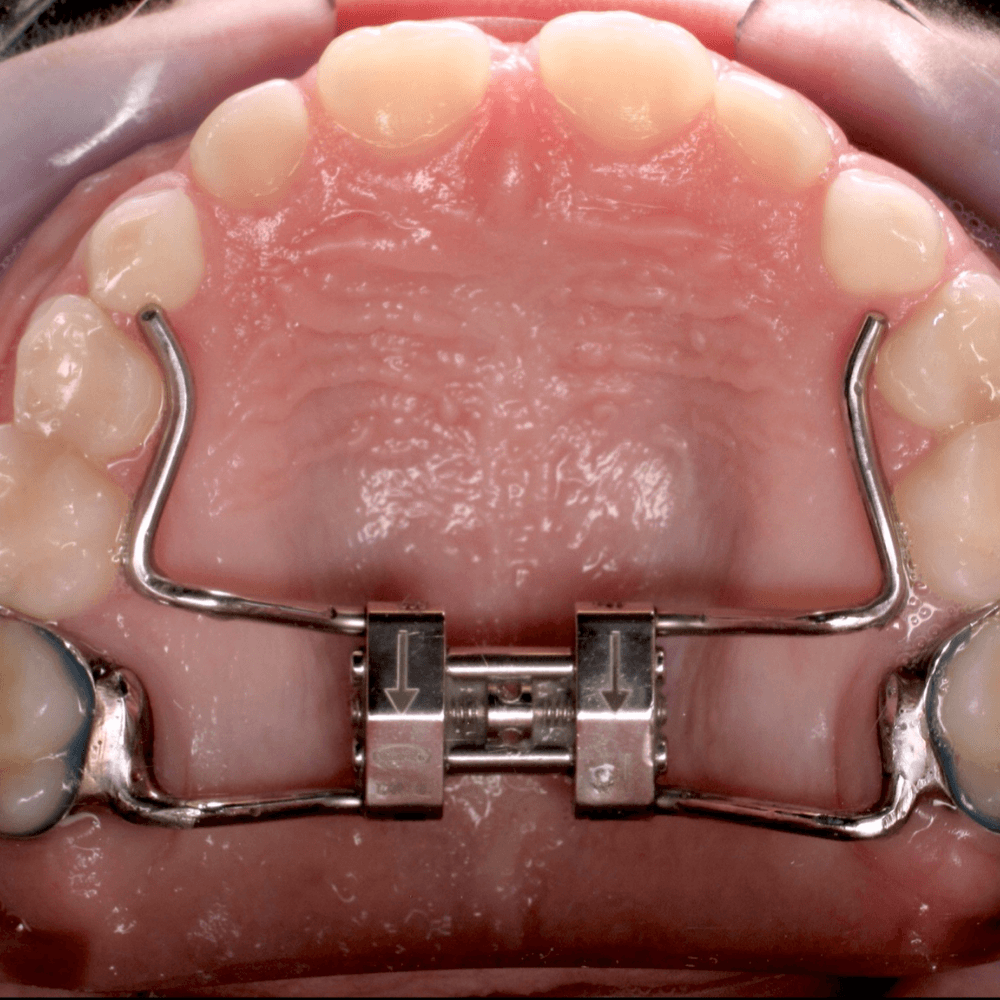
MARPE stands for "Miniscrew-Assisted Rapid Palatal Expansion." It's a treatment used to widen the upper jaw in adult and young adult patients with narrow upper jaw without surgery. Traditional rapid expansion appliances only work in children and young adolescents. After age 14-15, the midpalatal suture in the upper jaw begins to fuse, making it difficult to open with tooth-supported appliances. MARPE applies force directly to the bone through miniscrews, allowing this fused suture to be opened.
MARPE is especially used in cases of narrow upper jaw and related crossbite. When the upper jaw is narrow, teeth become crowded in the mouth, crowding develops, and nasal breathing may become insufficient. Patients typically present with complaints such as mouth breathing, snoring, difficulty chewing, and a narrow-looking dental arch in their smile line. MARPE can resolve most of these issues without surgery.
Before treatment, 3D tomography is used to evaluate the palatal structure, suture condition, and bone quality in the area where miniscrews will be placed. The appliance is digitally designed and custom-made for the patient. During the placement appointment, 4 miniscrews are placed in the palate under local anesthesia and the appliance is attached to these screws. The patient activates the appliance daily by turning its screw. The expansion phase takes an average of 2-4 weeks, during which millimeters of opening are achieved in the upper jaw. After expansion is complete, the appliance remains in the mouth for 3-6 months for retention purposes.
After MARPE treatment, braces or clear aligner treatment is applied to finalize tooth positioning. This achieves both skeletal and dental alignment. In advanced cases requiring surgery, SARPE is preferred. MARPE's biggest advantages are that it widens the upper jaw without surgery, requires no hospitalization, and has a short recovery time. For pricing information, you can visit the MARPE cost calculator page.
Treatment Process
Alternative Treatments
MARPE is a relatively new approach to upper jaw expansion that has gained attention in recent years. However, MARPE may not be the best choice for every patient. Factors such as age, the degree of palatal suture maturation, the severity of the narrowness, and additional orthodontic problems directly determine the treatment selection. At Doredent, no single method is imposed for upper jaw expansion treatment. The most suitable approach for each case is honestly recommended. Below you can find the real alternatives to MARPE for treating a narrow upper jaw, and when each one is most appropriate.Traditional Rapid Palatal Expansion (RPE / Hyrax)
In children and growing adolescents, the palatal suture is still open, so a classic expansion method can be applied directly without surgical assistance. This is also known as RPE (Rapid Palatal Expansion) or the Hyrax appliance. The appliance is fixed to the molars and the expansion force is transmitted through the teeth. Advantages:- Does not require mini screws or local anesthesia.
- Highly effective in children and growing adolescents.
- More affordable than MARPE.
- A well-understood method with decades of clinical use.
- Only effective in patients during their growth period (typically ages 7 to 14).
- In adults with advanced suture maturation, may cause tipping of the teeth rather than true skeletal expansion.
- For late adolescents and young adults, MARPE or SARPE provides more reliable results.
Surgically Assisted Rapid Palatal Expansion (SARPE)
In adult patients with fully mature sutures, when MARPE is insufficient or unsuccessful, surgically assisted expansion (SARPE) becomes necessary. In this procedure, the midpalatal suture is surgically loosened, and then an expansion appliance is used for active widening. Advantages:- Guarantees skeletal expansion in adults with completely fused sutures.
- The most reliable method for severe narrowing cases.
- Offers an effective alternative when MARPE fails.
- It is a surgical procedure that requires local or general anesthesia.
- The recovery period is longer than with MARPE.
- Significantly more expensive than MARPE and RPE.
- Carries surgical risks (bleeding, infection, swelling).
Dental Expansion (Orthodontic Treatment Only)
In mild cases of upper jaw narrowness, rather than expanding the jaw itself, the narrow appearance can be reduced by repositioning the teeth. This approach is called dental expansion or dental compensation. Advantages:- Does not require mini screws or surgery.
- The least invasive approach.
- Works within the standard orthodontic treatment process with no additional steps.
- Provides acceptable functional results in mild cases.
- Does not change the actual width of the jawbone.
- Only effective in mild narrowness cases.
- Insufficient for moderate to severe narrowing.
- Does not address functional issues such as nasal breathing difficulties.
Postponing Treatment and Regular Monitoring
In some mild narrowness cases, if the patient does not experience significant functional or aesthetic concerns, regular monitoring may be recommended instead of immediate treatment. This approach prevents unnecessary treatment burden on the patient. Advantages:- Avoids imposing unnecessary treatment on the patient.
- The most cost-effective approach.
- Allows observation of the condition's progression over years in mild cases.
- Problems related to upper jaw narrowness may persist during the monitoring period.
- As suture maturation progresses, the chances of successful MARPE may decrease, and SARPE may become necessary later.
- Requires regular checkups.
Which Treatment Is Right for You?
Choosing the right method for treating upper jaw narrowness depends on the following factors:- Age: RPE is preferred in children and adolescents, MARPE in late adolescents and young adults, and SARPE in mature adults.
- Suture maturation level: Three-dimensional cone beam computed tomography (CBCT) is used to assess the degree of suture closure. This is the foundation for deciding between MARPE and SARPE.
- Severity of narrowing: Dental compensation may suffice in mild cases, while skeletal expansion is necessary for moderate to severe cases.
- Accompanying orthodontic problems: Conditions such as crossbite, crowding, or mandibular anomalies shape the treatment plan.
- Patient preference: For suitable patients who wish to avoid surgery, MARPE is the priority option.
- Overall health status: In cases requiring surgery, the patient's general health is taken into account.
Risks and Complications
MARPE is a clinically well-researched treatment method that has gained prominence in modern orthodontics in recent years. Success rates are high when combined with proper patient selection, digital surgical planning, and regular follow-up. However, because MARPE involves both mini-screw placement and active skeletal expansion, there are a number of risks and complications you should be aware of. At Doredent, transparently sharing all risks so our patients can make informed decisions is a fundamental principle. Below, you can find a clear overview of the risks that may be encountered during MARPE treatment. The majority of these risks are rare and can be largely minimized with proper planning.Risk-Increasing Factors
Certain conditions can increase the risk of complications during MARPE treatment. These factors do not mean treatment cannot be performed, but they do require additional evaluation, special planning, or addressing certain conditions first.- Advanced suture maturation: As age increases, the midpalatal suture gradually fuses. In fully fused cases, MARPE may fail; in such cases, SARPE is planned. Suture assessment using CBCT is performed before the procedure.
- Inadequate oral hygiene: Plaque accumulation around mini-screws and the appliance area significantly increases infection risk. Regular and meticulous hygiene is the foundation of MARPE success.
- Active gum disease: Periodontal problems can negatively affect mini-screw integration and appliance success. Dental scaling and if necessary curettage must be completed before treatment.
- Smoking and tobacco use: Negatively affects mini-screw healing and bone tissue adaptation. Reducing or quitting smoking during treatment is strongly recommended.
- Non-compliance with activation protocol: If the patient does not turn the activation screws at home as instructed, expansion will not reach the desired level. Treatment time extends and results fall short of expectations.
- Uncontrolled systemic diseases: Diabetes and immunosuppressive treatments can negatively affect healing and require additional evaluation.
- Bisphosphonate use: In patients using these medications for osteoporosis, mini-screw and bone healing may be affected. Use history is always investigated.
- Missed follow-up appointments: Regular clinical monitoring during treatment makes the active expansion phase safe and effective. Missed appointments increase complication risk.
- Trauma: Impact to the face or palate while the appliance is in place can cause screws to loosen or the appliance to malfunction. Caution is important for patients who play sports.
How Are These Risks Managed at Doredent?
The vast majority of potential risks in MARPE treatment can be minimized through proper patient selection, comprehensive planning, and regular follow-up. The main components of the approach applied at Doredent are:- Detailed clinical and radiological evaluation: Before the procedure, panoramic X-ray, cephalometric analysis, and especially three-dimensional cone-beam computed tomography (CBCT) are used to thoroughly assess suture maturation level (Angelieri classification). This evaluation forms the basis for the MARPE or SARPE decision.
- Proper patient selection: Treatment is planned only for patients who are clinically suitable for MARPE. In cases with advanced suture maturation, SARPE is directly recommended; unnecessary failed MARPE attempts are avoided.
- Proper mini-screw placement: Screws are placed by Uzm. Dt. Merve Özkan Akagündüz under local anesthesia in a way that protects anatomical structures (nerves and vessels).
- Patient education: Before treatment, the patient is thoroughly informed about the activation protocol, hygiene rules, expected side effects, and emergency contact channels.
- Preparatory treatments: If active gum disease, cavities, or hygiene problems exist, these issues are resolved before MARPE.
- Regular clinical monitoring: The active expansion phase is closely monitored with frequent check-up appointments. Activation rate and progression are adjusted according to the case.
- Retention protocol: After active expansion is complete, the appliance remains in the palate for at least 4-6 months for retention purposes. An appropriate retention plan is then implemented.
- SARPE alternative: If MARPE fails or is not initially suitable, a SARPE alternative is offered in coordination with our contracted maxillofacial surgeon Uzm. Dt. Tayfun Cıvak.
- Emergency protocol: Open communication channels are provided for patients in case of appliance malfunction, screw loosening, or signs of infection.
Who Is MARPE Suitable For?
MARPE is not a suitable treatment option for every case of narrow upper jaw. This method is intended for a specific patient group whose upper palate suture is still flexible and who have a chance of skeletal expansion without surgery. Below, you can find the patient profiles for whom MARPE is most frequently applied and situations that require additional evaluation for this treatment.An Important Prerequisite: Suture Maturation Level
- Suture evaluation is performed with CBCT.
- Skeletal expansion can be achieved without surgery.
- There is the maturity capacity to comply with the activation protocol.
- Treatment takes 6-12 months including the retention phase.
- Jaw development and tooth alignment are corrected together.
- Chewing balance is re-established.
- For detailed information, you can review the crossbite page.
- Orthodontic completion is required after MARPE.
- The jaw is expanded to create space for teeth.
- Extraction of healthy teeth can be prevented.
- For detailed information, you can review the crowding page.
- Completed with Invisalign or braces afterward.
- Nasal cavity volume increases.
- Nasal breathing quality may improve.
- ENT consultation may be recommended.
- Can provide supportive effect in mild sleep apnea cases.
- The dark area at the sides when smiling decreases.
- A wider and fuller smile is achieved.
- The balance of facial proportions improves.
- Stands out in cases with high aesthetic expectations.
- General anesthesia is not required.
- There is no post-surgical recovery period.
- It is an outpatient treatment process.
- However, success depends on the suture maturation level.
- Extraction of healthy teeth is avoided.
- Orthodontic treatment duration is optimized.
- Jaw size is brought into alignment with orthodontic goals.
- Applied as the first phase of comprehensive treatment planning.
- Advanced sleep apnea cases require orthognathic surgery.
- Coordinated planning is made with sleep medicine and ENT specialists.
- Evaluation with polysomnography is recommended.
- May not be sufficient alone; additional treatments may be needed.
Which Patients Require Additional Evaluation?
In some situations, additional evaluation, preparation, or a different planning approach is needed before MARPE. This does not mean treatment cannot be performed; it often means an additional step needs to be added or certain conditions must be met first.- Adults with fully closed suture: In cases where the suture maturation level on CBCT is at stage D or E, MARPE may fail. For these patients, SARPE is a more reliable alternative.
- Children and adolescents in growth phase: In children aged 7-14, the suture is still open, so a conventional rapid expansion appliance (RPE) is usually sufficient. MARPE remains unnecessarily invasive in this age group.
- Patients with active gum disease: Healthy periodontal tissue is required for successful mini-screw retention. Before treatment, dental scaling and if necessary curettage are completed.
- Patients with active cavities: All active cavities must be treated before MARPE. Filling or if necessary root canal treatment is completed.
- Inadequate oral hygiene: Plaque accumulation around the mini-screws increases infection risk. Improving hygiene habits before treatment is important.
- Heavy smokers: Smoking negatively affects mini-screw healing and bone adaptation. Reduction or cessation during treatment is strongly recommended.
- Bisphosphonate and biological agent use: These medications can affect mini-screw and bone healing. History of use must be investigated.
- Uncontrolled systemic diseases: Diabetes, immunosuppressive treatments, and uncontrolled chronic diseases require additional evaluation.
- Inadequate palatal anatomy cases: There must be sufficient bone thickness in the palate to place mini-screws. This is evaluated with CBCT before surgery.
- Patients who cannot comply with activation protocol: With MARPE, the patient performs active activation at home. For patients who cannot comply with the disciplined activation protocol, an alternative approach may be evaluated.
- Pregnancy period: Routine orthodontic treatment can continue; however, new MARPE planning is generally postponed until after delivery.
- Special situations in palatal anatomy: In patients with cleft palate, previous palatal surgery, or congenital anomalies, MARPE requires special planning; a multidisciplinary team approach is essential.
What Steps Are Taken at the Initial Examination?
Whether MARPE is suitable for you is determined after a comprehensive evaluation at the initial examination. The basic steps of this evaluation are as follows:- Clinical examination: Our orthodontist Uzm. Dt. Merve Özkan Akagündüz examines the degree of upper jaw narrowness, bite relationship, tooth position, and general orthodontic status.
- Three-dimensional cone-beam computed tomography (CBCT): Suture maturation level (Angelieri classification) is evaluated; this is the basis for the MARPE or SARPE decision. Palatal anatomy, suitable areas for mini-screw placement, and anatomical structures (nerves, vessels) are examined in detail.
- Cephalometric analysis: Jaw-facial relationship and tooth position are evaluated in terms of orthodontic goals.
- Orthodontic plan development: It is determined whether MARPE will be applied alone or as part of comprehensive orthodontic treatment (Invisalign or braces).
- Patient information: Treatment duration, activation protocol, expected outcome, risks, and cost are clearly explained. The decision is made together with the patient.
After Treatment
MARPE treatment does not end when the active expansion phase is complete. The active expansion process is only the first stage of treatment; afterward, retention, orthodontic completion, and long-term follow-up periods begin. Proper management of this process is critical for long-term preservation of the skeletal expansion achieved with MARPE. Below you can find the post-MARPE period step by step, with all its stages.The First Week After Active Expansion
After the patient completes the active activation protocol at home, the first week is an important transition period. During this period, significant changes occur in the palate and a diastema (gap) becomes visible between the front teeth.- Observing the diastema: During the active expansion process, the midline suture opens, creating a noticeable gap between the two front teeth. This is a positive sign that MARPE is working successfully; it is not a cause for concern. The gap will be closed during the subsequent orthodontic treatment process.
- Sensitivity and pressure sensation: A mild pressure sensation in the teeth, palate, and nasal-facial region during the final period of active expansion is normal. This typically resolves completely within a few days.
- Diet: A soft and careful diet is recommended for the first week. Avoid hard, sticky, and foods that could damage the appliance.
- Oral hygiene: Meticulous oral hygiene is applied to prevent plaque buildup around the mini-screws and appliance. Use a soft toothbrush, water flosser, and antiseptic mouthwash solution.
- Clinical checkup: After active expansion is completed, a control appointment is scheduled with Uzm. Dt. Merve Özkan Akagündüz. The success of the expansion is evaluated clinically and radiologically.
Retention Period (4-6 Months)
After active expansion is completed, the MARPE appliance is not removed immediately. The appliance remains in the palate for at least 4-6 months for retention purposes. This period is a critical stage for the long-term success of MARPE.- Maturation of new bone: During the active expansion period, as the suture opens, new bone formation (callus) begins between the two bone segments. Full maturation and hardening of this new bone takes 4-6 months. During this process, the appliance remains fixed in the palate to protect the new bone tissue.
- No active activation: During the retention period, the patient no longer turns the screw. The appliance serves only a retention function.
- Periodic checkups: During this period, regular control appointments are scheduled with Merve Hoca. Appliance control, mini-screw status, and oral hygiene are evaluated.
- Continuing oral hygiene: Careful attention to hygiene must continue during the retention period.
- Diastema management: During the retention period, the gap between the front teeth may begin to close partially on its own. Complete closure is achieved with subsequent orthodontic treatment.
Removal of the MARPE Appliance
After the retention period is completed and it is clinically confirmed that the new bone tissue has matured sufficiently, the MARPE appliance is removed. This procedure is usually painless and completed quickly in clinical conditions.- Removal of mini-screws: Mini-screws are removed quickly in clinical conditions without requiring local anesthesia. The patient may feel slight pressure during this procedure but does not experience pain.
- Removal of the appliance: The appliance is removed from the palate; it does not leave any permanent marks on the teeth.
- Healing of screw sites: The sites where the mini-screws were removed heal completely within a few days; usually no trace remains.
- Palate adaptation: After the appliance is removed, the tongue readapting to the palate may take a few days. This process is brief and easy.
- Overall evaluation: After the appliance is removed, the expansion achieved, occlusal relationship, and tooth positions are reevaluated.
Next Stage: Orthodontic Completion
MARPE is not a treatment by itself; it is the upper jaw expansion stage. After the appliance is removed, orthodontic treatment begins to bring the teeth to their final positions and adjust the occlusal relationship. This stage is conducted at Doredent by Merve Hoca.- Treatment option: Depending on the patient's preference and clinical situation, Invisalign clear aligner treatment or traditional braces treatment can be applied. At Doredent, Invisalign treatment with Diamond Provider experience is offered as a prominent option.
- Closing the diastema: The gap between the front teeth formed after active expansion is gradually closed with orthodontic treatment. This process typically takes several months.
- Crossbite correction: If the patient has a crossbite accompanying upper jaw narrowness, this is also corrected with orthodontic treatment.
- Final alignment of teeth: The teeth are brought to their ideal positions in the expanded upper jaw.
- Comprehensive treatment duration: Orthodontic completion after MARPE can take 12-24 months. This duration depends on the clinical requirements of the case.
Retention Treatment
After all orthodontic completion is finished, orthodontic retention treatment begins. This is an integral stage that ensures long-term preservation of treatment results.- Fixed lingual retainer: A thin wire bonded to the back surface of the front teeth continuously maintains the position of the teeth. This is the standard retention method for adult orthodontic treatment.
- Night guard: In addition to the fixed retainer, use of a night guard is recommended. Nightly use for the first year, then several nights per week in subsequent years may be sufficient.
- Vivera (optional): Vivera can be chosen as a high-quality clear retainer system. Its three-set package ensures long-lasting durability.
- Width retention: After treatment of upper jaw narrowness, an additional palatal retention appliance may be recommended in some cases to prevent relapse. This is important for preserving the skeletal expansion achieved with MARPE.
- Annual checkups: During the retention period, orthodontic checkups are performed at least once a year. The condition of the retainer and tooth positions are evaluated.
Long-Term Care and Follow-Up
Certain habits are important for long-term preservation of the results achieved with MARPE. These habits support the lifelong health of treatment outcomes.- Compliance with retention protocol: Strict adherence to the night guard and retainer use protocol recommended by your doctor is essential. Skipping retention is the main cause of relapse.
- Regular oral hygiene: Brushing twice a day, flossing, and regular oral care are the foundation of long-term oral health.
- Routine dental checkups every 6 months: Standard 6-month checkups are sufficient to monitor both orthodontic status and general oral health.
- Annual orthodontic checkup: At least one orthodontic checkup per year during the retention period is important for the condition of the retainer and width stability.
- Professional dental scaling: Professional cleaning is applied during regular checkups when deemed necessary.
- Bruxism management: If you have a nighttime teeth-grinding habit, use the night guard recommended by your doctor regularly. Bruxism can be a significant cause of post-treatment relapse.
- Avoiding smoking and alcohol: Reducing smoking and alcohol is recommended to support overall oral and dental health.
Expected Improvements After MARPE
After successful MARPE treatment, patients generally experience the following improvements:- Increased upper jaw width: True skeletal expansion of the upper jaw is achieved; a permanent structural change is obtained, unlike dental compensation.
- Correction of crossbite: In cases of crossbite associated with upper jaw narrowness, the occlusal relationship normalizes.
- Reduced crowding: Space is gained in the upper jaw, allowing orthodontic treatment to address crowded teeth; extraction of healthy teeth is avoided.
- Wider and fuller smile: The dark spaces on the sides when smiling are reduced, and smile aesthetics improve.
- Improved nasal breathing: As nasal cavity volume increases, nasal breathing quality may improve; quality of life improves significantly in these patients.
- Improvement in mild sleep apnea: The airway is supported; improvement may be seen in cases of mild sleep apnea.
- Surgery avoided: In suitable cases, it means that a surgical procedure like SARPE is unnecessary; the patient achieves similar results without experiencing the surgical process.
Rare Problems and Management
Rare problems may be encountered after MARPE. Early detection and prompt intervention for these problems are important for treatment success.- Partial relapse: Partial relapse may occur if the retention protocol is not followed. If detected early, it can be managed with additional retention.
- Local sensitivity after mini-screw removal: Mild sensitivity in the area where the screws were removed for a few days is normal. If severe pain or signs of inflammation occur, contact the clinic.
- SARPE alternative after MARPE failure: Very rarely, sufficient skeletal expansion may not be achieved with MARPE. In this case, SARPE is planned in coordination with our contracted oral surgeon Uzm. Dt. Tayfun Cıvak.
- Gum recession: Gum recession may rarely occur in the mini-screw areas. This condition usually remains limited and is managed with clinical follow-up.
An Important Message for the Patient
Frequently Asked Questions
What is MARPE and how does it work?
Who is a candidate for MARPE?
Is MARPE treatment painful?
How long does MARPE treatment take?
Will a gap form between my front teeth during active expansion?
Can MARPE fail?
Is orthodontic treatment mandatory after MARPE?
Do mini-screws leave permanent marks on the palate?
Will MARPE really improve my nasal breathing?
Treatment Pricing
Non-Surgical Maxillary Expansion (MARPE) Pricing
At Doredent, we offer transparent pricing for our international patients. As every case is different, the final treatment cost depends on your individual evaluation.
The cost of Non-Surgical Maxillary Expansion (MARPE) varies based on factors such as the scope of the case, type of appliance used, and total treatment duration. For an accurate quote, a personalized assessment is recommended.
For pricing details, reach out via WhatsApp or book your initial consultation.
Our Dentists
Meet our specialist team.


Content Information
This page was prepared by the Dore Medical Editorial Board and medically reviewed by Dr. Merve Özkan Akagündüz.
