
Mandibular Retrognathia
Orthodontic and skeletal treatment for mandibular retrognathia, where the lower jaw sits behind the upper jaw. Jaw guidance in children, camouflage treatment or surgical planning in adults.
Medically reviewed. Last updated: May 18, 2026.What Is Mandibular Retrognathia?
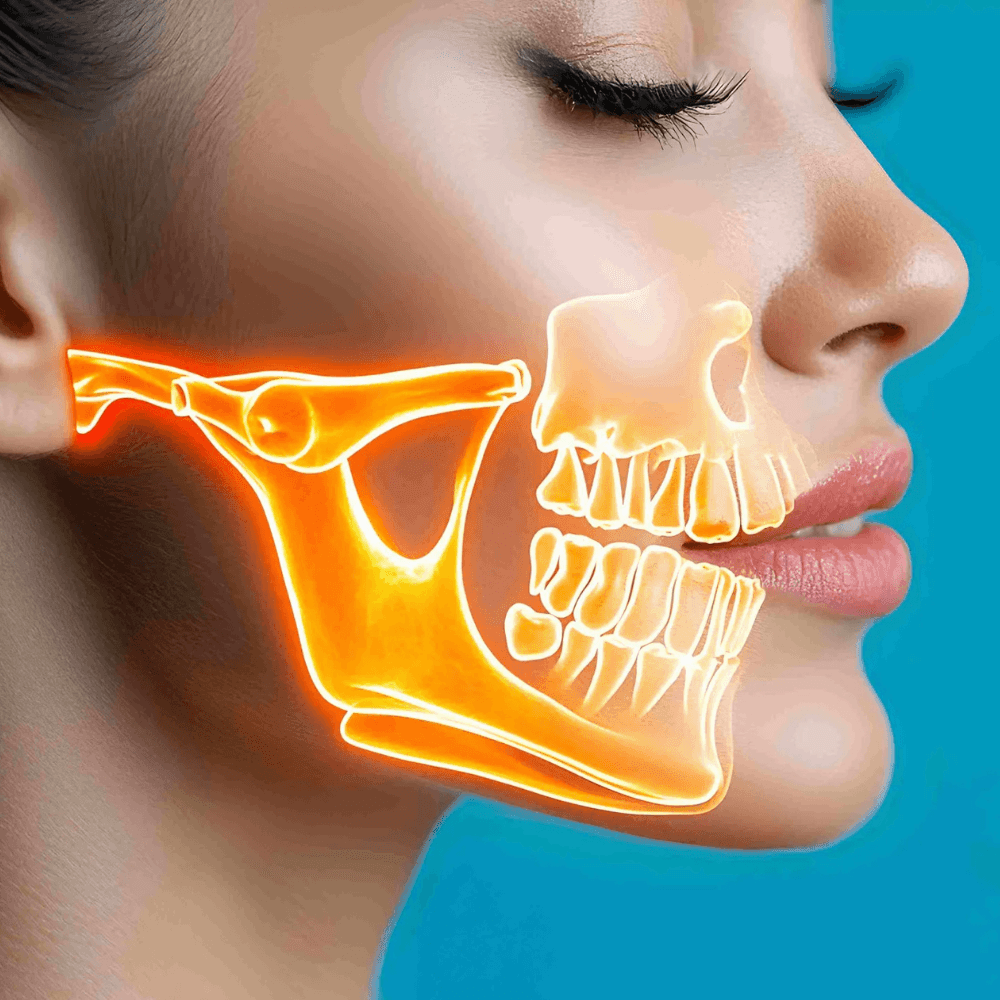
Mandibular retrognathia is a skeletal problem where the lower jaw is positioned behind the upper jaw, causing the chin to appear noticeably recessed in the facial profile. Medically known as mandibular retrognathia, it causes both aesthetic and functional problems. Patients experience a disrupted smile line, a small-looking chin, and an overall facial imbalance. It can also lead to serious functional issues such as difficulty chewing, jaw joint pain, snoring, and sleep apnea.
Mandibular retrognathia can develop due to genetic factors, childhood habits (thumb sucking, prolonged pacifier use, mouth breathing), or untreated orthodontic problems in early life. It often appears alongside deep bite and a protruding upper front teeth appearance. Jaw joint clicking, jaw pain, and TMJ disorders are also common accompanying complaints in these patients.
Treatment approach varies depending on the patient's age and severity of the problem. In children and adolescents during their growth and development period, it is possible to guide the lower jaw forward using functional appliances. Intervention during this period can eliminate the need for surgery later. In adult patients, skeletal growth is complete, so the problem can only be camouflaged at the dental level or surgical solutions are required. In mild cases, teeth can be moved using braces or clear aligner treatment to achieve visible alignment.
In severe cases, orthodontic treatment alone is not sufficient and orthognathic surgery is required. In this surgical procedure, the lower jaw bone is precisely cut, brought forward, and fixed in its new position. Orthodontic treatment is performed before and after surgery. The total process can range from 18 to 24 months. When treatment is complete, both facial aesthetics and chewing function improve significantly. Patient complaints such as snoring and sleep apnea also decrease. After surgery, use of a TMJ splint may be recommended for jaw joint issues.
Treatment Methods
There is no single standard approach for treating mandibular retrognathia. Factors such as the patient's age, growth and development status, whether the problem is skeletal or dental, and its severity directly determine the treatment choice. At Doredent, all approaches for mandibular retrognathia are planned by Uzm. Dt. Merve Özkan Akagündüz according to the clinical case. Below you'll find a quick overview of the main treatment methods applied at Doredent.- Age range: typically 8-13 years, during the growth period.
- Twin Block, Herbst, or Frankel appliances are applied depending on the case.
- Treatment duration is approximately 12-18 months.
- Early intervention may prevent the need for orthognathic surgery later.
- Age range: typically 8-16 years.
- Aesthetic treatment is achieved with clear aligners.
- Orthodontic correction and jaw advancement are performed together.
- Applied with Diamond Provider experience.
- Applied with Invisalign or conventional braces.
- The jawbone does not change; teeth are brought to new positions.
- Effective in mild to moderate mandibular retrognathia cases.
- Treatment duration is approximately 12-24 months.
- Pre-surgical and post-surgical orthodontic preparation is performed at Doredent.
- The surgical procedure is performed by Oral and Maxillofacial Surgery Specialist Uzm. Dt. Tayfun Cıvak.
- The procedure is performed under general anesthesia in a hospital setting.
- This is the only method that can achieve significant facial profile changes.
How Is the Right Method Determined?
Which treatment method is appropriate for you is determined through clinical and radiological evaluation at the initial examination. In this evaluation, the following factors are considered together:- Age and growth status: While growth guidance is possible in children and adolescents, skeletal change is not possible in adults.
- Type of problem: Is the issue only in tooth alignment, or in the position of the jawbone? This distinction directly affects treatment selection.
- Severity level: Different approaches are required for mild and moderate cases versus severe cases.
- Aesthetic expectation: The patient's expectation for facial profile change is an important factor affecting treatment choice.
- General health status: Especially in cases requiring surgery, the patient's general health is taken into account.
Problems Treated
Mandibular retrognathia is an orthodontic condition that can affect many areas, from the alignment of teeth to a patient's facial profile, chewing balance, and even sleep quality. Although the severity and structural characteristics vary from patient to patient, the consequences of this problem generally fall into similar categories. Below you can find the main problems addressed with mandibular retrognathia treatment.- A "receding chin" appearance emerges in the side profile.
- The chin-neck line may lose its definition.
- The upper lip sits further forward than the lower lip.
- An imbalance is felt in the lower third of the face.
- Upper front teeth are significantly ahead of lower teeth.
- Excessive overjet (horizontal tooth relationship) is seen.
- In some cases, upper teeth may rest on the lower lip.
- Proper chewing relationship cannot be achieved.
- Excessive chewing load occurs on certain teeth.
- Risk of enamel wear and tooth fracture increases.
- Chewing efficiency may decrease.
- Difficulty chewing some foods may be experienced.
- Pain and tenderness in the jaw joint may occur.
- Clicking sounds may be experienced when opening the jaw.
- Jaw fatigue may occur upon waking in the morning.
- May be associated with chronic headaches.
- Snoring at night may significantly increase.
- Sleep quality decreases and you may wake up unrefreshed.
- Daytime fatigue and difficulty concentrating may occur.
- In advanced cases, risk of sleep apnea increases.
- Difficulty may occur in pronouncing certain sounds.
- Speech may sound lisped.
- May affect language and speech development in children.
- Pronunciation improvement may be seen after treatment.
- Avoidance of smiling and taking photos may occur.
- Self-confidence in social settings may decrease.
- May have a particularly pronounced effect during adolescence.
- Increased self-confidence is frequently observed after treatment.
- Lips may not fully close at rest.
- Mouth breathing habit may develop.
- Risk of gum dryness and gum disease increases.
- Color changes may occur in upper teeth.
Why Is Early Diagnosis Important?
When mandibular retrognathia is detected during childhood and the growth development period, true skeletal correction can be achieved by guiding jaw development. After growth is completed, treatment options differ and orthognathic surgery may be required in some cases. For this reason, the first orthodontic examination in children around age 7-8 is critical for early detection of skeletal problems such as mandibular retrognathia. In the orthodontic evaluation conducted at Doredent by Uzm. Dt. Merve Özkan Akagündüz, not only the alignment of teeth, but also jaw structure, facial profile, chewing relationship, and the patient's growth period are considered together. The most appropriate treatment approach for the patient's age and clinical condition is honestly recommended.Treatment Process
Alternative Treatments
There is no single approach to treating mandibular retrognathia. Factors such as the patient's age, growth and development status, whether the problem is skeletal or dental, and its severity directly determine the treatment choice. At Doredent, all treatment options for mandibular retrognathia are evaluated based on the clinical case—no single method is imposed. Below you can find the main treatment approaches applied at Doredent and which method is preferred in which situation.Functional Appliances in Children
In growing children, functional appliances are the most powerful tool for mandibular retrognathia. These appliances guide jaw development by enabling the lower jaw to move forward. What matters is that this treatment provides true skeletal correction, which is only possible during the growth period. At Doredent, Merve Hoca applies different functional appliances for mandibular retrognathia cases in children, depending on the case:- Twin Block: A two-part, removable appliance system. The child can put it on and take it off. Provides effective results in mild to moderate mandibular retrognathia cases.
- Herbst: A fixed functional appliance system. It can be preferred in cases with low motivation because it does not depend on the child's compliance. Works actively 24 hours a day.
- Frankel: One of the classic functional appliances, still applied in certain cases. Guides jaw development with soft tissue support.
Invisalign Mandibular Advancement in Adolescents
In adolescents aged 8-16, while growth potential is still ongoing, Invisalign's special application mode called Mandibular Advancement (lower jaw advancement) protocol can be used. In this protocol, the lower jaw is gradually pushed forward with clear aligners featuring a special wing design. Advantages:- Much more aesthetic compared to traditional functional appliances.
- Does not affect social life and self-confidence.
- Provides hygiene advantage—aligners are removed for brushing.
- Offers all comprehensive corrections of clear aligner treatment at the same time.
Dental Camouflage (Orthodontic Treatment) in Adults
After growth is complete, it is not possible to change the true skeletal position of the lower jaw. However, in mild to moderate cases, Class II malocclusion can be resolved by compensating (balancing) tooth positions with orthodontic treatment. This approach is called dental camouflage. At Doredent, dental camouflage in adult mandibular retrognathia cases can be applied with two methods:- Invisalign clear aligner treatment: The ideal choice for adults with high aesthetic concerns. Does not affect social life, functional.
- Traditional braces treatment: Can be applied in more complex cases or depending on patient preference.
- Only tooth positions are changed, jaw bone structure remains the same.
- Does not provide sufficient results in cases with severe skeletal retrognathia.
- Change in facial profile is limited—in cases with high aesthetic expectations, patient expectations need to be managed realistically.
- Orthognathic surgery can be considered in cases where dental camouflage is insufficient.
Orthognathic Surgery in Adults (Advanced Cases)
In adults with severe skeletal mandibular retrognathia, where dental camouflage is insufficient, orthognathic surgery may be the only permanent solution. In this surgery, the lower jaw bone is advanced as planned and fixed. The procedure is performed under general anesthesia in a hospital setting. Orthognathic surgery approach at Doredent: At Doredent, cases requiring orthognathic surgery are handled in collaboration with Oral and Maxillofacial Surgery Specialist Uzm. Dt. Tayfun Cıvak. Tayfun Hoca was Merve Hoca's classmate at dental school and is an experienced specialist with academic studies published in international peer-reviewed journals in the field of orthognathic surgery. Surgical procedures are performed under general anesthesia in a contracted hospital. The treatment process has three stages:- Pre-surgical orthodontic preparation (6-12 months): At Doredent, Merve Hoca aligns the teeth according to the desired position after surgery. This preparation ensures proper occlusion after surgery.
- Orthognathic surgery: Performed by Tayfun Hoca under general anesthesia in a contracted hospital. The lower jaw bone is brought to the planned position and fixed with special plates.
- Post-surgical orthodontic completion (3-6 months): At Doredent, Merve Hoca makes final orthodontic adjustments and brings the final occlusion to the desired level.
Postponing Treatment and Regular Monitoring
In some pediatric cases, mandibular retrognathia is mild and early intervention is not yet necessary. In this situation, regular monitoring may be recommended instead of treatment. As the child grows, how the condition progresses is observed, and if necessary, intervention is planned at the appropriate time. Advantages:- Unnecessary treatment burden is not placed on the child.
- In mild cases, spontaneous improvement may occur with growth.
- The most cost-effective approach.
- In advanced cases, the opportunity for early intervention may be missed.
- After growth is complete, treatment options become limited.
- Requires regular check-ups.
Choosing the Right Treatment: Doredent's Approach
The right choice in mandibular retrognathia treatment is made according to the patient's age, growth status, whether the problem is skeletal or dental, and its severity. Even for two patients with the same diagnosis, the most appropriate method may differ. At Doredent, no single method is imposed for mandibular retrognathia cases—the most suitable treatment for the case is chosen. Functional appliances in pediatric cases, Invisalign Mandibular Advancement in adolescents, dental camouflage in mild adult cases, and orthognathic surgery approach conducted with Tayfun Hoca in advanced adult cases are applied. In some mild pediatric cases, regular monitoring is recommended instead of treatment. At the initial examination, Merve Hoca evaluates your orthodontic condition and clinical expectations in detail and honestly explains the most suitable treatment plan for you. What matters is achieving the best result with the least invasive method.Risks and Complications
Mandibular retrognathia treatment is a well-established area of modern orthodontics and orthognathic surgery that has been practiced for many years. With proper patient selection, appropriate planning, and regular monitoring, it demonstrates high success rates. However, because mandibular retrognathia treatment is a comprehensive process involving different approaches, there are certain risks and complications you should be aware of. The type and severity of these risks vary depending on the treatment method applied. Below you will find the main risks and complications that may be encountered in mandibular retrognathia treatment.Risk-Increasing Factors
Certain conditions can increase the risk of complications in mandibular retrognathia treatment. These factors do not mean treatment cannot be performed, but they require additional evaluation and special planning.- Lack of patient compliance: Irregular use of functional appliances or Invisalign aligners directly affects treatment success. Family support is essential in child and adolescent cases.
- Late treatment presentation: Since skeletal change is not possible after growth is complete, treatment options become limited. Orthognathic surgery may be needed.
- Smoking: Negatively affects the success of both orthodontic treatment and post-surgical healing. It is strongly recommended to avoid smoking for at least several weeks before and after surgery.
- Uncontrolled systemic diseases: Diabetes, heart disease, or immunosuppressive treatments require additional evaluation, especially in surgical cases.
- Uncontrolled bruxism: Excessive chewing forces can stress orthodontic appliances during treatment and increase relapse risk afterward.
- Active gum disease: Periodontal problems must be resolved before orthodontic treatment. Dental scaling and if necessary curettage are completed.
- Unrealistic expectations: Especially in dental camouflage cases, if you expect dramatic change in facial profile, dissatisfaction may occur. Realistic management of expectations is addressed during the initial examination.
- Missing regular check-up appointments: Check-ups during orthodontic treatment are an integral part of treatment planning. Delays extend treatment time and can affect results.
How Are These Risks Managed at Doredent?
The majority of potential risks in mandibular retrognathia treatment can be minimized with proper patient selection, comprehensive planning, and regular follow-up. The main elements of the approach applied at Doredent are:- Detailed clinical and radiological evaluation: Before treatment, jaw structure, skeletal relationships, and growth status are thoroughly examined with panoramic X-ray, cephalometric analysis, and if necessary three-dimensional tomography. This evaluation performed by Merve Hoca forms the foundation of the treatment plan.
- Proper treatment selection: The most appropriate treatment method is chosen based on your age, growth status, and clinical needs. Functional appliances in children, Invisalign Mandibular Advancement in adolescents, and dental camouflage or orthognathic surgery approaches in adults are selected as most appropriate.
- Multidisciplinary approach: In cases requiring orthognathic surgery, coordinated work is done with Oral and Maxillofacial Surgery Specialist Tayfun Hoca. Pre-surgical and post-surgical orthodontic preparation is performed at Doredent, and the surgical procedure is performed under general anesthesia in a contracted hospital.
- Patient education: Before treatment, all options, expected results, risks, and limitations are clearly explained. You are enabled to make an informed decision.
- Pre-treatment preparations: If there is active gum disease, decay, or bite problems, these issues are resolved before orthodontic treatment.
- Regular check-up monitoring: Progress is monitored through regular check-up appointments during treatment. Problems detected early are resolved with minor interventions.
- Retention protocol: After treatment is completed, a detailed retention plan is applied to prevent relapse risk. Retention extends over a long period and requires regular follow-up.
Who Is It Suitable For?
Mandibular retrognathia treatment can be applied at any age, but the most appropriate treatment approach varies significantly based on the patient's age and clinical condition. The patient profiles below represent the groups most commonly treated for mandibular retrognathia. The key is applying the right treatment approach at the right time.- Jaw development can be directly guided.
- Future need for orthognathic surgery may be prevented.
- Options like Twin Block, Herbst, and Frankel appliances are evaluated.
- Foundation is laid for permanent teeth to erupt in correct position.
- Aesthetic treatment provided with clear aligners.
- Mandibular advancement and orthodontic correction performed simultaneously.
- Does not impact social life or self-confidence.
- Applied with Diamond Provider expertise.
- Invisalign or traditional braces can be applied.
- Class II malocclusion can be corrected without surgery.
- Chewing balance and tooth relationship improve.
- Change in facial profile is limited.
- Pre-surgical and post-surgical orthodontic preparation performed at Doredent.
- Surgery performed under general anesthesia at contracted hospital.
- Significant change in facial profile can be achieved.
- Entire process coordinated and monitored by specialists.
- Airway expands after orthognathic surgery.
- Sleep quality can improve significantly.
- Requires multidisciplinary approach, ENT consultation is important.
- Significant improvement in quality of life is achieved.
- Condition is monitored as child grows.
- Optimal treatment timing is determined.
- Unnecessary early intervention is avoided.
- Family is educated and process is conducted transparently.
Who Requires Additional Evaluation?
In some situations, additional evaluation, preparation, or different planning is needed before mandibular retrognathia treatment. This does not mean treatment cannot be done. It often means an additional step needs to be added to treatment or certain conditions must be met first.- Active gum disease: Periodontal issues must be resolved before orthodontic treatment. Dental scaling, and curettage if needed, are completed.
- Active cavities: Necessary repairs like fillings or root canal treatment are completed before starting orthodontic treatment.
- Uncontrolled bruxism: Severe nighttime teeth grinding can stress appliances during treatment and increase relapse risk. Night guard use is incorporated into the treatment plan.
- Heavy smokers: Smoking negatively affects both the orthodontic treatment process and healing in surgical cases. Smoking cessation before and after surgery is strongly recommended.
- Uncontrolled systemic conditions: Patients with diabetes, heart disease, or immunosuppressive therapy require coordinated planning with their physician, especially for surgical cases.
- Patients taking bisphosphonates: Jaw surgery requires additional evaluation in patients using these medications for osteoporosis.
- Children or adolescents who cannot maintain compliance: For children and adolescents who cannot comply with functional appliance or Invisalign use, alternative approaches or postponing treatment may be considered.
- Patients with unrealistic aesthetic expectations: Dramatic changes in facial profile should not be expected, especially in dental camouflage cases. Managing expectations realistically is an important part of treatment success.
- Pregnancy: Routine orthodontic treatment can continue, but new surgical planning is generally postponed until after delivery.
After Treatment
When mandibular retrognathia treatment is completed, your jaw structure and tooth positions are brought to the desired level. However, this does not mean the process is finished. The long-term success of a comprehensive orthodontic treatment like mandibular retrognathia is directly related to the retention phase and regular follow-up applied afterwards. When retention is not done or neglected, the results obtained may deteriorate over time. Below you can find the post-treatment period step by step.After Treatment in Child and Adolescent Cases
When treatment with functional appliances or Invisalign Mandibular Advancement is completed, the retention process begins to preserve the skeletal and dental gains achieved. This process is planned differently from adults because the child's growth and development continues.- Retention treatment: A night guard is used after treatment to maintain the new position of the teeth. The child wears the appliance only while sleeping at night. In some cases, a fixed retainer may also be applied to the back surface of the teeth.
- Growth monitoring: Regular follow-up is critical as the child's growth and development continues, permanent teeth will erupt, and jaw structure may change. Check-up appointments are usually planned every 4-6 months.
- Phase 2 evaluation: After all permanent teeth have erupted (usually around ages 12-13), the orthodontic status is re-evaluated. In some cases, a short-term adult Invisalign treatment may be needed for final adjustments.
- Family education: When treatment is completed, the family is informed in detail that the process is not completely finished, the child's development will continue, and regular follow-up is required.
After Adult Dental Camouflage
When dental camouflage treatment with Invisalign or traditional braces is completed, retention treatment is applied to make the new position of the teeth permanent. In adults, the tendency of teeth to relapse is managed with a different approach than children because growth is complete.- Fixed lingual retainer: The position of the teeth is continuously maintained with a thin wire bonded to the back surface of the front teeth. It is the standard retention method for adult orthodontic treatment.
- Night guard: Use of a night guard is recommended in addition to the fixed retainer. Wearing it every night for the first year, then a few nights per week in subsequent years may be sufficient.
- Vivera (optional): Vivera can be applied as a high-quality clear retainer system. Thanks to its three-set package, it lasts for a long time.
- Annual check-ups: During the retention period, orthodontic check-ups are performed at least once a year. The condition of the retainer and the position of the teeth are evaluated.
After Orthognathic Surgery
The post-orthognathic surgery period is one of the most critical stages of mandibular retrognathia treatment. Even if the surgery is successful, the care applied in the following weeks and months, the healing process, and orthodontic completion determine the long-term success of the treatment. First Week: Early Post-Hospital Period- Swelling and bruising: Significant facial swelling and bruising in the first few days after surgery is normal. Cold compresses and keeping the head elevated help during this process.
- Nutrition: In the first week, you are fed with liquid and pureed foods. Soft options like soup, yogurt, smoothies, mashed potatoes, and eggs are preferred.
- Oral hygiene: The surgical area should be cleaned gently. The special hygiene protocols recommended by your doctor must be followed.
- Medication use: Antibiotics and painkillers prescribed by Tayfun Hoca are used regularly.
- Smoking and alcohol: Smoking seriously affects healing negatively. You should stay away from smoking and alcohol completely for at least 2-3 weeks after surgery.
- Reduction of swelling: Significant swelling largely resolves within 2-3 weeks. Mild swelling may last for several months; the final facial contour becomes clear after 4-6 months.
- Transition to normal diet: You gradually transition from soft foods to normal foods. The timing of adding hard foods is determined by Tayfun Hoca.
- Nerve sensitivity: Temporary nerve sensitivity or numbness in the lower lip and chin tip is normal. In most cases, it completely resolves within weeks and months.
- Regular check-ups: Regular check-up appointments are planned by Tayfun Hoca in the early post-surgical period.
- Final orthodontic adjustments: Within 3-6 months after surgery, final orthodontic adjustments are made at Doredent by Merve Hoca. The teeth are brought to their final occlusion position.
- Retention treatment: After all orthodontic treatment is completed, a fixed lingual retainer and night guard are applied. Retention is used long-term.
- Multidisciplinary follow-up: Regular coordination is maintained between Tayfun Hoca and Merve Hoca throughout the post-surgical period. The patient is monitored continuously from both surgical and orthodontic perspectives.
Long-Term Care and Follow-up
Some habits are important to preserve the results obtained after mandibular retrognathia treatment in the long term:- Compliance with retention protocol: The night guard and retainer usage protocol recommended by your doctor must be strictly followed. Skipping retention is the main cause of relapse.
- Regular oral hygiene: Brushing twice a day, using dental floss, and regular oral care are the foundation of long-term oral health.
- Routine dental check-ups every 6 months: Standard check-ups every 6 months are sufficient to monitor both orthodontic status and general oral health.
- Annual orthodontic check-up: During the retention period, having an orthodontic check-up at least once a year is important for the condition of the retainer and the position of the teeth.
- Professional tartar cleaning: Professional cleaning is applied when deemed necessary during regular check-ups.
- Bruxism management: If you have a nighttime teeth grinding habit, the night guard recommended by your doctor should be used regularly. Bruxism can be an important cause of post-treatment relapse.
- General health: Controlled diabetes and other systemic diseases support healing after implants or orthognathic surgery.
Expected Improvements After Treatment
When mandibular retrognathia treatment is successfully completed, patients generally experience these improvements:- Aesthetic improvement: The facial profile becomes more balanced and harmonious. The jawline becomes more defined.
- Improvement in chewing balance: Chewing efficiency increases as the upper and lower teeth close in the correct relationship.
- Speech improvement: Difficulties in pronouncing certain sounds decrease.
- Jaw joint relief: Incorrect loading on the joint decreases, clicking and pain symptoms may improve.
- Improvement in sleep quality: Especially after orthognathic surgery, the airway widens, and snoring and sleep apnea symptoms may significantly decrease.
- Increased self-confidence: The aesthetic improvement in facial profile and smile positively reflects on the patient's social life and self-confidence.
An Important Message to the Patient
Frequently Asked Questions
Does mandibular retrognathia resolve on its own?
At what age is mandibular retrognathia treated?
Are only braces used in treatment?
Can mandibular retrognathia be treated in adults?
Does mandibular retrognathia affect facial profile?
What determines treatment duration?
Does every patient need orthognathic surgery?
Where is orthognathic surgery performed?
Does relapse occur after treatment?
Treatment Pricing
Mandibular Retrognathia Treatment Pricing
At Doredent, we offer transparent pricing for our international patients. As every case is different, the final treatment cost depends on your individual evaluation.
The cost of Mandibular Retrognathia Treatment varies based on factors such as the severity of the case, patient age, the treatment method selected (functional appliance, orthodontic, or surgically assisted), and treatment duration. For an accurate quote, a personalized assessment is recommended.
For pricing details, reach out via WhatsApp or book your initial consultation.
Our Dentists
Meet our specialist team.


Content Information
This page was prepared by the Dore Medical Editorial Board and medically reviewed by Dr. Merve Özkan Akagündüz.
