
Impacted Tooth Extraction
Surgical removal of teeth trapped beneath the jawbone or gum tissue. Safe intervention with detailed planning, from wisdom teeth to impacted canines.
Medically reviewed. Last updated: May 20, 2026.What Is Impacted Tooth Extraction?
Impacted tooth extraction is the surgical removal of teeth that remain trapped within the jawbone or beneath the gum tissue, unable to emerge normally into the mouth. Unlike a routine tooth extraction, the tooth is not visible. The gum tissue must be opened, the bone may need to be reduced, and the tooth is often sectioned into pieces for removal. This is why impacted tooth extraction is considered a surgical procedure.
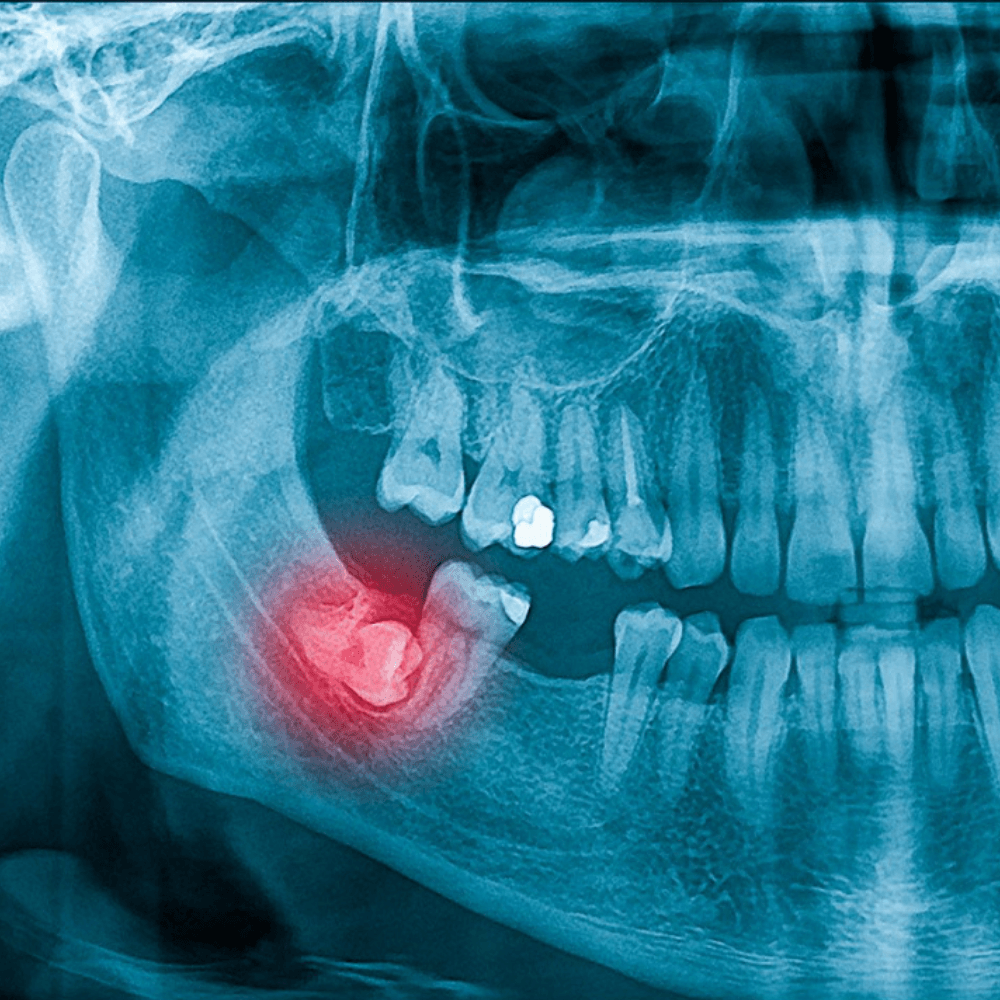
A tooth is classified as impacted when it fails to erupt into the mouth during its expected development period. This most commonly occurs with wisdom teeth because when there is insufficient space in the jaw, these teeth cannot emerge in the correct direction. They may be positioned horizontally, at an angle, or inverted, and may partially erupt while remaining beneath the gum tissue. Canine teeth, especially in the upper jaw, are also frequently impacted. Less commonly, premolars or permanent teeth waiting beneath baby teeth can remain impacted.
The decision to extract is not automatic for every impacted tooth. If the tooth causes no symptoms, does not damage neighboring teeth, and carries no infection risk, it may simply be monitored. However, extraction is often recommended. An impacted tooth is prone to gum infection, leading to recurring gum swelling and toothache. It can press against the root of an adjacent tooth, causing decay or root resorption. In some cases, it may lead to cyst formation. Additionally, for patients planning braces or clear aligner treatment, an impacted tooth that could interfere with orthodontic movement is typically removed beforehand.
Before the procedure, a panoramic X-ray and, when necessary, a 3D scan (CBCT) are used to evaluate the tooth's position, the number of roots, and its relationship to surrounding structures such as nerves and sinuses. Under local anesthesia or sedation, the gum is opened, bone may be removed if needed, and the tooth is extracted either whole or in sections. The area is sutured and healing begins. The procedure typically takes 20 to 60 minutes, depending on the tooth's position. During recovery, cold compresses during the first 24 hours, a soft diet, and prescribed medications are important. For cost information, you can visit our tooth extraction cost calculator page.
Treatment Process
Alternative Treatments
Risks and Complications
Impacted tooth extraction is one of the most commonly performed surgical procedures in dentistry, and the vast majority are completed without issues. However, working beneath the gum line or within the bone increases the likelihood of certain complications compared to standard extractions. Most of these complications are temporary and can be managed through proper planning, careful surgical technique, and patient adherence to post-extraction instructions. At Doredent, potential complications are discussed openly with patients before the procedure.Dry Socket (Alveolar Osteitis)
This is the most common complication of impacted tooth extraction. It occurs when the blood clot that should form in the extraction socket becomes dislodged or fails to form, leaving the bone surface exposed. It typically manifests 2-4 days after extraction as severe, throbbing pain that may radiate to the ear or temple. Smoking, female patients using oral contraceptives, and habits that disrupt the clot (using a straw, spitting, sucking motions) increase the risk. Treatment involves in-office dressing changes, and significant relief usually begins within a few days.Nerve Injury
The roots of impacted lower jaw teeth (especially wisdom teeth) may lie close to or in contact with the mandibular nerve canal. If this nerve is affected during extraction, numbness or tingling may occur in the lower lip, chin, or tongue. For impacted upper jaw teeth, proximity to the infraorbital nerve may cause similar symptoms in the upper lip and cheek area. The literature reports nerve complications occurring in 1-5% of cases, and in the vast majority, sensation returns spontaneously within a few weeks to months. Permanent damage is quite rare. Pre-extraction panoramic X-rays or 3D imaging are used to assess nerve canal position and minimize risk.Sinus Perforation
The roots of impacted upper jaw teeth (especially wisdom teeth and premolars) may be positioned close to the sinus floor. If the sinus membrane is perforated during extraction, a temporary connection between the mouth and sinus cavity (oro-antral communication) may form. When detected, this is managed with appropriate intervention. Patients are instructed not to blow their nose, to keep their mouth open when sneezing, and to avoid using straws. Small perforations typically heal on their own.Infection
Post-surgical infection may develop at the extraction site. It presents with symptoms such as increased swelling, fever, bad taste in the mouth, or discharge. It is controlled with antibiotic therapy and, when necessary, drainage. Maintaining oral hygiene and regularly taking prescribed medications reduces infection risk.Bleeding
Mild bleeding or oozing is normal for the first 24 hours after extraction. However, it may be more pronounced in patients taking anticoagulants (blood thinners) or those with bleeding disorders. For this reason, all medications must be disclosed to the dentist before extraction. If bleeding cannot be controlled, contact the clinic immediately.Trismus (Limited Mouth Opening)
Especially after lower jaw impacted tooth extractions, temporary stiffness in the chewing muscles and difficulty opening the mouth may occur. This is related to swelling and muscle spasm in the surgical area and typically resolves on its own within 7-10 days. As swelling decreases, mouth opening gradually returns to normal.Damage to Adjacent Tooth
Depending on the position and root structure of the impacted tooth, damage to the root, filling, or crown of an adjacent tooth may occur during extraction. This risk is higher when the impacted tooth is very close to or pressing against the neighboring tooth. Detailed imaging allows advance assessment and risk minimization, with protective approaches planned for the adjacent tooth when necessary.Jaw Fracture
This is a very rare complication. It may theoretically occur with deeply impacted lower jaw teeth, in older patients with reduced bone density, or when the tooth occupies a large area. It is prevented through proper surgical technique and controlled force application.Difficulty with Ankylosed Teeth
Some impacted teeth become fused to the surrounding bone over time (ankylosis). In these cases, the tooth cannot be removed using standard methods and requires more extensive surgery. The procedure time may be longer, more bone removal may be necessary, and the healing process may take longer than usual. Ankylosis is largely detectable through pre-extraction imaging.When Is Extraction Necessary?
Not every impacted tooth needs to be extracted. Impacted teeth that cause no problems, do not damage surrounding tissues, and can be monitored may remain in the mouth. However, the decision to extract is made based on the position of the impacted tooth, its relationship to surrounding structures, and the problems it causes or may cause. Proper timing reduces the risk of complications and makes the surgery more controlled.Situations Requiring Extraction
Recurrent infection and pericoronitis: The gum tissue covering partially erupted impacted teeth creates an environment where food debris accumulates and recurrent infections develop. If pericoronitis attacks—presenting with swelling, pain, difficulty opening the mouth, and trouble swallowing—recur regularly, extraction is considered. Resorption on the root surface of the adjacent tooth: Pressure from an impacted tooth on the root of an adjacent tooth can cause resorption (root erosion) over time. This typically progresses without symptoms and is detected on X-rays. Extraction may be necessary to protect the neighboring tooth. Cyst or pathology development: The follicular tissue surrounding an impacted tooth can create an environment for cyst formation over time. Pathologies such as dentigerous cysts typically grow without symptoms and are detected on routine X-rays. Early intervention prevents bone loss and damage to surrounding structures. Untreatable decay on the adjacent tooth: A horizontally impacted tooth creates areas of contact with the neighboring tooth that cannot be cleaned. Decay developing in this area is typically invisible externally and is detected on X-rays. In advanced cases, root canal treatment or extraction of the adjacent tooth may become necessary. Orthodontic reasons: Clear aligner or braces treatment may require impacted tooth extraction to create space before treatment or to prevent relapse (tooth shifting) after treatment. Impacted wisdom teeth in particular can create pressure that contributes to crowding in the front teeth. Ankylosis preventing tooth movement: Some impacted teeth fuse with the surrounding bone over time and become unable to move. If ankylosis is detected in an impacted canine tooth, orthodontic traction is no longer possible, and extraction followed by dental implant treatment may be considered. Position interfering with prosthetic planning: If the position of an impacted tooth negatively affects implant or prosthetic treatment planning, extraction may be necessary.Situations Where Extraction May Not Be Necessary
Asymptomatic fully impacted teeth: Fully impacted teeth that cause no symptoms, exert no pressure on adjacent teeth, and have no pathology around them can be monitored with periodic X-ray follow-up. However, continuing follow-up is important—cyst development or position changes may occur over time. Risk-benefit balance in older patients: In older patients with asymptomatic impacted teeth, surgical risks and the benefits of extraction are evaluated together. In teeth causing no problems, monitoring may be preferred. Impacted canine teeth in young patients: For impacted canine teeth detected early, the goal is typically not extraction but bringing the tooth into the mouth through orthodontic treatment. Because canine teeth are critical for both function and aesthetics, surgical exposure and orthodontic traction to bring them into the mouth are preferred.After the Procedure
Recovery After Impacted Tooth Extraction
Impacted tooth extraction is a comprehensive surgical procedure involving work beneath the gum tissue or within the jawbone. Recovery takes slightly longer than a simple tooth extraction and requires careful attention. Swelling, tenderness, and temporary stiffness in the jaw muscles are expected. Smooth healing depends directly on following post-extraction instructions.First 24 Hours
The first day after surgery is the most critical period. During this time, a blood clot forms in the extraction socket and the healing process begins. Protecting this clot is essential for complication-free healing.- Bite down gently on the gauze placed over the extraction site for 30-45 minutes.
- Avoid spitting, using straws, or making sucking motions for the first 24 hours. Dislodging the clot increases the risk of dry socket.
- Apply ice to the outside of your cheek on the surgical side (20 minutes on, 20 minutes off).
- Do not smoke. The smoking ban lasts at least 72 hours. Sucking motion disrupts the clot, and nicotine slows healing.
- Avoid alcohol and hot foods or drinks.
- Take pain medication and antibiotics regularly at the times prescribed by your dentist.
- Eat only soft, lukewarm foods (yogurt, soup, pudding, mashed potatoes).
- Avoid lying on the extraction side. Keep your head slightly elevated.
First Week
Swelling typically peaks on days 2-3 and then begins to decrease. Bruising in the cheek and jaw area is normal and resolves on its own. Protecting the surgical site remains the priority during the first week.- Continue eating soft foods. Do not chew on the extraction side.
- Do not brush the extraction site. Clean your other teeth carefully with a soft toothbrush.
- Rinse gently with the mouth rinse prescribed by your dentist. Avoid vigorous rinsing.
- If stitches were placed, they are typically removed on day 7-10. Dissolvable stitches fall out on their own.
- Avoid strenuous physical activity, sports, and heavy lifting.
- Avoid hot baths, saunas, and swimming pools.
Limited Jaw Opening (Trismus)
After lower jaw impacted tooth extractions especially, you may experience temporary stiffness in your chewing muscles and difficulty opening your mouth. This is related to swelling and muscle spasm in the surgical area.- Trismus typically resolves on its own within 7-10 days.
- As swelling decreases, jaw opening gradually returns to normal.
- After the first few days, warm compresses and gentle jaw opening-closing exercises support recovery.
- If trismus persists beyond two weeks or worsens, contact your dentist.
- If you have a history of bruxism, night guard use can be re-evaluated after healing.
Dry Socket Signs and What to Do
Dry socket (alveolar osteitis) develops when the blood clot in the extraction socket is lost. It is the most common complication after impacted tooth extraction. Recognizing the signs and seeking early treatment shortens recovery.- Severe throbbing pain that begins 2-4 days after extraction and does not respond adequately to pain medication is the most distinctive sign.
- Pain may radiate to the ear, temple, or eye area.
- The extraction socket shows no clot, and whitish exposed bone may be visible.
- You may notice a bad taste or odor in your mouth.
- If you suspect dry socket, contact the clinic. Treatment involves specialized dressings placed at the clinic, typically providing significant relief within a few days.
Complete Healing Process
Soft tissue healing is largely complete within 2-3 weeks. The extraction socket filling in with bone can take 3-6 months. In more extensive surgical cases, these timelines may be slightly longer.- Within the first 2-3 weeks, the gum tissue closes and you can gradually return to your normal diet.
- Within 3-6 months, the extraction socket fills with bone and complete healing is achieved.
- Attending follow-up appointments and having your dentist monitor healing is important.
- If the extraction results in tooth loss, dental implant treatment planning is evaluated after healing is complete.
- In pediatric patients, follow-up after impacted tooth surgery continues with pediatric dentistry checkups.
Frequently Asked Questions
Is impacted tooth extraction painful?
How long does impacted tooth extraction take?
Does every impacted tooth need to be extracted?
What is the difference between impacted tooth extraction and normal tooth extraction?
How long does healing take after impacted tooth extraction?
Can I smoke after extraction?
Are impacted canine teeth extracted?
Can impacted teeth cause cysts?
Are stitches placed after impacted tooth extraction?
When does swelling go down after extraction?
Treatment Pricing
Impacted Tooth Extraction Pricing
At Doredent, we offer transparent pricing for our international patients. As every case is different, the final treatment cost depends on your individual evaluation.
The cost of Impacted Tooth Extraction varies based on factors such as the degree of impaction, the surgical complexity of the case, and imaging requirements. For an accurate quote, a personalized assessment is recommended.
For pricing details, reach out via WhatsApp or book your initial consultation.
Our Dentists
Meet our specialist team.


Content Information
This page was prepared by the Dore Medical Editorial Board and medically reviewed by Dr. Merve Özkan Akagündüz.
