
Space Maintainer
A dental appliance that preserves the space left by a prematurely lost baby tooth, maintaining the necessary room for the permanent tooth to erupt properly.
Medically reviewed. Last updated: May 20, 2026.What Is a Space Maintainer?
A space maintainer is an orthodontic appliance that preserves the space left by a prematurely lost baby tooth for the permanent tooth that will erupt underneath. Baby teeth not only serve a chewing function, they also reserve space for the permanent teeth that will follow. When a baby tooth is lost before its natural shedding time, neighboring teeth shift toward the gap, the opposing tooth in the opposite jaw over-erupts, the permanent tooth cannot find space to emerge, and crowding develops. A space maintainer prevents this.
Space maintainers are most commonly used after early baby tooth extraction. Reasons for early extraction include advanced decay, failed root canal treatment, tooth loss after trauma, or congenitally missing permanent teeth. If the permanent tooth will erupt within six months after the baby tooth is lost, a space maintainer may not be necessary. However, if more than one year remains before the permanent tooth erupts, a space maintainer is strongly recommended. Otherwise, long and costly orthodontic treatment will likely be needed later.
Space maintainers are grouped into two main categories: fixed and removable. Fixed space maintainers are generally applied in two types: a band and loop design for single tooth loss, and a lingual arch design for multiple tooth loss. These appliances are cemented to adjacent teeth, cannot be removed by the child, and carry no risk of loss. Removable space maintainers are preferred when multiple teeth are missing or for aesthetic concerns in the front area. They resemble a retainer, and the child can insert and remove them.
Before the appliance is made, an X-ray is taken to evaluate the development stage of the permanent tooth and how long until it erupts. An impression is taken using the iTero intraoral scanner or a traditional method, and the appliance is custom-fabricated in the laboratory. At the fitting appointment, the fit is checked and the appliance is cemented. The child adapts to the space maintainer quickly. Regular brushing must be maintained, and the area around the appliance should be cleaned especially well. At routine check-ups, the integrity of the appliance and the eruption status of the permanent tooth are evaluated. When the permanent tooth begins to erupt, the appliance is removed. For all pediatric dental procedures, see our pediatric dentistry page. For cost information, see our space maintainer cost calculator page.
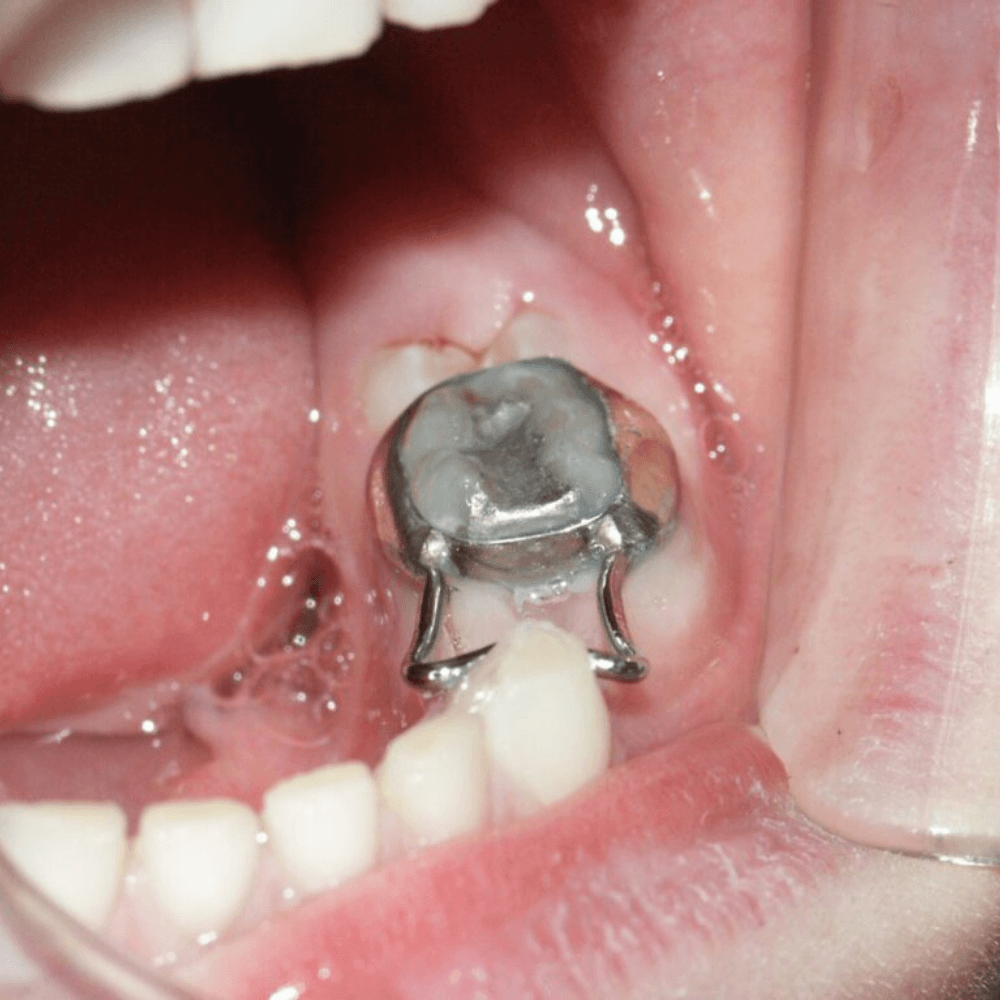
Types of Space Maintainers
Space maintainers are not one-size-fits-all. Different types of space maintainers are used depending on the location of the lost tooth, the number of teeth lost, the child's age, and when the permanent tooth is expected to erupt. At Doredent, the most suitable type of space maintainer for each child is determined after a clinical evaluation.- Standard option for single tooth loss.
- Does not depend on patient compliance; works 24/7.
- Cannot be removed by the child; highly reliable.
- Does not cause significant discomfort in the mouth.
- Monitored through regular check-ups.
- Ideal when the support tooth has a restoration.
- Protects the treatment and functions as a space maintainer.
- As reliable as the band-loop.
- Cannot be removed by the child.
- For cases with bilateral or multiple tooth loss.
- Lingual arch: lower jaw, wire contacting the back surface of teeth.
- Nance appliance: upper jaw, acrylic pad + wire contacting the palate.
- Fixed design, does not depend on patient compliance.
- For cases with multiple tooth loss or front tooth loss.
- Artificial teeth can be added if there is an aesthetic need.
- Removable; easy to clean.
- Completely depends on patient compliance; no protection if not worn.
- Fixed space maintainers are generally preferred for younger children.
Which Type of Space Maintainer Is Right for Your Child?
Treatment Process
Alternative Treatments
Risks and Complications
Which Children Need a Space Maintainer?
A space maintainer is not automatically placed for every child who loses a baby tooth early. The risk of space loss depends on the position of the lost tooth, the child's age, and when the permanent tooth is expected to erupt.- The highest risk of space loss occurs with primary molar loss.
- When the second primary molar is lost, the six-year molar drifts forward rapidly.
- Space loss can begin within weeks.
- A fixed space maintainer (band and loop) is the standard option.
- If more than one year remains before eruption, a space maintainer is essential.
- If six months to one year remain, it is strongly recommended.
- If less than six months remain, your dentist will decide based on eruption status.
- X-rays help estimate expected eruption time.
- Space loss risk increases markedly with multiple tooth loss.
- Bilateral losses require bilateral space maintainers.
- Comprehensive space preservation is planned.
- This may reduce the need for future orthodontic treatment.
- Space loss risk is lower in the front area.
- An artificial tooth can be added if there are aesthetic concerns.
- It can support speech development.
- Removable space maintainers are preferred in these cases.
- Space maintainer planning begins with the extraction decision.
- In some cases, the space maintainer can be placed during the same visit.
- Delays can trigger space loss.
- Impressions are taken before or immediately after extraction.
When a Space Maintainer Is Not Needed
- If the permanent tooth is due to erupt very soon (the X-ray shows complete root formation and the tooth is ready to erupt beneath the gums).
- When space loss risk is low after front primary tooth loss.
- If the permanent tooth is already erupting and can be felt clinically beneath the gums.
- If your child has sufficient space in the mouth and space loss risk is low.
After the Procedure
Space maintainer placement is typically a simple and quick procedure. Fixed space maintainers do not require anesthesia, while removable space maintainers are custom-made from impressions. Below you can find details that families should know after space maintainer placement.First Days: Adjustment
- Adjustment period: During the first few days, your child will notice the new appliance in their mouth. This is normal, and most children fully adjust to the space maintainer within 3-5 days.
- Speech: Especially with removable space maintainers, there may be slight changes in the pronunciation of certain sounds during the first few days. This is temporary.
- Eating: After a fixed space maintainer is placed, your child can eat normally. Sticky foods (gum, caramel candy, sticky gummy candies) should be avoided as they increase the risk of dislodging the space maintainer.
- Discomfort: A slight pressure sensation or tongue irritation is normal. If there is significant pain, contact the clinic.
Caring for the Space Maintainer
- Fixed space maintainer hygiene: Food debris can accumulate around the band and wire. Pay special attention to these areas during brushing. Gently cleaning around the wire and band with a toothbrush is sufficient.
- Removable space maintainer cleaning: It should be removed and rinsed after each meal. It can be gently brushed with a soft toothbrush. When not in use, it should be stored in its storage case.
- Avoid sticky foods: Gum, caramel candy, and sticky gelatin candies can dislodge or deform the fixed space maintainer.
- Watch out for hard foods: Habits like chewing ice, hard nuts, and pencils can damage the space maintainer.
Follow-up and Monitoring
- Regular checkups: During pediatric dentistry checkups every 6 months, the condition of the space maintainer is evaluated. The integrity of the band, position of the wire, and eruption status of the permanent tooth are checked.
- Monitoring permanent tooth eruption: When the permanent tooth is about to erupt, the space maintainer is removed. This timing is determined through regular checkups. If the space maintainer is removed too early, space loss may occur during the remaining period; if removed too late, it may prevent the permanent tooth from erupting.
- If the space maintainer comes loose: If the fixed space maintainer comes loose, contact the clinic as soon as possible. During the time without a space maintainer, adjacent teeth can shift. Loosening is typically corrected with re-cementation.
- Removable space maintainer use: Removable space maintainer effectiveness depends entirely on patient compliance. If your child does not wear the appliance, no protection is provided. It is important for families to monitor usage discipline.
When Is the Space Maintainer Removed?
- When the permanent tooth begins to erupt: When an X-ray or clinical examination shows that the permanent tooth is ready to erupt, the space maintainer is removed.
- Removal is simple: Removing a fixed space maintainer is a simple procedure that takes a few minutes, is painless, and does not require anesthesia.
- Removal timing is critical: Timing is determined through regular checkups. Permanent tooth eruption should not be prevented.
An Important Message for Families
Frequently Asked Questions
What is a space maintainer and why is it needed?
Is a space maintainer needed for every early loss of a baby tooth?
Does a space maintainer cause pain?
How long does a space maintainer stay in the mouth?
What happens if the space maintainer comes loose?
What happens if a space maintainer is not placed?
Treatment Pricing
Space Maintainer Pricing
At Doredent, we offer transparent pricing for our international patients. As every case is different, the final treatment cost depends on your individual evaluation.
The cost of Space Maintainer varies based on factors such as the type of space maintainer (fixed or removable) and scope. For an accurate quote, a personalized assessment is recommended.
For pricing details, reach out via WhatsApp or book your initial consultation.
Our Dentists
Meet our specialist team.


Content Information
This page was prepared by the Dore Medical Editorial Board and medically reviewed by Dr. Merve Özkan Akagündüz.
