
Does Root Canal Treatment Cause Cancer? Debunking the Myth
A persistent claim circulates on social media and alternative health channels: root canal treated teeth cause cancer, create hidden infection sources, and trigger autoimmune diseases. These assertions trace back to a specific documentary, a specific book, and a specific practitioner, constantly reproduced online. The question is, is this a scientifically grounded debate or a myth born from fear culture?

A few years ago, a 45-year-old man came in for an exam. He had advanced decay in an upper molar requiring root canal treatment. I explained the procedure, the process, the outcomes. He listened silently, then pulled a paper from his bag. A printout from the internet, with the headline: "Every Root Canal Treated Tooth Is a Cancer Bomb." Rather than accepting the treatment I'd just described, he wanted the tooth extracted. "I'd rather be toothless than get cancer," he said. We've been hearing this sentence frequently in recent years.
A persistent claim circulates on social media and "alternative health" channels: root canal treated teeth cause cancer, create hidden infection sources, and trigger autoimmune diseases. These assertions trace back to a specific documentary, a specific book, and a specific practitioner, constantly reproduced online. The question is, is this a scientifically grounded debate or a myth born from fear culture?
The Origin of the Claim: Weston Price and His Story
To properly understand this issue, we need to go back 100 years. An American dentist named Weston Price conducted studies in the 1920s supporting what's known as the "focal infection theory." According to this theory, bacteria remain hidden inside root canal treated teeth, these bacteria enter the bloodstream and travel to other organs, causing inflammation and disease. Price claimed to support this view with rabbit experiments.
The scientific community examined this view at the time, began questioning it from the 1930s onward, and rejected it in the 1950s due to insufficient evidence. Price's experiments did not conform to modern scientific methodology, lacked control groups, had excessively manipulated experimental conditions, and could not be replicated. In subsequent decades, focal infection theory disappeared from mainstream medical literature.
But here's the interesting part. In the 1990s, Weston Price's books were republished, and certain circles reintroduced this view as "the truth that big medicine is hiding." After the 2010s, the internet and social media spread this content explosively. Videos titled "Side Effects of Root Canal Treatment" and "The Secret Dentists Are Hiding" were viewed millions of times. The viral clip featured figures dressed like scientists, speaking seriously in office settings, stating "every root canal treated tooth is a cancer bomb."
What Does Modern Science Say?
Let's evaluate this topic from the perspective of scientific literature. The American Association of Endodontists, American Dental Association, European endodontic societies, and Cochrane Library all state in their systematic reviews: no scientific link has been demonstrated between properly performed root canal treatment and cancer.
Moreover, large epidemiological studies have been conducted on this topic. Studies from Mayo Clinic and Harvard, following tens of thousands of patients for years. These compared cancer incidence in people who had root canal treatment versus those who hadn't. No statistically significant difference was found between the two groups. In fact, some studies found slightly lower cancer risk in the root canal group, because this group tends to have more regular health monitoring.
In other words, the misleading nature of a 100-year-old theory has been demonstrated repeatedly by modern science. But the internet still keeps this theory alive.
What Does Root Canal Treatment Actually Do?
The myth persists because people's mental picture hasn't changed. Most people don't know what root canal treatment is. They have a perception like "something gets stuffed inside the tooth and sealed, germs remain inside."
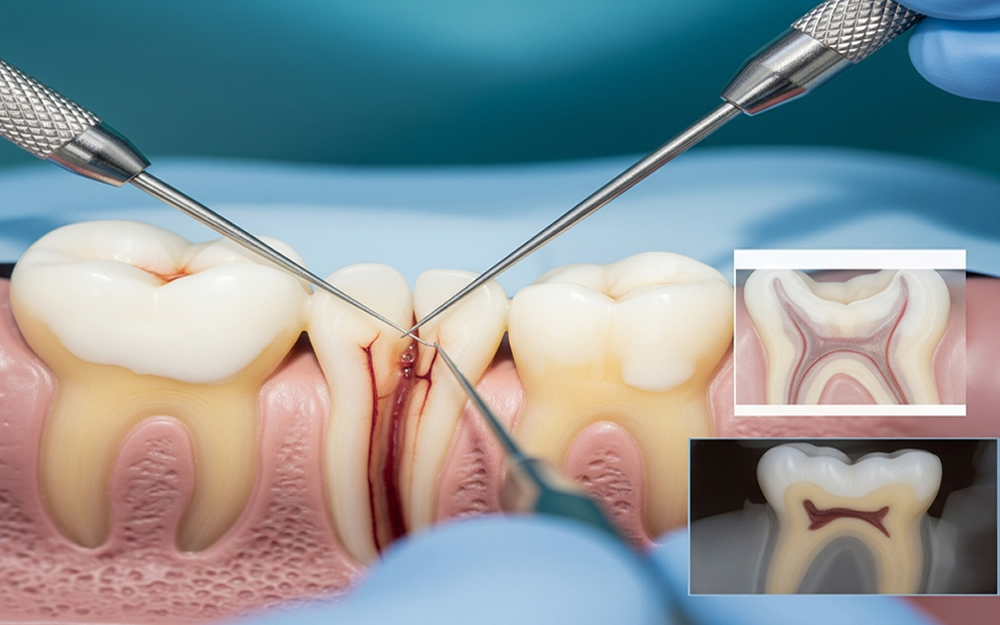
Here's the reality. Inside the tooth is nerve and vascular tissue, called pulp. When this tissue becomes infected or dies due to decay or trauma, treatment is needed. In root canal treatment, the tooth is opened, infected tissue inside is completely removed, canals are disinfected, then sealed with a biocompatible filling material that prevents bacteria from entering. An appropriate restoration is placed on top.
Root canal treatment doesn't trap infection inside the tooth, it removes infection from the tooth and prevents it from re-entering. When done correctly, the tooth's pain resolves, it functions for years, and infection risk is eliminated.
Of course, the phrase "when done correctly" is important here. Improperly performed root canal treatment (incompletely cleaned canals, inadequate protective restoration) can cause problems. In this case, bacteria inside the tooth can multiply and create infection at the root tip. This is called an "apical lesion" or bone infection. It's correctable, either the root canal is retreated or resolved with a minor procedure called apical surgery. Even then, the issue isn't "root canal causing cancer," it's "a complication requiring retreatment."
"Toxins Leaking from Decayed Teeth"?
One claim frequently used by myth supporters is this: toxins leak from root canal treated teeth into the body, causing chronic diseases. Does this claim have scientific basis?
Root canal filling materials (gutta-percha, calcium hydroxide, bioactive sealers) are materials used for years, passed biocompatibility tests, and accepted by the body. For these materials to have toxic effects, they would need to enter systemic circulation, which isn't possible. They're placed inside the canal, not in direct contact with bone or blood outside the tooth.
In past years, silver cone fillings existed, and there were some debates about them. But modern endodontics no longer uses this material. Today's materials are much safer. Some newer generation calcium silicate-based sealers even have properties that support the tooth's own structure.
The claim that "bacteria remain in the tooth and enter the blood" also collapses under modern technique. Irrigation solutions used during root canal treatment (sodium hypochlorite, EDTA) clean canals both mechanically and chemically. With old methods, success rates were perhaps 60-70%. With modern technique (microscope use, rotary instruments, advanced irrigation protocols), this rate has risen above 90%.
Is Tooth Extraction a Logical Alternative?
This is very critical. Patients who refuse root canal treatment out of cancer fear opt for extraction. As if this were a safer choice. Actually, it's a much riskier and more costly path.
Loss of a molar isn't just a problem with that gap. Adjacent teeth start tilting toward the gap, opposing teeth begin drifting down. The chewing system becomes disrupted. Missing tooth initiates a chain leading to another missing tooth, then orthodontic problems, then implant treatment. Within five to ten years, the initial "simple extraction" transforms into a much more complex treatment plan.
Moreover, bone resorption occurs after tooth extraction, and soft tissue healing in the extraction site may not be entirely problem-free. It's important to remember that tooth extraction is also a surgical procedure with its own risks. When dental implant treatment is decided for space filling, the implant site is monitored over years, and conditions like peri-implantitis can also be observed.
So the logic of "I'd rather extract than do a root canal" appears simple in the short term but creates more problems long term. The biological function of a natural tooth, preserved jawbone, natural chewing balance. None of these can be fully replaced by artificial alternatives.
Under the Name of "Holistic Dentistry"
The spread of this myth is also influenced by a movement marketed as "holistic dentistry." This movement starts with the claim of evaluating oral health inseparably from the whole body (which is a correct approach), but then embeds many scientifically unfounded claims into this framework.
Claims like "all amalgam fillings are poisonous and must be removed," "every root canal treated tooth should be extracted," "implants cause cancer," "fluoride is harmful" are marketed in this framework. Patients become fearful, have existing treatments removed, have healthy teeth extracted. They ultimately suffer major financial and health damages.
The point is, holistic approach isn't wrong. We also know the connection between oral health and systemic health. Scientific links exist between diabetes and gum disease, heart disease and periodontitis, pregnancy complications and oral health. But these links don't lead to the conclusion that "root canal treatment causes cancer." A scientific connection and a speculative claim are different things.
Who Should Decide?
The question of root canal treatment versus tooth extraction should be evaluated by the clinician examining your mouth, not by an internet video. Because every case is different. The amount of remaining tooth structure, the point to which decay has progressed, the condition of root anatomy, the patient's general health, restoration options, all affect the treatment decision.
In some cases, saving the tooth truly isn't possible, extraction is the right decision. In some cases, root canal treatment is the only logical option. In others, root canal retreatment or apical surgery comes into play. None of these decisions should be made on the basis of "I saw it in an internet video."
In our clinic, all options are discussed with the patient before every treatment decision. It's important not just to explain what we'll do, but to explain alternatives and enable the patient to make an informed decision. If there's a concern like "cancer fear," that's also put on the table and discussed. Because when you understand its source, fear diminishes.
What's the Real Cause of the Fear?
Let's think about why root canal treatment gets targeted so much. There are several reasons.
First, fear of pain. Root canal treatment truly was a painful procedure in past years. Anesthesia technique was undeveloped, equipment was inadequate. Today, with modern technique, root canal treatment has become a procedure where patients often can't even tell the difference from a filling. But the fear in older generations' memories is still alive, and this gets transmitted to new generations.
Second, hesitation about invisible things. When a tooth is extracted, it's visible, what's done is clear. In root canal treatment, something is done inside the tooth but it's not visible. This invisibility creates question marks in people's minds.
Third, the nature of the internet. Fear-producing content gets more clicks, more shares. Scientific explanations seem boring, dramatic claims go viral. This leads to misinformation being repeated over and over.
Fourth, genuinely bad experiences. Improperly performed root canal treatments can occur. Cases that develop pain afterward, require retreatment, or fail exist. When these cases are shared online, the conclusion drawn is "root canal treatment is dangerous." Whereas the problem isn't the technique, it's the quality of that case's execution.
Practical Advice
Let me clarify in conclusion what I want to say. When making decisions about root canal treatment, pay attention to these points.
First, trust your clinician but don't hesitate to question. Ask "are there other options for this tooth, if so what are the differences?" A good clinician will take time to explain.
Second, don't refuse treatment based on internet videos. There's no scientific data that root canal treatment causes cancer, it's a topic researched for 100 years, the result always comes out negative.
Third, if you're undecided, get a second professional opinion. Professional opinion is always more valuable than an internet video. In our clinic, we always welcome patients who say "I came for a second opinion," we explain the issue in detail. In some cases we truly say extraction is appropriate, in others we say root canal treatment is appropriate. The decision is the patient's.
Fourth, don't assume your tooth is fine just because it doesn't hurt. For some teeth, when tooth decay reaches the nerve, the nerve can fail on its own without causing pain. It can later return as an abscess. Regular examination is critical for this reason.
Fifth, don't neglect post-treatment follow-ups. A root canal treated tooth should be monitored over years, the restoration on it should be followed. You can get information about check-ups and follow-ups from our dental treatment prices page.
Final Word
Seeing the difference between a scientifically established strong claim and a sensational claim circulating online is a difficult skill in the modern world. Decisions about your health are one of the most critical areas where this skill is applied. Before refusing a treatment, question the scientific source of that claim. Remember that a technique with 100 years of history like root canal treatment has been examined repeatedly and found safe repeatedly.
Losing your natural tooth is a much greater loss than you think. Refusing a treatment that would prevent this because of a myth creates later regret. Science may explain some things in a boring language, but it's on the right side. Conspiracy theories use exciting language because that's their only sales pitch.
This content is prepared for informational purposes. It absolutely does not replace physician examination and personal evaluation.
