
Braces or clear aligners: which is better?
Decided to straighten your teeth but can't choose between braces and clear aligners? Both methods treat crooked and misaligned teeth, but they differ significantly in application, comfort, aesthetics, and ideal patient profile. This guide compares both options across all dimensions to help you make the right choice.

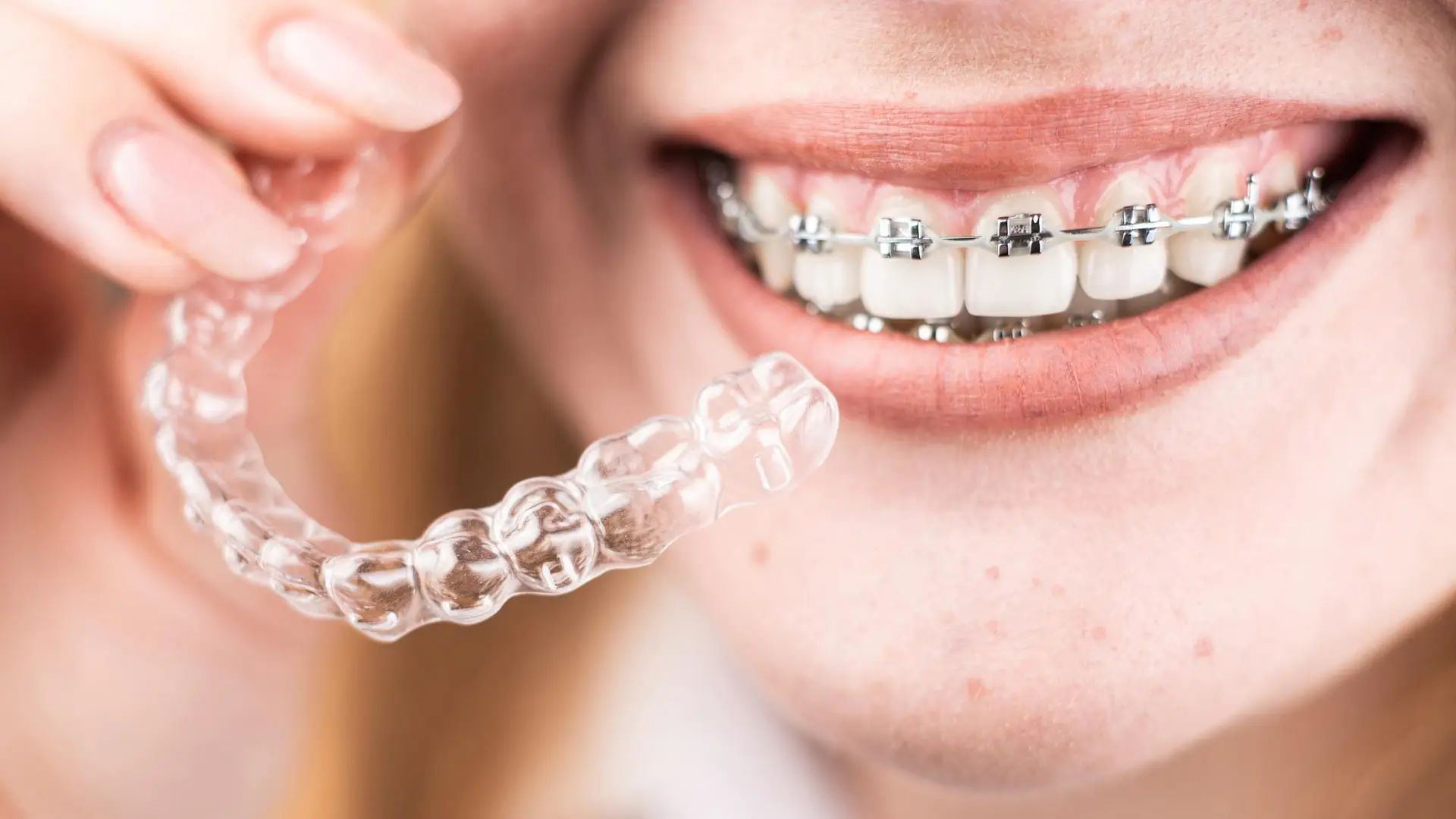
Decided to straighten your teeth but can't choose between braces and clear aligners? Both methods treat crooked and misaligned teeth, but they differ significantly in application, comfort, aesthetics, and ideal patient profile.
This guide compares both options across all dimensions to help you make the right choice.
Invisalign or traditional braces?
Compare both treatment methods across 14 criteria
At Doredent, Invisalign and braces are priced the same!
Your orthodontist will help you choose the best option during your exam.
Why Do You Need Orthodontic Treatment?
Orthodontic treatment is not just about aesthetics. Misaligned teeth and jaw discrepancies can:
- Increase risk of tooth decay and gum disease (due to difficulty cleaning)
- Lead to chewing and speech problems
- Cause pain and discomfort in the jaw joint (TMJ)
- Result in excessive tooth wear; in advanced cases, restoration with zirconia crowns may be needed
Orthodontic treatment is therefore an investment in both health and aesthetics.
What Is Braces Treatment?
Braces use brackets bonded to the teeth and metal or ceramic wires that connect them to gradually move teeth into the desired position. This is the classic orthodontic method.
Types of Braces
- Metal braces: The most common and economical option. Effective and durable.
- Ceramic (clear) braces: Brackets match tooth color; less noticeable than metal.
- Lingual braces: Brackets are bonded to the inner surface of teeth; completely invisible from the outside.
Advantages
- Effective for complex cases such as crowding, deep bite, and underbite
- Not dependent on patient compliance; works continuously because they are fixed
- Generally more affordable than clear aligners
- Long-standing clinical evidence and track record
Disadvantages
- Aesthetically noticeable, especially metal braces
- Makes oral hygiene more challenging; brushing and flossing require extra care
- Can cause pain and sensitivity initially and after wire adjustments
- Some hard and sticky foods must be avoided
What Is Clear Aligner Treatment (Invisalign)?
Clear aligner treatment is a modern orthodontic method that uses transparent, removable plastic trays to move teeth. You switch to a new aligner every 1-2 weeks, gradually moving teeth to the desired position.
At Doredent, clear aligner treatment is provided through the Invisalign system, which has been used by over 15 million patients worldwide. Treatment plans are customized for each patient by our orthodontist using 3D digital technology.
Advantages
- Nearly invisible; does not affect your social or professional life
- Removable, making eating and oral hygiene easier
- More comfortable because there are no metal or sharp components
- 3D simulation lets you preview your treatment outcome
- Lower risk of gum and tissue irritation
Disadvantages
- Must be worn at least 20-22 hours per day; patient discipline is essential
- May not be sufficient on its own for very advanced and complex cases
- Generally more expensive than braces
- Aligners can be lost or damaged
Braces or Invisalign? Which Is Right for You?
Both methods deliver excellent results when applied to the right case. Your choice depends on the complexity of your case, your lifestyle, and your expectations.
Braces may be more suitable if:
- Your case involves severe crowding or jaw discrepancies
- You are concerned about using a removable appliance
- Budget is a priority
- You are a child or teen patient (coordinated assessment with our pediatric dentist)
Invisalign may be more suitable if:
- You want your treatment to be invisible
- You have an active social or professional life
- You have mild to moderate problems such as gap teeth, open bite, or crossbite
- You want to maintain oral hygiene easily
- You want to see your treatment outcome before starting
Orthodontic Treatment at Doredent
At Doredent, orthodontic treatments are led by our specialist orthodontist. We offer both braces and the Invisalign system. Treatment choice is determined by evaluating your oral structure, case complexity, and lifestyle together.
For Invisalign treatment, 3D digital planning allows you to simulate your outcome before starting, so you can see how your teeth will look in advance.
What to Keep in Mind During Orthodontic Treatment
- Treatment duration can range from 6 months to 2-3 years depending on your case; patience is essential
- Retainer use after treatment is mandatory; otherwise, teeth may shift back to their original position (this is called orthodontic relapse and can be corrected quickly with Invisalign)
- Invisalign users must wear aligners at least 20-22 hours per day
- Regular check-up appointments are critical for treatment success
Braces and Invisalign are both powerful orthodontic options, each with its own advantages. The right choice depends on your case, lifestyle, and expectations. At Doredent, our orthodontist evaluates both options and creates the most suitable plan for you.
Contact us to schedule an orthodontic exam and receive a personalized assessment.
Frequently Asked Questions
Which gives faster results, braces or Invisalign?
There is no significant speed difference between the two; duration depends on the case. In mild cases, Invisalign may sometimes produce faster results, while braces have the advantage in complex cases.
Is Invisalign suitable for every case?
It is highly effective for mild to moderate malocclusion. In cases with advanced skeletal anomalies or severe rotation, braces or combination treatment may be necessary. The final decision is made during the orthodontic exam.
Do teeth shift back after treatment?
If retention appliances are not used, teeth may gradually shift back to their original position. That's why retainer use after treatment is essential.
