
Teeth whitening disappointment: Why doesn't everyone get the same results?
Your friend had teeth whitening and got brilliant white teeth. You went to the same clinic, had the same treatment, but the result is nothing like theirs. Your teeth lightened a bit, maybe, but you didn't achieve that "magazine-perfect white" look. What happened? Was the clinic bad, was the method wrong, or is there something about your teeth?

Your friend had teeth whitening and got brilliant white teeth. You went to the same clinic, had the same treatment, but the result is nothing like theirs. Your teeth lightened a bit, maybe, but you didn't achieve that "magazine-perfect white" look. What happened? Was the clinic bad, was the method wrong, or is there something about your teeth?
Many people experience this, and the reason for the disappointment is usually not about treatment quality. The real issue is not understanding how teeth whitening works and what determines the outcome. Let's explore this topic in depth.
How Does Teeth Whitening Work?
Teeth whitening is fundamentally an oxidation reaction. The whitening agent, hydrogen peroxide or carbamide peroxide, penetrates the enamel and dentin layers. There it breaks down organic color pigments. As the pigments break down, the tooth takes on a lighter tone.
This process should not be confused with cleaning surface stains. Dental scaling and polishing mechanically remove external stains (tea, coffee, tobacco) from the tooth surface. Whitening chemically alters color pigments in the tooth's internal structure. These are completely different procedures and are not alternatives to each other.
The effectiveness of whitening depends on the tooth's natural structure, the type and concentration of color pigments. And this is exactly why not everyone gets the same results.
Why Doesn't Everyone Get the Same Results?
Many factors affect teeth whitening outcomes, and most are beyond the patient's control.
Natural tooth color is the most determining factor. Tooth color is genetically determined. Some people have thicker, more opaque enamel, these teeth appear naturally whiter. Others have thinner, more translucent enamel, the yellowish dentin layer beneath shows through more prominently. Teeth with thin enamel always have more limited whitening results.
The type of discoloration is also very important. Age-related yellowing (dentin darkens over time and enamel thins) generally responds well to whitening. Tea, coffee, and tobacco stains also lighten with whitening. However, stains from tetracycline antibiotics, stains from excess fluoride (fluorosis), and trauma-related discoloration are much more resistant to whitening.
Tetracycline stains in particular have penetrated deep into the tooth structure and cannot be fully removed with standard whitening protocols. In such cases, long-term, high-concentration whitening protocols may provide partial improvement, but expecting "brilliant white teeth" is not realistic.
Existing restorations also affect the outcome. Dental fillings, crowns, and bridges do not respond to whitening agents. Only natural tooth structure whitens. This causes color mismatch in teeth with fillings. After whitening, old fillings may need replacement because they no longer match the new tooth color.
In-Office or At-Home?
Teeth whitening is applied through two main methods: in-office (performed in a clinical setting) and at-home (applied by the patient at home). Both have advantages and limitations.
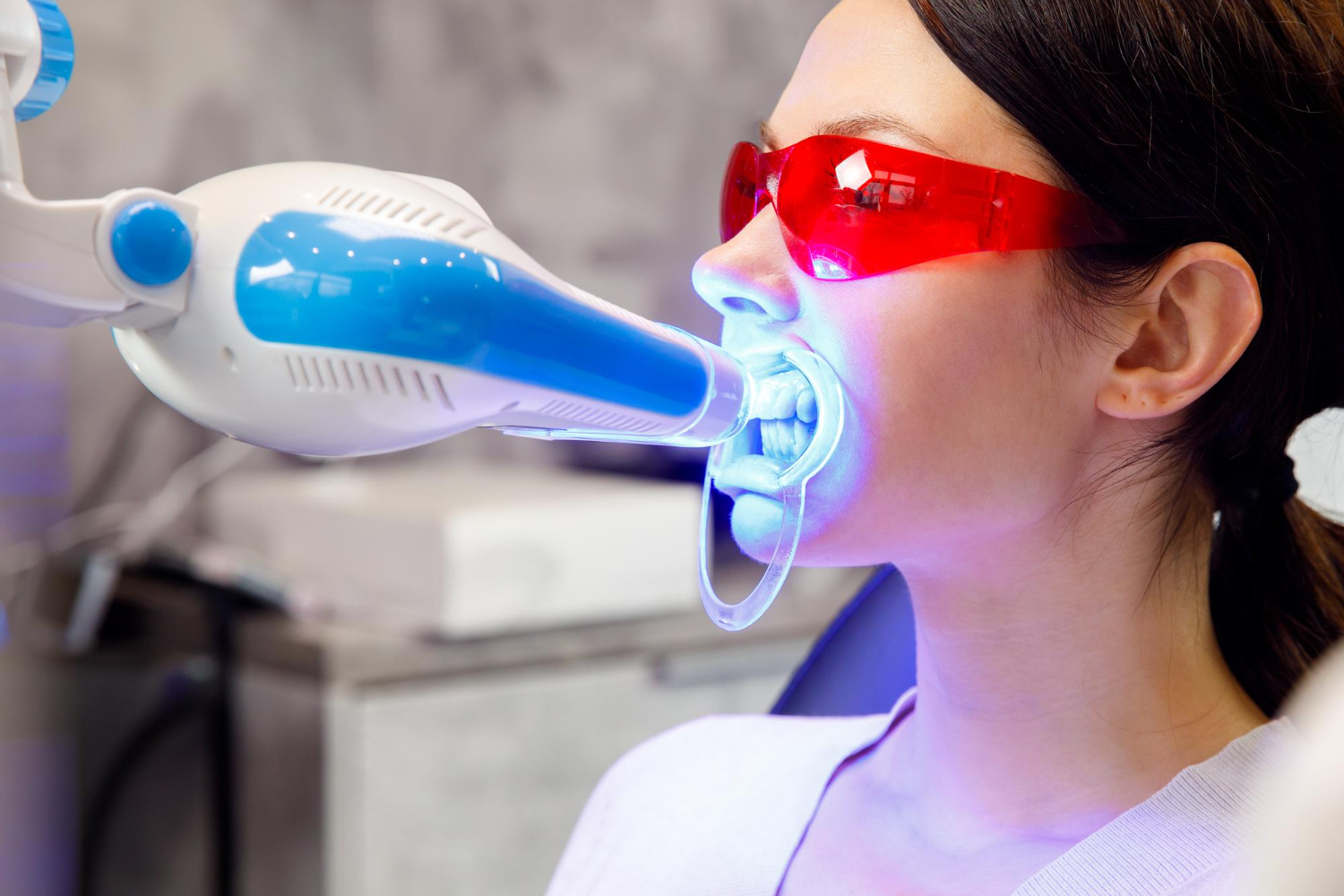
In-office whitening uses high-concentration whitening agents and is performed in a clinical setting. Light or laser-activated systems also fall into this category. The advantage is noticeable results in a single session. The disadvantage is that results are not always permanent. Some of the lightening achieved with in-office whitening can revert in the first few weeks. The reason is that the tooth loses water and becomes dehydrated during the procedure. A dehydrated tooth appears whiter, when the tooth rehydrates, the color darkens somewhat.
At-home whitening uses a lower concentration agent applied at home in a custom-made tray. Application typically lasts 2 to 4 weeks. Results are more gradual but tend to be more stable. Because the whitening agent acts for a longer time at a lower dose, this provides deeper and more lasting color change.
Many clinicians recommend combination treatment to achieve the best results: first, in-office whitening is performed, then the result is reinforced with at-home whitening. This approach provides both quick results and long-term stability.
Over-the-Counter Whitening Kits
Products like "at-home teeth whitening kits," "activated charcoal whitening," and "whitening strips" sell widely online. Some of these products contain low-concentration whitening agents and may have limited effect on mild external stains. However, most are incomparably less effective than professional whitening.
More importantly, unsupervised whitening products can cause harm. Gum irritation, enamel wear, excessive sensitivity, and even chemical burns are possible consequences of improper use. Activated charcoal products, due to their abrasive nature, wear down the enamel surface over time. This makes teeth appear brighter in the short term but leads to enamel thinning and yellowing in the long term.
The fundamental difference between professional whitening and internet products is customization. Your dentist evaluates your teeth's current condition, determines the appropriate concentration and duration, manages sensitivity risk, and monitors the outcome. Internet products take a "one size fits all" approach.
Post-Whitening Sensitivity
Post-whitening sensitivity is the most common side effect patients complain about. Increased sensitivity to cold, heat, and even air can continue for a few days after teeth whitening.
The reason for this sensitivity is that the whitening agent increases fluid movement within the enamel and dentin. Movement of fluid in the dentin tubules stimulates nerve fibers in the pulp and creates a pain sensation.
Sensitivity is usually temporary and decreases within 24 to 72 hours. Sensitivity-relief toothpastes containing potassium nitrate, used before and after treatment, can reduce this risk. Your dentist can minimize sensitivity by applying a desensitizing agent to your teeth before whitening.
In some patients, sensitivity may be more severe and longer-lasting. Sensitivity risk is higher in teeth with thin enamel, craze lines, or exposed dentin surfaces. Therefore, performing a detailed examination before whitening and evaluating risk factors is important.
How Long Does Whitening Last?
The concept of "permanent whitening" is misleading. Teeth whitening results are not permanent, over time teeth darken again. The reason is that in daily life, teeth are re-exposed to color pigments: colored foods and beverages like tea, coffee, red wine, pomegranate juice, tomato sauce gradually re-stain teeth over time.
How long whitening results last depends on the patient's dietary habits, oral hygiene, and whether they smoke. On average, professional whitening results last between 6 months and 2 years. After this period, touch-up applications can restore whiteness.
The first 48 hours after whitening are critical. Avoiding colored foods and beverages during this time helps preserve results longer. Smokers are the group that loses whitening results most quickly.
When Whitening Should Not Be Done
Not every tooth is a whitening candidate. In some situations, whitening is contraindicated or does not produce the expected result.
Whitening is not recommended during pregnancy and breastfeeding. The safety of whitening agents during these periods has not been sufficiently studied and is avoided as a precautionary approach.
Whitening should not be performed on teeth with active cavities or those needing root canal treatment. Whitening agent can reach the pulp through a cavity or an open canal and cause severe pain. Cavities should be treated first, then whitening applied.
In extremely sensitive teeth, advanced enamel erosion, and severe gum recession, whitening should also be carefully evaluated. Teeth with zirconia crowns do not respond to whitening, so if the mouth has both natural teeth and crowns, color mismatch may occur after whitening.
Realistic Expectations
The biggest cause of disappointment in teeth whitening is unrealistic expectations. Most of the brilliant white smiles you see on social media are achieved with photo filters, professional lighting, or crown treatments. Reaching those results with natural tooth whitening is often not possible.
A realistic expectation is this: professional whitening can lighten your teeth by 2 to 8 shades. This creates a visible and noticeable difference. But the result has an upper limit determined by your teeth's natural structure. Your dentist can show you this limit before treatment and determine the achievable shade together with you.
Natural Teeth Whitening: Is It Possible?
"Natural whitening methods" like baking soda, lemon juice, strawberries, apple cider vinegar are among the internet's most popular content. Most of these methods lack scientific basis and some are directly harmful.
Baking soda (sodium bicarbonate) has mild abrasive properties and can mechanically remove superficial stains. However, with regular use it causes enamel wear. Lemon juice and apple cider vinegar, due to their acidic nature, lead to enamel erosion. This erosion is irreversible, eroded enamel never comes back.
Activated charcoal also works with abrasive action. In the short term, teeth may appear brighter, but in the long term, as enamel thins, the underlying yellow dentin layer becomes more prominent. So the method used to "whiten" makes teeth more yellow in the long run. This is an unwelcome irony, but it's true.
Teeth whitening is a controlled chemical procedure and should be performed in a professional setting. "Natural" experiments at home often create new problems instead of solutions.
Whitening or Veneers?
In some patients, whitening alone does not produce sufficient results. In teeth with very deep stains, structural discoloration, or enamel irregularities, whitening is limited. In this case, alternative treatment options come into play.
Restorative methods like laminate veneers or zirconia crowns provide the desired color and form by completely covering the tooth surface. However, unlike whitening, these methods require tooth reduction and are irreversible procedures.
The correct approach is always to start with the least invasive method. First, professional whitening is tried. If the result is insufficient, minimal interventions like bonding are considered. Crowns come into play only when these options prove inadequate. This gradual approach ensures preservation of natural tooth structure at the highest possible level.
Final Word
Teeth whitening, with correct expectations and professional application, is a highly satisfying treatment. But it is not a miracle. What determines the outcome is your teeth's natural structure more than the method used.
If you are considering whitening, the first step should be an examination appointment. Your dentist will evaluate your teeth's current color, enamel thickness, existing restorations, and sensitivity risk to determine the most appropriate method for you. Whitening started without this evaluation carries a risk of ending in disappointment. Whitening done with correct expectations and the right method, however, makes a real difference in your smile.
