
Where Do You Place Your Tongue When Swallowing? Improper Swallowing and Dental Misalignment
Try swallowing something right now. Water, saliva, it doesn't matter. Did you notice where your tongue was at the exact moment of swallowing? Did it touch your palate, push against your front teeth, or stay in the middle of your mouth? Most people can't answer this question clearly. That's because swallowing is a reflex action we repeat approximately two thousand times a day without ever thinking about it.

Try swallowing something right now. Water, saliva, it doesn't matter. Did you notice where your tongue was at the exact moment of swallowing? Did it touch your palate, push against your front teeth, or stay in the middle of your mouth? Most people can't answer this question clearly. That's because swallowing is a reflex action we repeat approximately two thousand times a day without ever thinking about it.
But this reflex affects everything from the alignment of your teeth to the way you speak, even the shape of your face. Improper swallowing, known as "infantile swallowing" or "tongue thrust," is one of the hidden causes of orthodontic problems.
What Does Proper Swallowing Look Like?
In healthy swallowing, the tip of the tongue touches the front part of the roof of the mouth, the small ridge just behind the upper front teeth. In anatomy, this point is called the "papilla palatina." The body of the tongue rises to the palate and moves food or saliva backward in a wave-like motion. The lips are gently closed during this process but not clenched. The cheek muscles are not engaged.
This correct swallowing pattern is called "somatic swallowing" or "mature swallowing." Normally, children transition to this pattern after the primary tooth stage. In newborn infants, "infantile swallowing" is observed. In this type of swallowing, the tongue thrusts forward and the lips make a sucking motion. This is a necessary reflex for breastfeeding.
The problem is when the infantile swallowing pattern does not disappear with growth. Some children and adults continue to swallow by thrusting the tongue forward. This condition eventually leads to serious orthodontic problems.
How Does Tongue Thrust Damage Teeth?
The tongue may seem small, but it is a powerful muscle. It can exert approximately 1 to 6 kilograms of pressure with each swallow. When you consider it's repeated two thousand times a day, the total force the tongue applies to the teeth is significant.
In improper swallowing, the tip of the tongue does not rest behind the upper front teeth. Instead, it presses directly between or in front of the front teeth. Over years, this pressure pushes teeth forward. The result:
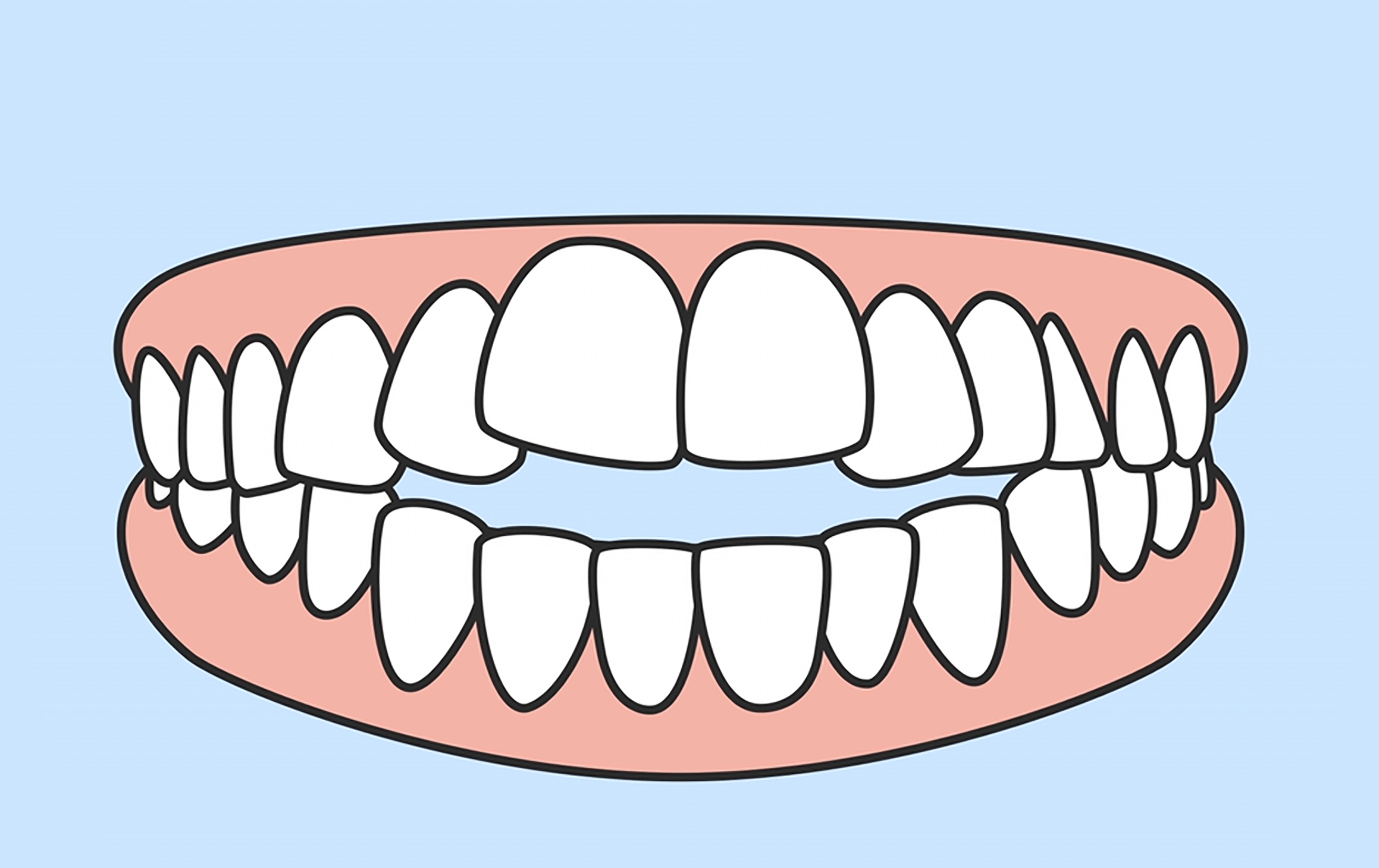
Open bite: The front teeth do not touch each other. The patient's back teeth close, but a gap remains in front. The tongue protrudes through this gap, sometimes accompanied by speech disorders. Biting function weakens, making it difficult to bite food with the front teeth.
Protrusion of upper teeth: With constant pressure from the tongue, the upper incisors tilt forward. This creates both aesthetic and functional problems.
Retrusion of lower teeth: As the upper teeth protrude, the occlusal relationship with the lower teeth is disrupted.
Palatal narrowing: Normally, the tongue rests against the roof of the mouth, helping to widen the upper jaw. When the tongue stays low, this natural widening force is lost and the palate narrows.
These conditions are frequently encountered in orthodontic clinics. And even if they are treated, if the improper swallowing habit continues, the teeth tend to return to their original positions.
What Causes Swallowing Disorders?
The causes of improper swallowing patterns are varied. Prolonged pacifier or thumb sucking habits can prevent a child from transitioning to a mature swallowing pattern. In children who breathe through their mouths, tongue position changes and the swallowing pattern is disrupted. In people with tongue-tie (ankyloglossia), tongue movement is restricted and proper swallowing cannot develop.
Enlarged tonsils and adenoids can also affect swallowing patterns. Because the child breathes through the mouth, the tongue thrusts forward, and this position is reflected in swallowing. The effects of pacifier and thumb sucking habits on teeth are often seen together with improper swallowing.
Is It Also Seen in Adults?
Yes, and this condition often goes unnoticed. When many adult patients seek orthodontic treatment, an improper swallowing pattern is detected. The patient has been swallowing this way for years without knowing it. They are also unaware that this pattern is the cause of their dental misalignment.
In adult patients, orthodontic treatment success depends on correcting the swallowing pattern. Even if the teeth are properly aligned, if the patient continues to swallow improperly, the teeth will gradually become misaligned again. This is one of the hidden causes of treatment failure.
How Is It Treated?
Treatment for improper swallowing is a process carried out alongside orthodontic treatment. Simply correcting the teeth is not enough; the swallowing pattern must also be changed.
Myofunctional therapy consists of exercises designed to retrain the tongue and muscles around the mouth. Exercises are performed to keep the tongue in the correct position and establish the correct movement pattern during swallowing. This therapy is usually administered by an orthodontist, speech therapist, or specialist trained in myofunctional therapy.
Orthodontic appliances also provide support. "Tongue crib" appliances physically prevent the tongue from pressing against the front teeth. These appliances are usually in the form of a metal structure on the upper palate and prevent the tongue from thrusting forward. They help break the habit in child or adult patients.
If mouth breathing is present, it is necessary to work with an ear, nose, and throat specialist. When underlying causes such as adenoid or tonsil enlargement are addressed, tongue position and swallowing pattern may begin to correct spontaneously.
Test Your Tongue's Correct Position
Pay attention to where your tongue is right now. Is it touching your palate, in the middle of your mouth, or behind your lower teeth? Even in the resting position, the correct place for the tongue is the roof of the mouth. The tip of the tongue should be just behind the upper front teeth, with the body of the tongue attached to the palate.
If your tongue is constantly positioned low, this may be a habit. Try consciously placing your tongue on the palate. It may feel uncomfortable at first, but over time the new position becomes natural. This simple awareness alone can reduce incorrect pressure on your teeth over the years.
When Should It Be Evaluated in Children?
The ideal time for orthodontic evaluation in children is around age 7. During this period, both primary teeth and the first permanent teeth are present in the mouth, and the orthodontist can evaluate swallowing pattern, tongue position, and jaw development together.
When improper swallowing is detected, early intervention is critical. Myofunctional therapy performed in childhood yields much more effective results thanks to growth and development potential. The same treatment in adulthood takes longer and has a lower success rate.
Not Just Teeth, Speech Is Also Affected
Improper swallowing can also affect the production of certain speech sounds. Especially sounds like "s," "z," "t," and "d," which require the tongue to be positioned close to the front teeth, may be produced incorrectly in individuals with tongue thrust habits. Lisping, difficulty producing "s" and "z" sounds correctly, are frequently seen together with improper swallowing.
For this reason, in some cases the orthodontist and speech therapist work together. Treatment aims to both correct the teeth and improve speech function.
Tongue-Tie: A Frequently Overlooked Cause
One of the causes of improper swallowing is tongue-tie (ankyloglossia). The thin tissue extending from the underside of the tongue to the floor of the mouth may be shorter or tighter than it should be in some individuals. This condition restricts tongue movement.
The tongue's inability to rise sufficiently to the palate prevents the development of a proper swallowing pattern. If tongue-tie in children goes unnoticed, improper swallowing habits become established, leading to both orthodontic and speech problems later.
Tongue-tie can be corrected with a simple surgical procedure (frenectomy). However, simply cutting the tie is not enough. Myofunctional therapy must also be applied to retrain the tongue muscle. Otherwise, the tongue tends to return to its old habit.
Tongue-ties detected in infancy are generally treated easily. In adulthood, treatment may be more complex because the tongue has adapted to this restriction over the years. This is why early evaluation is of great importance.
Awareness Exercise for Adults
Check where your tongue is throughout the day. The resting position of the tongue should be on the palate. Pay attention to your tongue's movement with each swallow. If you notice yourself thrusting your tongue toward the front teeth, consciously place it back on the palate.
This awareness alone does not solve the problem, but it is the first step toward change. Breaking a habit that has persisted for years takes time. Combined with professional support, it is possible to change swallowing patterns even in adulthood.
Tongue Position During Sleep
Not only when awake, but also during sleep, tongue position is important. In the correct position, the tongue should rest against the palate. This position both naturally widens the upper jaw and keeps the upper airway open.
Keeping the tongue low during sleep can lead to mouth breathing and even mild sleep apnea symptoms. In some patients, sleeping with the mouth open, snoring, and morning dry mouth are related to disrupted tongue position.
Improper swallowing is a reflection of the combined disruption of daytime and nighttime tongue position. For this reason, myofunctional therapy focuses not only on the moment of swallowing but on 24-hour tongue position. When the tongue learns to rest on the palate for most of the day, the swallowing pattern naturally begins to correct.
The Picture Seen with Mouth Breathing
Improper swallowing is frequently seen together with mouth breathing. The two are habits that feed and sustain each other. A child who breathes through the mouth keeps the tongue low. A tongue positioned low cannot apply pressure to the palate. The palate narrows, breathing becomes even more difficult, and the cycle repeats itself.
To break this cycle, an ear, nose, and throat specialist, orthodontist, and sometimes myofunctional therapist work together. If there are enlarged adenoids or tonsils, they are surgically removed; if there is allergic rhinitis, it is treated; orthodontically, the narrow palate is expanded, and tongue position is retrained. This multifaceted approach can permanently resolve problems that have settled in over the years.
Final Word
Swallowing is a reflex we perform without awareness, but over the years it can be one of the most important determinants of your teeth, jaw, and even face shape. If you are considering orthodontic treatment or have previously received treatment that did not remain stable for long, evaluation of your swallowing pattern is of great importance.
Correcting your teeth alone is not enough. Understanding why these teeth became misaligned and solving the underlying cause is the key to long-term success.
This content has been prepared for informational purposes. It is not a substitute for a physician's examination and individual evaluation.
