
Teeth Whitening Methods: In-Office vs. At-Home
White and bright teeth are the foundation of a confident smile. However, factors like coffee, tea, smoking, and aging can gradually dull your teeth over time. This is where teeth whitening treatment comes in. But does it really work? Should you go for in-office or at-home whitening? Which method is right for you?

White and bright teeth are the foundation of a confident smile. However, factors like coffee, tea, smoking, and aging can gradually dull your teeth over time. This is where teeth whitening treatment comes in. But does it really work? Should you go for in-office or at-home whitening? Which method is right for you?
In this article, we explore teeth whitening methods in detail, the differences between them, and what you need to know before starting treatment.
What Is Teeth Whitening and How Does It Work?
Teeth whitening (bleaching) is an aesthetic dentistry procedure that chemically breaks down pigments on the tooth surface and beneath the enamel layer. The active ingredient is typically hydrogen peroxide or carbamide peroxide.
Important note: Teeth whitening is only effective on natural teeth. It does not change the color of artificial restorations such as crowns, bridges, fillings, or veneers.
Why Do Teeth Change Color?
Tooth discoloration can be examined in two main categories:
Extrinsic (External) Staining
- Coffee, tea, and red wine consumption
- Cigarettes and tobacco products
- Colored foods (pickles, pomegranate, berries, etc.)
- Inadequate oral hygiene
Intrinsic (Internal) Discoloration
- Thinning of enamel and yellowing of the dentin layer with age
- Certain antibiotics used in childhood (tetracycline)
- Excessive fluoride exposure (fluorosis)
- Internal bleeding after tooth trauma
External staining responds better to whitening. For intrinsic discoloration, whitening effects may be limited, and in these cases, restorative options such as veneers or crowns may be more suitable.
In-Office Teeth Whitening (Professional Bleaching)
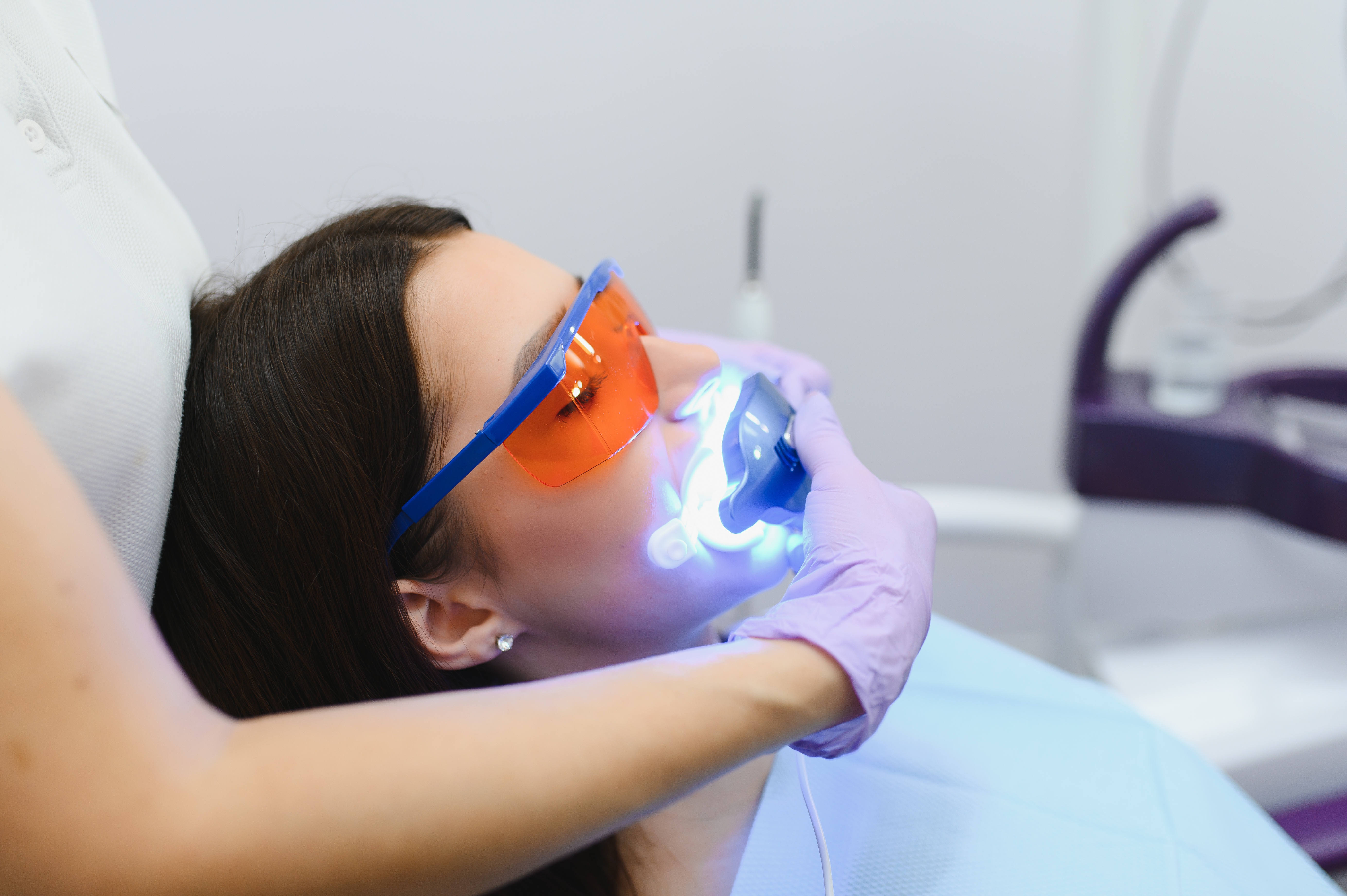
This method, performed under the supervision of a dentist in the clinic, is the fastest and most effective whitening option.
How Is It Applied?
- The gums are covered with a protective barrier.
- High-concentration whitening gel is applied to the teeth.
- LED or laser light is used to activate the gel.
- The procedure takes 45-90 minutes and is completed in a single session.
Advantages
- Provides 4-8 shades of lightening in a single session
- Results are visible immediately
- Safe because it is performed under dentist supervision
- Protects gums and enamel
Disadvantages
- Higher cost compared to at-home methods
- Temporary sensitivity may occur after the procedure (1-3 days)
At-Home Teeth Whitening (Home Bleaching)
You apply the whitening gel at home using custom-made trays prepared by your dentist, following a specific schedule.
How Is It Applied?
- An impression is taken at the clinic, and custom clear trays are made for you.
- Whitening gel is placed inside the tray, which is then worn on the teeth.
- Worn for 4-8 hours daily or overnight.
- Continued for 2-4 weeks as recommended by your dentist.
Advantages
- More economical than in-office treatment
- You can apply it at home on your own schedule
- Gradual whitening can provide a more natural result
Disadvantages
- Takes longer to see results (2-4 weeks)
- Requires discipline for regular use
- Less shade improvement compared to in-office methods
Teeth Whitening at Doredent: The Opalescence System
At Doredent Dental Clinic, we use the globally trusted Opalescence system for both in-office and at-home whitening applications.
Opalescence is recognized as the gold standard in dentistry thanks to its high biocompatibility, effective formula, and gum-friendly composition. Our ability to offer the same brand assurance for both in-office and at-home applications ensures a consistent and controlled treatment process.
During your examination, our dentists evaluate your tooth color, structure, and expectations to decide together whether in-office, at-home, or a combination of both methods is more suitable for you.
In-Office or At-Home?
We compare the key features of both methods side by side to help you determine which one is best for you.
| Application Setting | In clinic, under dentist supervision | At home, with custom trays |
| Duration | ⚡ Single session45-90 minutes | 📅 2-4 weeks4-8 hours daily use |
| Whitening Level | 4-8 shades lighter | 2-4 shades lighter |
| Speed of Results | Immediately visible results | Gradual whitening |
| Naturalness | Fast and noticeable difference | More natural transition |
| Dentist Control | Fully supervised | Dentist prescribed, self-administered |
| Sensitivity | May be temporary1-3 days | MinimalLow concentration |
| Cost | Higher | More economical |
| Discipline Required | Completed in one visit | Regular daily use required |
| System | 🔬 Opalescence (same brand assurance for both methods) | |
Which Is Right for You? In-Office or At-Home?
In-office treatment may be more suitable for those who want quick results, while at-home methods may be better for those who are budget-conscious and prefer a gradual process. However, the best decision should be made by your dentist based on your oral structure and the type of tooth discoloration you have.
In some cases, a combination of both methods can be applied: first, a fast Opalescence application is performed in the clinic, then the results are reinforced with at-home trays.
Important Considerations for Teeth Whitening
- Dental scaling must be done before the procedure
- If there is active decay or gum disease, it must be treated first
- Avoid colored foods and beverages for 48 hours after treatment
- Smoking reduces the effectiveness of whitening
- Whitening is not recommended during pregnancy or breastfeeding
- Over-the-counter whitening products generally have only superficial effects and are not professionally supervised
Conclusion
Teeth whitening, when performed correctly, is a safe, effective aesthetic treatment that restores your confidence. In-office or at-home, both methods deliver successful results. What matters is choosing the right one for you.
At Doredent Dental Clinic, we evaluate your oral structure and expectations to create the most suitable whitening plan together. All it takes to achieve a brighter smile is booking an appointment!
It is not permanent, but with proper care, the effect can last 1-3 years. Avoiding cigarettes, coffee, and tea, and having regular dental checkups every 6 months can extend this period.
When performed under dentist supervision with approved products, it is safe. It does not cause enamel loss. Temporary sensitivity may occur, which typically resolves within a few days.
In-office whitening typically provides 4-8 shades of improvement. Results vary depending on your starting tooth color, the method used, and the structure of your teeth.
