
Bad News for Parents Who Think Milk Protects Their Child's Teeth
We hear this statement almost daily in pediatric dentistry exams: "Our child drinks a lot of milk, so their teeth are healthy." The parent genuinely believes it because that's what they were taught. Milk contains calcium, calcium builds teeth, therefore a child who drinks milk has strong teeth. The logic sounds airtight.

Bad News for Parents Who Think Milk Protects Their Child's Teeth
We hear this statement almost daily in pediatric dentistry exams: "Our child drinks a lot of milk, so their teeth are healthy." The parent genuinely believes it because that's what they were taught. Milk contains calcium, calcium builds teeth, therefore a child who drinks milk has strong teeth. The logic sounds airtight.
The problem is, this chain is scientifically broken. When you examine each link individually, you find that each one is half-true, half-incomplete, and in some places completely misleading. Milk is undoubtedly a valuable part of children's nutrition. But the assumption that "a child who drinks milk automatically has healthy teeth" is one of the common misconceptions pediatric dentistry practice encounters regularly.
How Does Calcium Affect Teeth?
Let's start with the first link. Milk contains calcium, that's true. Calcium is found in the structure of teeth, that's also true. But there's a timing issue here.
The structural formation of teeth begins while the child is still in the womb and continues in the early years. During this stage, the calcium intake is indeed integrated into the tooth matrix, contributing to mineralization. So adequate calcium intake during pregnancy and breastfeeding is important, and calcium in the child's diet during infancy matters. So far, everything checks out.
But once a tooth erupts into the mouth, the story changes. The calcium in consumed milk doesn't enter the erupted tooth and "strengthen" it. After eruption, tooth mineralization is not supported by dietary calcium but by minerals in saliva and fluoride. So even if a six-year-old drinks three glasses of milk every day, the structural strength of their current teeth isn't changed by that milk.
At this point, parents usually object with "but during the growth period." True, the child is growing and their permanent teeth are still forming. But that formation is happening inside the jawbone, not related to the erupted teeth. So milk's contribution is toward teeth that will erupt in the future, not protecting the ones currently in the mouth from decay.
The Sugar in Milk: Lactose
Now let's move to another link in the chain. The assumption that because milk is a beneficial food, it behaves beneficially in the oral environment.
Milk contains lactose. That is, milk sugar. Being natural makes no difference, because the bacteria in the mouth don't distinguish between natural and artificial. The cavity-causing bacteria we call Streptococcus mutans uses lactose just as much as sucrose. It produces acid, attacks enamel, disrupts mineralization.
So milk itself can be a decay factor. The statement "but it's natural, a healthy food" doesn't change this mechanism. A natural sugar is still a sugar.
I say "itself can be" because milk isn't as aggressive as other sugary foods. It has low acidity, contains lipids, includes protective proteins like casein. These properties make milk a milder decay agent than chocolate. But there's a huge difference between "mild decay agent" and "doesn't cause decay."
Frequency Is the Real Determinant
In cavity formation, the most critical factor isn't quantity, it's frequency. I need to explain this.
Tooth enamel is in constant equilibrium in the oral environment. When food is eaten, acid forms and enamel dissolves slightly. Afterward, saliva kicks in, neutralizes the acid, and repairs the enamel again with calcium and phosphate. This process takes about 30-60 minutes.
If the child eats or drinks something every hour, the enamel never gets this repair opportunity. The tooth surface under constant acid attack gradually becomes depleted without repair.
This frequency trap is very pronounced in milk-drinking children. Milk at breakfast, yogurt at mid-morning snack, ayran at lunch, cheese for afternoon snack, milk again before bed. The parent reads this as "healthy eating." The mouth perceives it as a constant carbohydrate flow. The enamel can't catch its breath.
Moreover, dairy foods leave a coating layer on the tooth surface. This layer doesn't rinse away quickly, staying on the tooth for minutes. One of the most common profiles we encounter in the tooth decay in children picture is children who "don't get sugary snacks but have a high milk-yogurt-cheese cycle."
The Bedtime Milk Section
Another critical point is nighttime consumption. Saliva production decreases at night, the natural protective system slows down. A glass of milk taken before bed can remain in the mouth half-unwashed throughout the night. The odor in the child's mouth in the morning is an indicator of this.
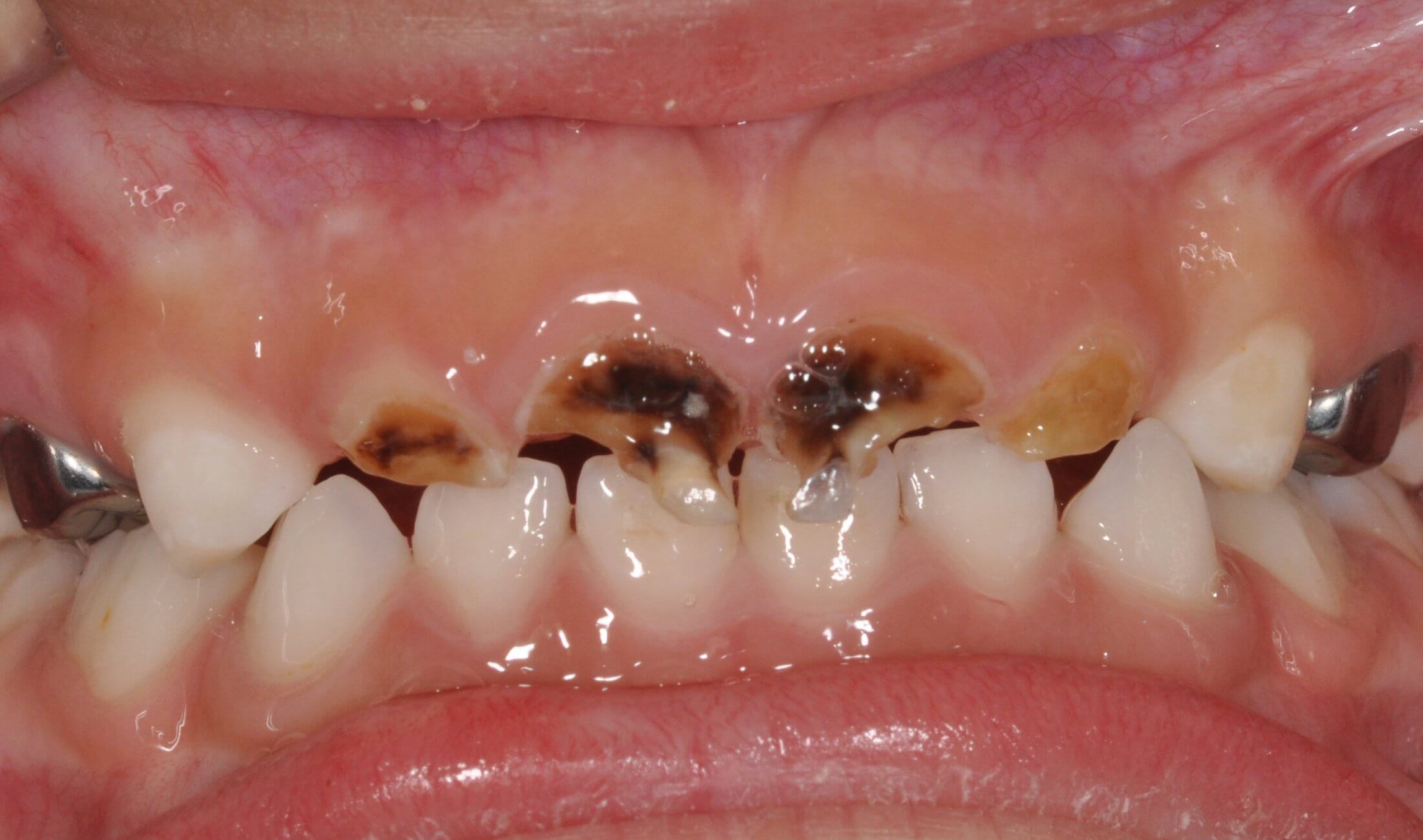
Worse, when a child takes something into their mouth before falling asleep or dozes off while drinking milk half-awake, the liquid pools and stays behind the front teeth, under the palate. This is called early childhood caries. Typical picture: mattification on the labial side of upper incisors, white lines, brown spots.
Parents who say "we don't put them to sleep with a bottle, they drink from a cup" aren't fully protected from this trap either. Milk sits in the cup by the bed, the child wakes up at night, takes a sip, and goes back to sleep. The mechanical picture is nearly identical.
The Wrong Definition of "Strong Teeth"
The "strong teeth" in parents' minds usually means "teeth without cavities." However, tooth strength is a multidimensional concept, decay resistance is just one dimension.
Enamel quality is largely genetic. Some children are born with less resistant enamel. There's a condition we call MIH (Molar Incisor Hypomineralization), where the enamel structure hasn't fully formed in the upper-lower first permanent molars and incisors. In these children, cavity risk is markedly high despite standard care. Drinking liters of milk doesn't change this situation.
Saliva chemistry is another dimension. Some children's saliva can be acidic, others' basic. Children with high saliva buffering capacity have strong natural protection, those with low capacity have weak protection. This too is largely genetic.
Oral flora composition also matters. The bacterial profile in the child's mouth generally passes from caregivers. A mother or caregiver can transfer cavity-causing bacteria from their own mouth to the child through kissing, sharing spoons, or cleaning pacifiers. A child who acquires a high-risk flora has a different decay picture.
The quality of tooth alignment shouldn't be forgotten either. If there are no spaces between baby teeth, if teeth touch each other, cleaning between teeth becomes difficult. Assessment of alignment during pediatric dentistry checkups is actually part of decay prevention.
The False Security Created by Good Nutrition
Milk-based nutrition harbors another trap. A parent confident that their child is "well-nourished" may become lax in other protective steps. Tooth brushing gets postponed to the next day because "they didn't eat anything today." Checkups are skipped because "their mouth looks clean." Brushing is skipped after a sugary birthday cake because "their overall nutrition is good, it compensates."
The result of this cumulative neglect emerges one day at an exam as multiple cavities. The parent is shocked, saying "but we're very careful." Care is being taken, but in the wrong place. Focus has been on milk, not on brushing.
Yet the balance is very clear. If a child drinks little milk but brushes well, cavity risk is low. If they drink a lot of milk but brush poorly, cavity risk is high. The amount of milk doesn't substitute for the quality of brushing.
How Should Brushing Be Done?
The brushing plan for a milk-consuming child should be as follows. Main brushing after breakfast in the morning, before bed in the evening. Between meals, at least rinsing the mouth after snacks, especially dairy snacks. The child must brush before getting into bed, with a rule of not eating or drinking anything after brushing.
Toothpaste choice also matters. Under three years old, rice grain-sized fluoride toothpaste, between three and six years old, pea-sized. Rinsing the mouth thoroughly with water after brushing reduces fluoride's effect, just spitting out the residue is sufficient. This detail is a point often missed in most families.
Dental floss isn't always necessary for baby teeth because there can be spaces between teeth. But in areas where teeth touch each other, floss use is essential because the brush doesn't reach there. Pediatric dentist Dr. Dt. Ceyda Pınar Tanrıverdi shows families these details at every checkup because theoretical knowledge can fall short when put into practice.
The Role of Vitamin D
An overlooked issue in the milk discussion is vitamin D. Vitamin D is required for the calcium in milk to be absorbed. In children with vitamin D deficiency, even if liters of milk are consumed, calcium isn't adequately absorbed.
Vitamin D deficiency is quite common in Turkey, even despite being a sunny geography. Because sun exposure is low, clothing covers, children spend time indoors. In these situations, the expected benefit from calcium doesn't materialize. Pediatricians therefore recommend vitamin D supplementation from early ages.
So saying "milk is sufficient" for tooth development does injustice to both milk and the vitamin D need. Focusing on one substance while neglecting the other is like stepping on only one of two pages descending into a well.
The Road Map When Cavities Appear
In cases where cavities are caught because checkups were postponed due to confidence in milk, the situation escalates. While it's possible to stop decay with fluoride application and dietary adjustments in the early stage, in the middle stage dental filling is needed. If decay has reached the nerve, baby tooth root canal treatment or extraction comes up.
Early loss of a baby tooth has more serious consequences than you think. The permanent tooth coming underneath loses space, its position becomes distorted, creating situations requiring braces treatment later on. The "it will fall out anyway" assumption leads to much greater expenses down the road. You can access current information from the pediatric dentistry cost calculator page, but there's a significant difference between the cost of an early-caught case and a late-caught one.
A Practical Framework
There are a few points parents should keep in mind. Milk is a valuable food, there's no need to remove it from the diet. But milk is not a tooth protector, just a food. The real pillars of decay prevention are brushing, checkups, and fluoride application when needed.
The frequency of milk matters as much as quantity. Not one glass instead of three, but at specific times between meals instead of every hour. Oral cleaning after consumption.
Milk taken before bed at night should not be after brushing. Before the child gets into bed, teeth should be clean, and nothing should be taken afterward.
Checkups should begin from the moment the first tooth erupts. Before there's a problem, just to get acquainted. When this routine is established, the child grows up comfortable with the dentist's chair, not afraid when major treatments are needed later.
Believing that giving your child milk protects their teeth may comfort you, but this comfort is not a protective shield. Real protection comes from the care you show every day. Let milk remain on the table as a good food, but don't let it replace dental care. When you think of both together, your child's mouth settles into a much healthier developmental trajectory.
This content is prepared for informational purposes. It absolutely does not replace a physician's examination and personal evaluation.
